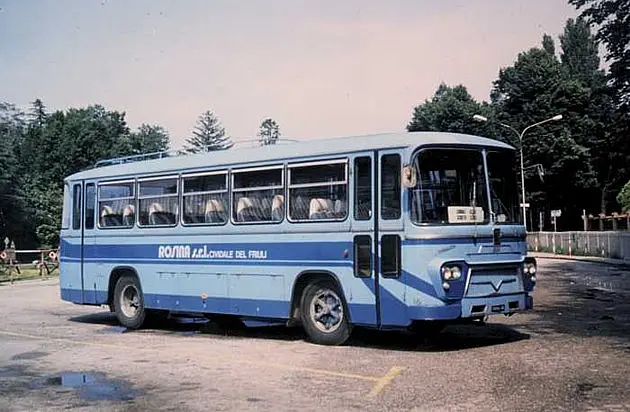
The Fiat 309 is a bus model produced by the bus division of Fiat Veicoli Industriali from 1958. It was launched to replace the Fiat 642RN, which had been derived from the lorry of the same name, but like the Fiat 306 the 309 was designed from scratch rather than bodied onto a lorry chassis. Production ended in 1970, when the 308 took its place.
Fiat 309 at a glance
| Production | 1958–1970 |
|---|---|
| Type | intercity and gran turismo bus |
| Manufacturer | Fiat Veicoli Industriali |
| Predecessor | Fiat 642RN |
| Replaced by | Fiat 308 |
| Length class | 9 metres |
| Engine | Fiat 220/H, 9,161 cc six-cylinder |
| Power | 153 cv |
| Gearbox | five-speed |
| Factory bodywork | Cansa plant, Cameri |
| Model update | 309/1 from 1963 |
based on one source
History of the Fiat 309
Design
The 309 was developed as a purpose-built bus, not as a body mounted on a lorry chassis. That approach was shared with the Fiat 306, and it marked the 309 apart from the Fiat 642RN it replaced, which had grown out of the 642 lorry. The bus was offered in a nine-metre version with line and gran turismo trim.
Fiat built a version with its own bodywork at the Cansa plant in Cameri, near Novara, and that version became very widespread. Beyond it, the 309 was also sold as a bare chassis for coachbuilders outside Fiat, who bodied it for both line and gran turismo service. Among them were Carrozzeria Orlandi, Dalla Via, Portesi, De Simon, Bianchi and Pietroboni, and above all Officine Padane and Menarini.
Mechanical development
The first 309s used mechanicals derived from the Fiat 642 lorry, including a reduction unit, and were simply called 309. From 1963 the mechanics came from the Fiat 643 lorry and the model was renamed 309/1.
The engine was the Fiat 220/H, a six-cylinder inline unit of the tipo a sogliola layout with a displacement of 9,161 cm³ producing 153 cv. It was paired with a five-speed gearbox.
Diffusion
The 309 became notably widespread in Italy, both as an intercity bus and in the gran turismo version.
Design and features
- Purpose-built bus: designed from scratch rather than bodied onto a lorry chassis.
- Two levels of bodywork: factory Cansa bodywork or chassis for outside coachbuilders.
- Large six: a 9,161 cc Fiat 220/H six-cylinder of 153 cv.
- Line and gran turismo: both intercity and long-distance versions were catalogued.
Fiat 309 versions
- Fiat 309: the original version with mechanicals derived from the Fiat 642 lorry.
- Fiat 309/1: from 1963, with mechanicals derived from the Fiat 643.
- Cansa-bodied 309: factory bodywork built at Cameri.
- Coachbuilt 309: chassis supplied to Orlandi, Padane, Menarini and others.
The 309 was preceded by the Fiat 642 lorry and its bus derivatives, and was replaced by the Fiat 308. The larger Fiat 413 double-decker followed a different route. More cars are in the Fiat collection.
Sources
- Fiat 309, Italian Wikipedia: production dates, bodies, engines, coachbuilders, 309/1