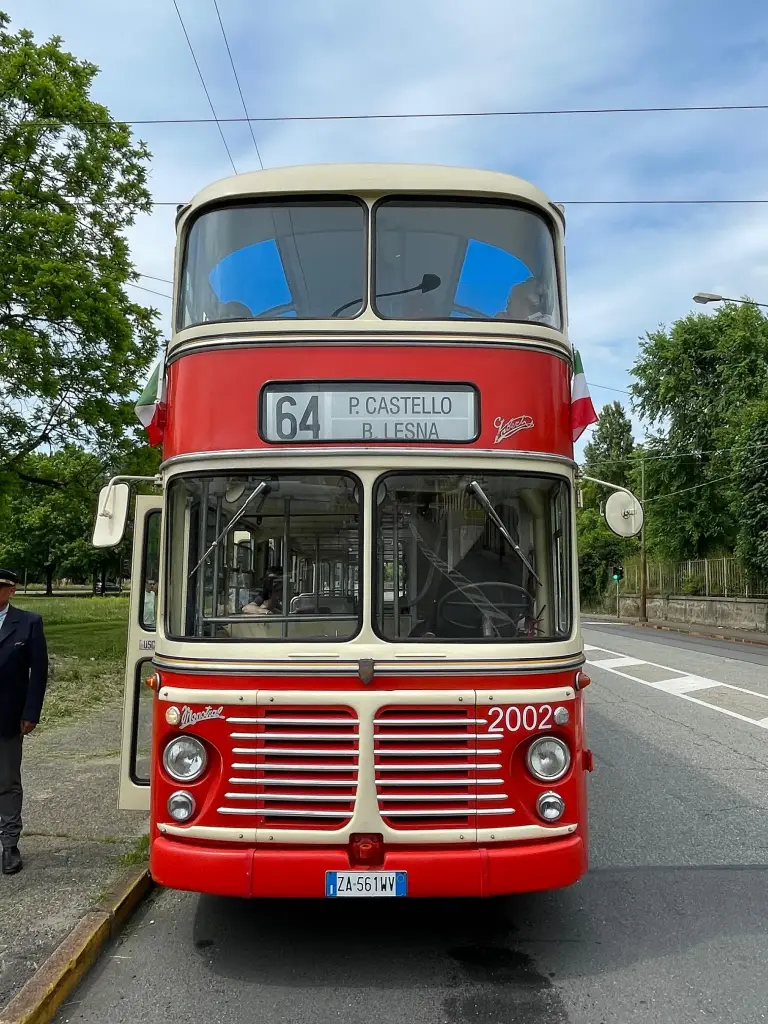
The Fiat 413, also known as the Viberti Monotral CV61, is an Italian bus model produced in 1961 by Fiat and the Viberti workshops specifically for special services during the Expo 1961 in Turin. It was a two-storey city bus on a six-wheel chassis, and twelve examples were built for the city operator ATM.
Fiat 413 at a glance
| Production | 1961 |
|---|---|
| Also called | Viberti Monotral CV61 |
| Type | two-storey city bus |
| Built for | Expo 1961, Turin |
| Length | 12 m |
| Height | 4.15 m |
| Seats | 67, of them 47 on the upper deck |
| Standing places | about 70 on the lower deck |
| Engine | 203.0/156, 10.7-litre six-cylinder |
| Power | 175 hp |
| Layout | 6×4, double rear axle |
| Examples built | 12, numbered 2001 to 2012 |
based on one source
History of the Fiat 413
Origins
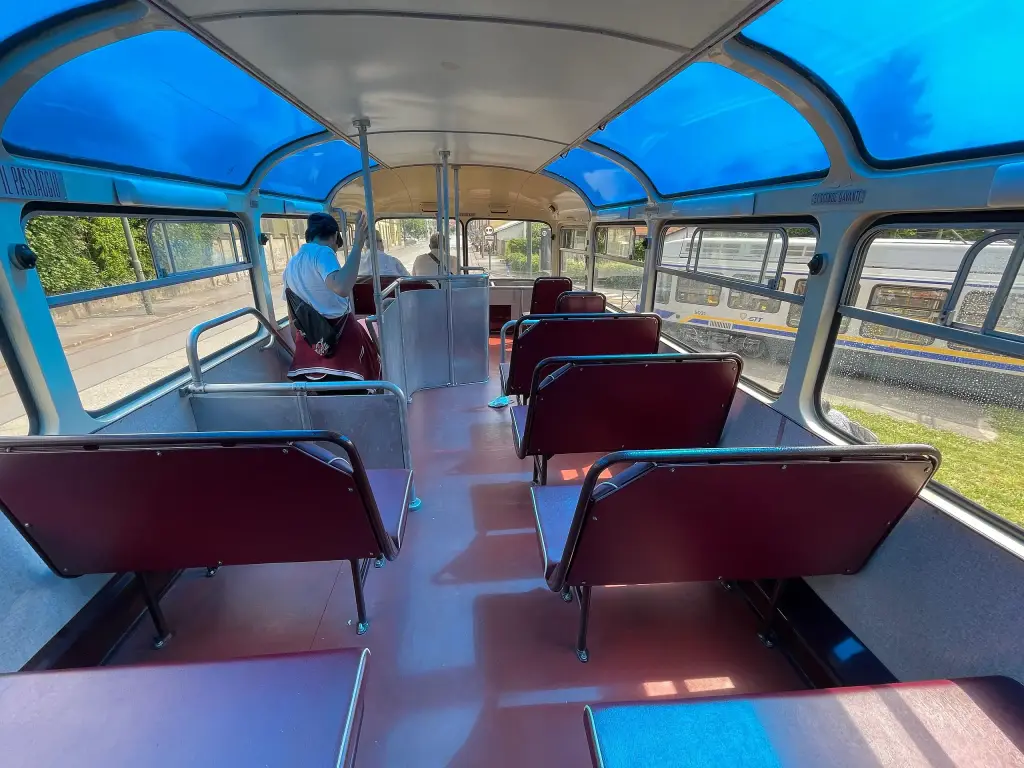
In 1960 the bus division of Fiat and the Viberti workshops, specialists in the bodywork and fitting out of heavy vehicles, answered an order from ATM for a special high-capacity bus. It was intended for urban services during the universal exposition due to open in Turin the following year, in the centenary of the unification of Italy.
Fiat prepared the 413 chassis with six wheels, a front axle and a double rear axle with independent wheels, and Viberti built a two-storey bus on it with Monotral bodywork, whose load-bearing structure was a welded steel lattice. The vehicle had a lowered floor, a novelty for Italy at the time, and measured 12 metres long by 4.15 metres high.
Interior
The interior was laid out with 67 seats, 47 of them on the upper deck, which had a particular panoramic glazing and was reached by a double internal staircase, one for going up and another for coming down. About 70 standing places were available on the lower level. Every seat upstairs was equipped with a weight sensor that, when a person sat down, lit a lamp on a panel at the conductor’s booth, so the conductor could check how many passengers were aboard and whether seats remained free. Passengers boarded through the rear door and left through the central and front doors, all closed by electro-pneumatic folding leaves, one double and two quadruple.
Mechanicals
The 203.0/156 engine was derived from the unit used in the Fiat 682 S lorry, a six-cylinder of 10.7 litres with supercharging, and produced 175 hp with considerable torque. The semi-automatic Magneti Marelli gearbox also came from the 682 but had no reduction unit and used electro-pneumatic servo assistance taken from the Fiat 401 and 411 Cameri buses; the clutch was automatic with a hydraulic converter. Suspension was pneumatic. Placing the engine in a side compartment just behind the front left wheel freed space for passengers on the ground floor, and traction went to the double rear axle with single wheels, a 6×4 arrangement.
Approval and service
A two-storey bus for urban service was an absolute novelty for Italy. The only precedent was a special version of the Lancia Omicron long-distance coach built in 1927, which had a different role. The approval process for the Turin double-decker was therefore long and complex, with particular fears that so large and heavy a vehicle could damage elevated road passages; authorisation to run was eventually granted for the urban area of Turin only.
After carrying visitors at the exposition, ATM kept the twelve buses, numbered 2001 to 2012, in service in a red and cream livery, first on line 64 and later on special runs for Fiat workers. In 1985 all were withdrawn and sent for scrap, except units 2002 and 2006, which were kept with little care: 2002, stripped of almost all mechanical parts, ended up as an observation tower at the riding school of the Socià Ippica Torinese at Stupinigi.
Preservation
Around the 2010s, through the efforts of private individuals and the Associazione Torinese Tram Storici, the surviving units were recovered from storage and work began to return one to running order. The body of 2002 was joined to the mechanical parts of 2006, with missing components recovered elsewhere, and in 2011 Fiat 413 number 2002 was re-registered and returned to service as a historic vehicle for special and commemorative duties, including outside Turin under an ad hoc approval granted when it emerged that in 1961 circulation had been authorised only within the city. Ownership is shared equally between ATTS and GTT. It is the only two-storey bus of Italian construction kept in working order.
Design and features
- Two decks: 47 seats upstairs under panoramic glazing, reached by separate up and down staircases.
- Lowered floor: a novelty for Italian buses at the time.
- Seat sensors: weight sensors lit a panel at the conductor’s booth to show free seats.
- Six wheels: a 6×4 chassis with a double rear axle on independent wheels.
- Survivor: unit 2002 remains operational as a historic vehicle.
Fiat 413 versions
- Fiat 413 / Viberti Monotral CV61: the only version, built as a two-storey city bus.
- Units 2001–2012: the twelve ATM buses, of which 2002 and 2006 survived.
- 2002 (2011): the restored historic vehicle combining the body of 2002 with the mechanicals of 2006.
The 413 was a special project alongside the standard Fiat 309 bus, and its engine came from the Fiat 642 family. More cars are in the Fiat collection.
Sources
- Fiat 413, Italian Wikipedia: origin, body, interior, engine, service and preservation