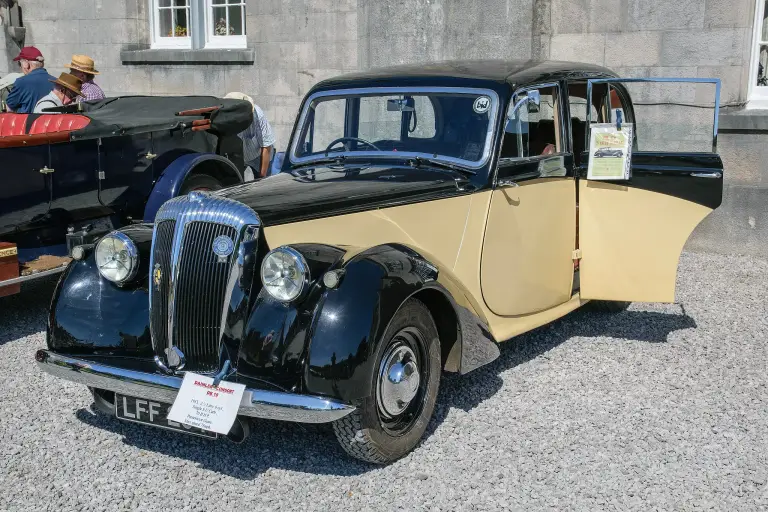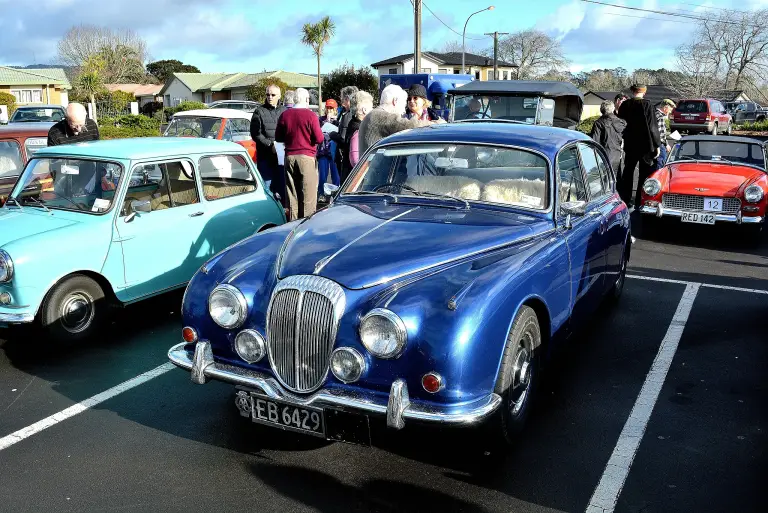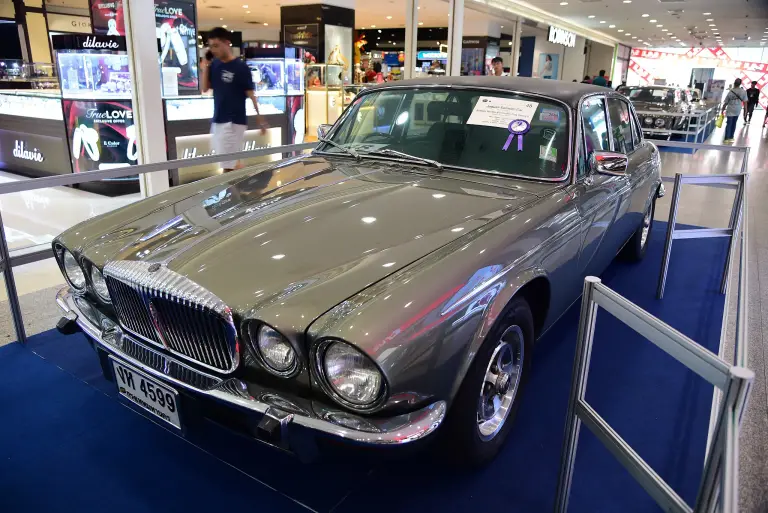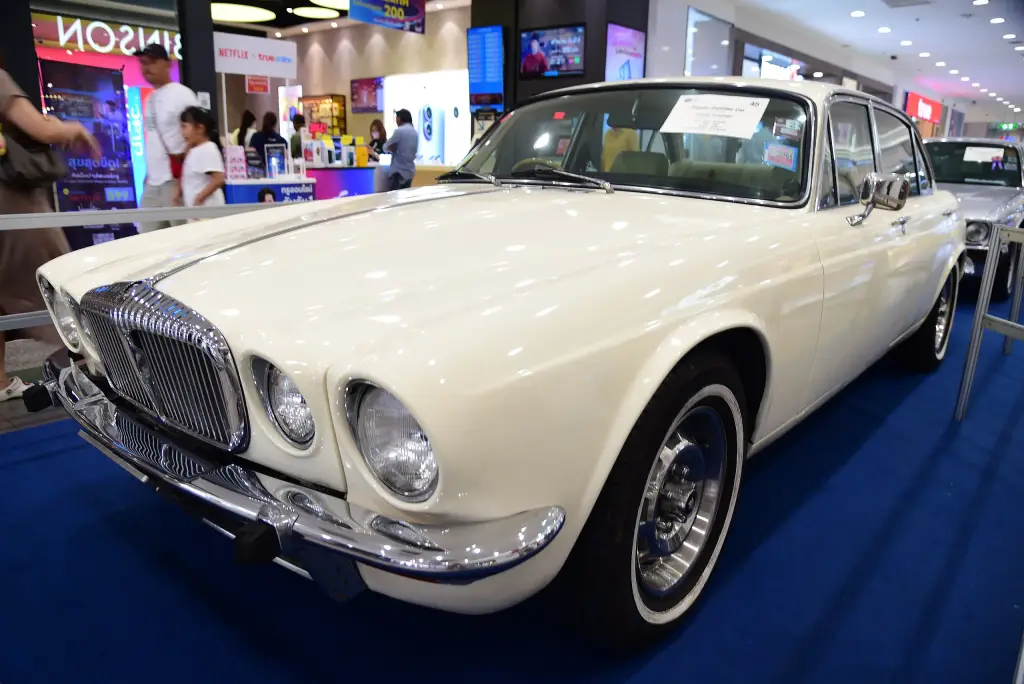
The Daimler Sovereign was the name Jaguar gave to a series of luxury cars carrying the Daimler badge between 1966 and 1983. Each was based on a contemporary Jaguar, with a Jaguar engine, and was distinguished mainly by the traditional fluted Daimler grille. The name covered the 420-based car, the Series I, II and III XJ6 versions and a two-door coupé, before passing to Jaguar itself in 1983.
Daimler Sovereign at a glance
| Name used by | Jaguar Cars, under the Daimler badge |
|---|---|
| Years | 1966–1983 |
| First car | Sovereign 420, based on the Jaguar 420 |
| Engine, first car | 4.2-litre XK straight-six |
| Body, first car | four-door saloon with four-headlight nose |
| 1969–1973 | Series I XJ6-based, 2.8 or 4.2 litres |
| 1973–1979 | Series II, with a raised bumper and extended wheelbase |
| 1975–1977 | two-door coupé on the short wheelbase |
| 1979–1983 | Series III |
| After 1983 | the name went to Jaguar; the top Daimler had no model name |
Based on one source.
History of the Daimler Sovereign
Badge engineering begins
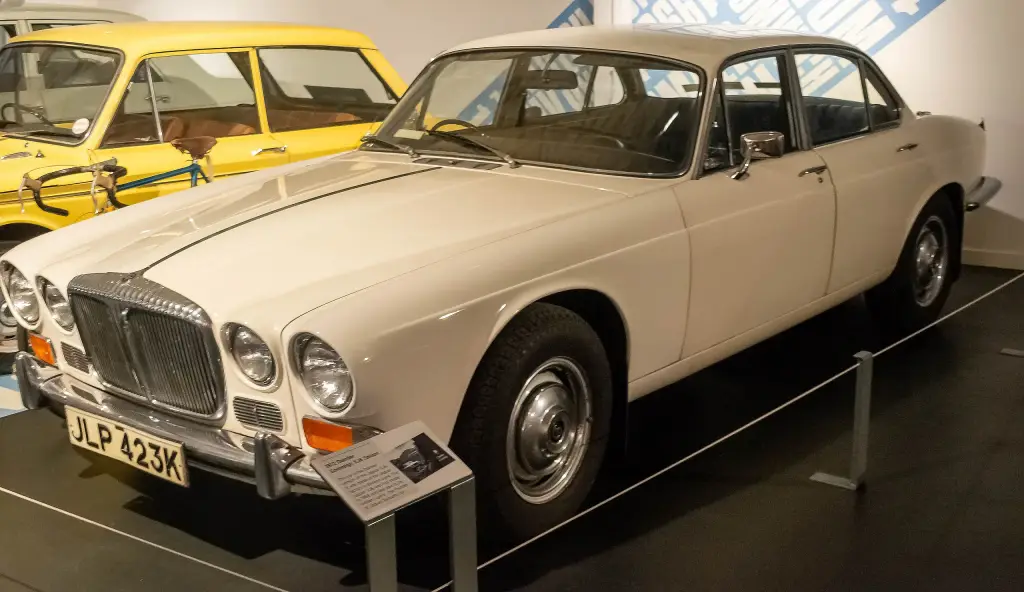
Jaguar took over The Daimler Company in 1960, and the 1966 Sovereign was the second Daimler built on a Jaguar model, after the 2½-litre V8 with Edward Turner’s engine. Unlike that car, the Sovereign used a Jaguar engine, which marked the end of the Turner-designed units. The first Sovereign was a badge-engineered Jaguar 420, itself based on the S-Type; the 420 and Sovereign differed from the S-Type in having a revised four-headlight nose reminiscent of the Mark X and a 4.2-litre version of the XK straight-six, and the main external difference between the Jaguar and the Daimler was the traditional fluted radiator grille.
There were thoughts of fitting the Sovereign with the Daimler 4½-litre V8 from the Majestic Major, but it outperformed the Jaguar XK unit so clearly that the Sovereign would have outgunned the Jaguar 420, and the idea was dropped: the Jaguar marque was supposed to be the sportier of the two. In 1967 the final drive went quietly from 3.31:1 to 3.54:1, which brought press complaints about fussier high-speed cruising but improved acceleration within the speeds that were legal after Britain’s 70 mph limit arrived in December 1965. The 420 and Sovereign began to be replaced by the Jaguar XJ6 in September 1968: Jaguar production stopped in December 1968, the Daimler in July 1969. The front of the DS420 limousine of 1968 shared the family look of a Daimler grille on a four-headlight nose.
Series I, II and III
A new Sovereign on the Series I XJ6 was introduced in October 1969, again virtually identical to its Jaguar source apart from the fluted grille and badging, with trim differences such as the deletion of the Jaguar’s wood door cappings. It came with the 2.8 or 4.2-litre XK engine. The name continued on the Series II of 1973, which had a raised front bumper and shallower grille and introduced an extended wheelbase that eventually became standard; from 1975 a 3.4-litre version replaced the 2.8. The Series III of 1979 brought thicker bumpers, the loss of the front doors’ separate quarter-lights and a revised rear roofline with a more angular C-pillar, and it initially included a Daimler Sovereign.
In 1983, during the Series III run, the range was renamed: the base model became the Jaguar XJ6, the more luxurious one the Jaguar Sovereign, and the top car simply the Daimler, without a model name. Some top versions carried the Vanden Plas designation, and in markets where the Daimler name could not be licensed, cars with the Daimler grille were sold as Jaguar Vanden Plas.
The two-door and the V12
A two-door coupé on the shorter Series II platform was sold from 1975 to 1977 as the Daimler Sovereign 4.2 two door. From 1972 the XJ range also offered Jaguar’s 5.3-litre V12, and the Daimler version revived a name used by the company from 1926 to 1938: the Double-Six. The new chairman, FRW “Lofty” England, had been a Daimler apprentice from 1927 to 1932 and finished second on the first RAC rally driving a 30/40 hp Daimler Double-Six, so he decreed the name. Unlike the Jaguar, the twelve-cylinder Daimler had the same grille as its six-cylinder sibling and only the badges distinguished them; the Double-Six followed the Sovereign’s changes from Series I to Series III and kept its name until Series III production ended in 1992.
Design and features
- Fluted grille: the traditional Daimler radiator grille was the main external difference from the Jaguar.
- Jaguar engines: the 4.2-litre XK six, then the 2.8, 3.4 and 4.2, and from 1972 the V12 in the Double-Six.
- Series I to III: the name followed the XJ6 through three generations of styling.
- Two-door coupé: the Sovereign 4.2 two door of 1975–1977.
- Name handover in 1983: Sovereign became a Jaguar trim level and the top Daimler lost its model name.
Daimler Sovereign versions
- Sovereign 420 (1966–1969): the first car, based on the Jaguar 420.
- Series I (1969–1973): XJ6-based, with 2.8 or 4.2-litre engines.
- Series II (1973–1979): raised bumper, shallower grille and an extended wheelbase.
- Sovereign 4.2 two door (1975–1977): the short-wheelbase coupé.
- Series III (1979–1983): the last car to carry the Sovereign name as a Daimler.
The Sovereign shared its range with the V12 Double-Six and with the DS420 limousine, and followed the Daimler 250 as the second Jaguar-based Daimler. More cars are in the Daimler collection.
Sources
- Daimler Sovereign, English Wikipedia: series, engines, styling changes, Double-Six origin