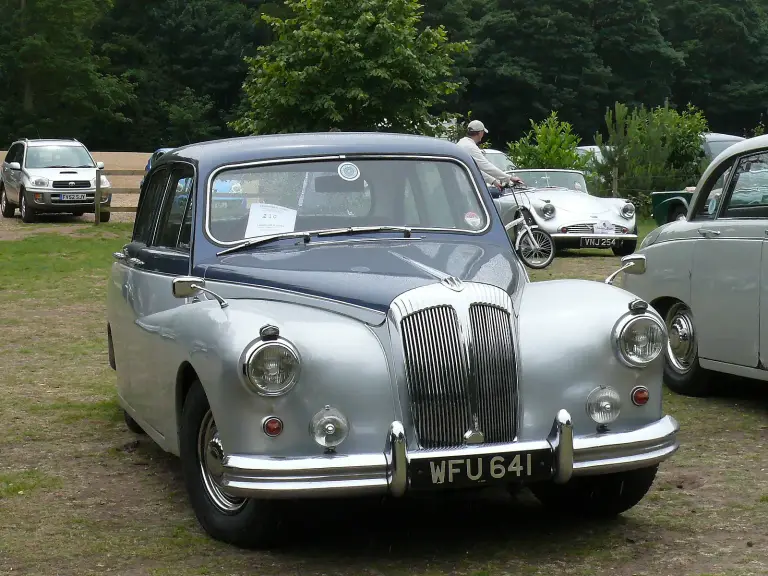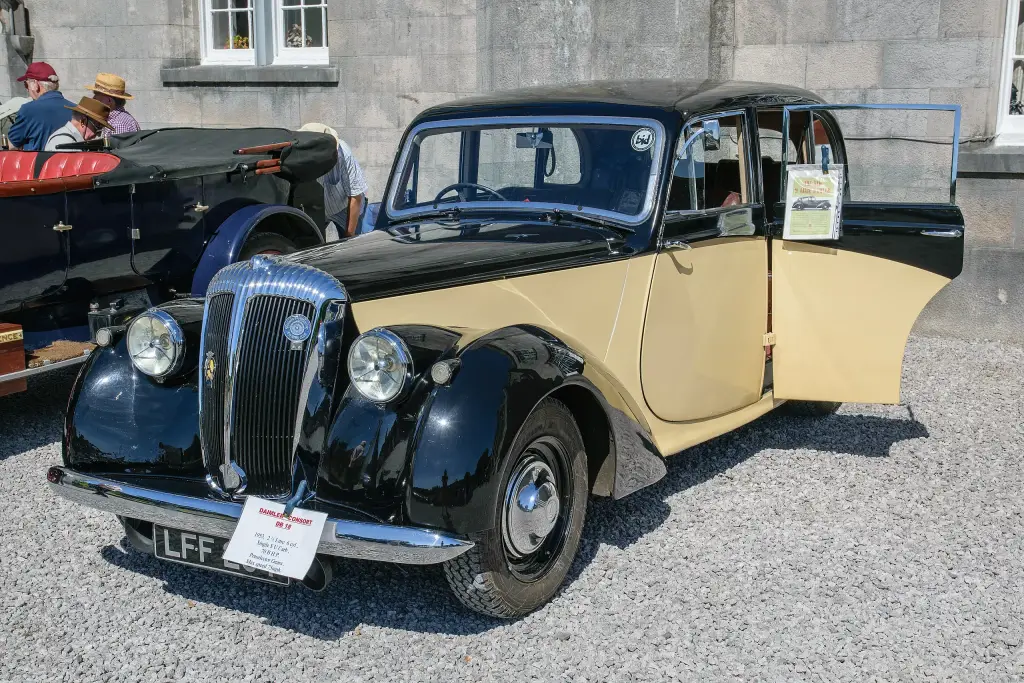
The Daimler DB18 was the company’s 2½-litre car of 1939 to 1953, developed from the 2.2-litre New Fifteen. From 1949 an all-steel export version with a curved grille and hydraulic front brakes was sold as the Daimler Consort. Both were among the last Daimlers with a separate chassis, and the Consort was replaced by the Conquest.
Daimler Consort at a glance
| Maker | The Daimler Company, Coventry |
|---|---|
| Production | 1939–1953 |
| Predecessor | Daimler New Fifteen |
| Engine | 2,522 cc straight-six, pushrod OHV |
| Carburettor | single SU |
| Power | 70 bhp |
| Gearbox | four-speed Wilson pre-selector with fluid flywheel |
| Brakes | Girling-Bendix hydraulic front, rod rear (Consort) |
| Top speed | 76 mph, 82 mph after the 1950 gearing change |
| Post-war built | 3,355 DB18, 608 Sports Special, 4,250 Consort |
| Coachwork | Daimler saloon or chassis for outside coachbuilders |
Based on one source.
History of the Daimler Consort
A 2½-litre before the war
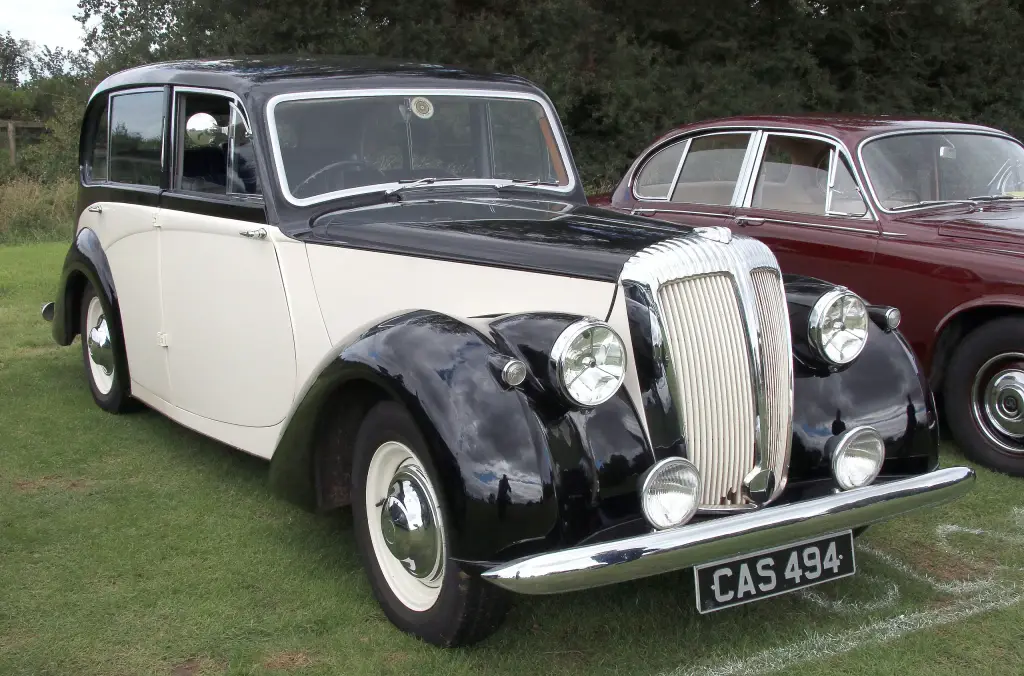
The DB18 was introduced immediately before the Second World War as a 2½-litre version of the 2.2-litre New Fifteen of 1937. Its engine came from the Daimler Scout Car and, in civilian form, was a 2,522 cc pushrod six with a single SU carburettor that produced 70 bhp throughout the model’s life. It was sold first as a six-cylinder chassis on which Daimler and a number of British coachbuilders built bodies, including drophead coupés. During the war the company concentrated on military vehicles.
To its own generation the car was simply the Daimler 2½-litre until Daimler began giving its cars names in the North American fashion. The all-steel export version, introduced at the London Motor Show in October 1948 and branded the Daimler Consort, brought a number of changes: the firewall was built into the body instead of the chassis, the brakes went from rod operation to a Girling-Bendix hydraulic front and rod-operated rear system, the headlights were set into the front wings, and a curved radiator grille replaced the flat one, with a badge plate behind the front bumper.
Chassis and performance
The car used a separate chassis that was underslung at the rear, with the main members passing below the rear axle. The independent front suspension used coil springs and the rear axle semi-elliptical springs. The Daimler fluid flywheel was coupled to a four-speed Wilson pre-selector gearbox. In mid-1950 a conventional hypoid bevel rear axle replaced the traditional underslung worm drive, whose limited ground clearance had hampered sales outside Britain, and the gearing change raised the saloon’s top speed from 76 to 82 mph and cut the 0–50 mph time from 17.9 to 16.9 seconds. By the standards of the time the car was brisker than it looked.
Coachwork and customers
After the war the most common version was a four-door saloon built by Daimler itself, trimmed in matt leather with polished wood fillets; by the early 1950s the shape was beginning to look upright and “severe yet dignified”. In 1939 Winston Churchill ordered a drophead coupé on a DB18 chassis, number 49531, from the Carlton Carriage Company and used it in election campaigns in the late 1940s. About 1,000 DB18s and 25 DB18 Special Sports were built before 1940; after the war came 3,355 DB18s, 608 DB18 Sports Specials and 4,250 DB18 Consorts. The Consort was popular with the wealthy in India, where over 100 cars were ordered, mainly by Maharajas, and a further dozen went to royalty in Ceylon and Burma. Production ended in 1953, when the Conquest took its place.
Design and features
- Separate chassis: the DB18 was sold as a chassis for coachbuilders as well as a complete saloon.
- Scout Car engine: the 2,522 cc six was developed from the unit used in Daimler’s armoured scout car.
- Fluid flywheel: a pre-selector transmission that made the car smooth and hard to stall.
- 1949 Consort updates: integral firewall, hydraulic front brakes, headlights in the wings and a curved grille.
- Royal and vice-regal sales: over a hundred cars went to India, Ceylon and Burma.
Daimler Consort versions
- DB18 (1939–1950): the original 2½-litre chassis and saloon.
- DB18 Special Sports: a more sporting version, 25 built before the war and 608 after it.
- Consort (1949–1953): all-steel export saloon with the curved grille and hydraulic front brakes.
- Carlton drophead coupé: the body Churchill ordered in 1939 on chassis 49531.
The Consort was replaced by the Conquest in 1953, and the two cars shared Daimler’s pre-selector transmission and fluid flywheel. More cars are in the Daimler collection.
Sources
- Daimler Consort, English Wikipedia: development, specification, coachwork, production figures