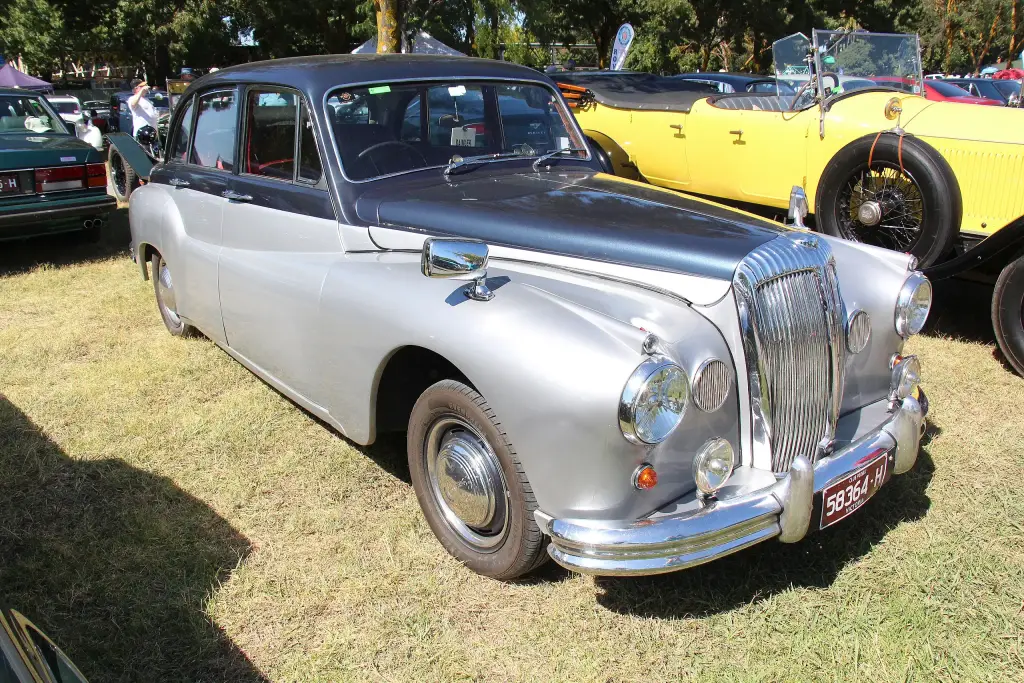
The Daimler Regency was the company’s attempt to fill the gap between the small Consort and the large DE27 and DE36 limousines. Introduced at the 1951 Paris show with a three-litre six, it ran through three series, the last sold as the One-O-Four, and gathered a confusing spread of bodies from Barker, Hooper and Mulliners. Fewer than 1,000 cars were built in seven years.
Daimler Regency at a glance
| Maker | The Daimler Company, Coventry |
|---|---|
| Production | 1951–1958, in three series |
| First series | Regency DF300/301, 1951–1953 |
| Engine | 2,954 cc straight-six, twin SU |
| Power | 90 bhp at 4,100 rpm; 100 bhp in the Empress II |
| Transmission | fluid flywheel and four-speed Wilson pre-selector |
| Chassis | box-section steel, cruciform braced |
| Second series | Regency Mark II DF304/305, from October 1954 |
| Engines offered | 3½ litres or 4½ litres |
| Third series | One-O-Four DF310, from October 1955 |
| Built | about 49 three-litre cars, 345 Mark II, fewer than 1,000 in all |
History of the Daimler Regency
A gap in the range
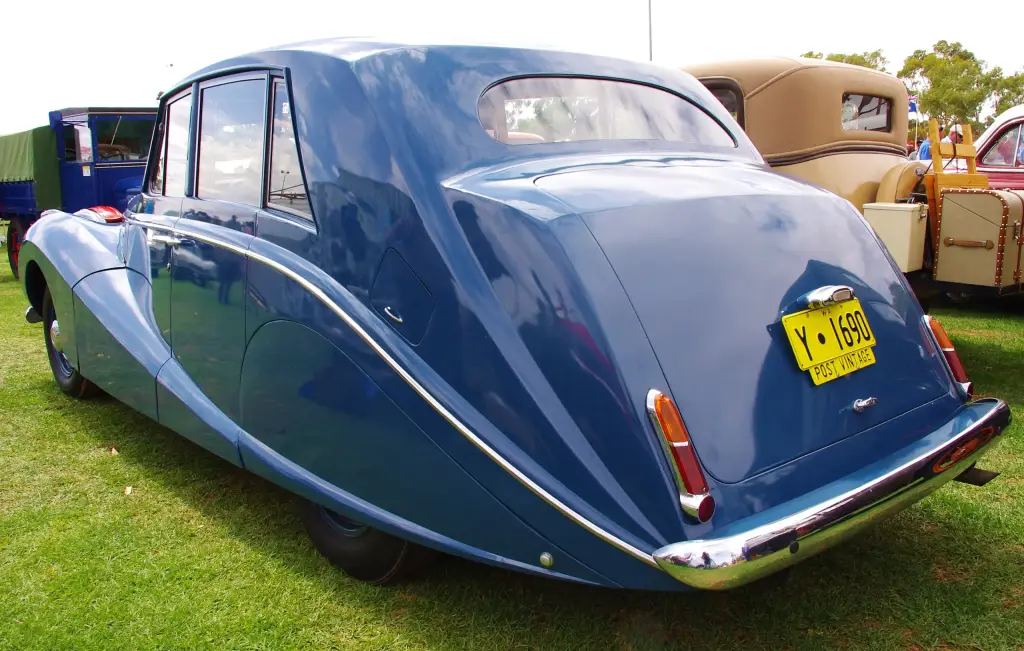
In the years after the war Daimler’s entry model was the DB18 and its successor the Consort, both with small six-cylinder engines. To bridge the gap to the DE27 and DE36 state limousines the company added the Regency in 1951, technically derived from the DB18 and Consort. It was shown to the press on 26 September 1951 and at the Paris Motor Show, then to the British public at the October 1951 Motor Show; DF300 was the right-hand-drive chassis code and DF301 the left-hand-drive one.
The chassis carried several developments from the Consort: the engine was moved well forward, ground clearance went up by an inch and the side members were lowered. The new three-litre six was derived from the four-cylinder two-litre engine of the Lanchester Fourteen, with twin SU carburettors giving 90 bhp at 4,100 rpm. The standard Barker saloon closely resembled the much smaller Lanchester Fourteen apart from headlights set into the wings as on the Consort, and in 1952 it was joined by an Empress II saloon, limousine and convertible, all with razor-edge styling by Hooper. Only about three Regency Barker Special Sports were made, with front-hinged doors instead of the smaller car’s suicide doors. The usual Daimler fluid flywheel and Wilson four-speed pre-selector were fitted.
Sales collapsed in 1952 as buyers waited for the removal of a temporarily increased purchase tax, which finally came in April 1953, by which time the luxury tax stood at 66.6 per cent. Only about 49 three-litre cars were built, including the Empress models, and only about seven Regency saloons, of which three survived into the 21st century; one had belonged to the Queen Mother.
Regency Mark II
In October 1954, almost three years after the first series stopped, Daimler announced the Regency Mark II, DF304 for right-hand drive and DF305 for left. The new body was slightly longer with a much longer boot and wings, and sat lower; it could be ordered with a 3½ or a 4½-litre engine. Hooper again supplied Empress IIa and III bodies, and Mulliners of Birmingham built the Sportsman four-light saloon with a three-piece wrap-around rear window. Prices with tax were £2,324 for the 3½-litre Regency saloon and £2,778 for the 4½-litre, or £2,650 and £3,104 for the Sportsman. The chassis was again box-section steel with cruciform bracing, but the side members now rose over the rear axle instead of passing under it, automatic chassis lubrication continued, and steering was Marles worm and double roller. Brakes were Girling hydro-mechanical, hydraulic at the front and mechanical at the rear.
The 4½-litre cars, chassis DF400 and DF401 for left-hand drive, had a four-speed pre-selector with direct drive in third and overdrive fourth, plus fully hydraulic brakes with vacuum assistance. After the engine was raised from 127 to 167 bhp in 1956 the extra torque proved too much for the pre-selector gearboxes, so very few 4½-litre cars survived: further deliveries were cancelled, most existing cars were converted back to 3½ litres and the bigger engine was restricted to the DK400 chassis. The Motor tested a 3,468 cc Regency II in 1955 at 82.8 mph, 0–60 mph in 22.7 seconds and 15.7 mpg, at £2,324.
One-O-Four and the end
After 345 Mark II cars the series was replaced in October 1955 by the faster, uprated One-O-Four, DF310, which kept the same family of bodies. In August 1958 the Majestic took over the Regency’s place in the range, and the Regency line as a whole never sold well: all versions together came to fewer than 1,000 cars in seven years, while the smaller Conquest of 1953 was built almost ten times as often.
Design and features
- Three-litre six: derived from Lanchester’s four, with twin SU carburettors and 90 bhp.
- Hooper Empress bodies: razor-edge saloons, limousines and convertibles on the Regency chassis.
- Two engine sizes in the Mark II: 3½ or 4½ litres, the bigger one later withdrawn.
- Sportsman saloon: Mulliners coachwork with a wrap-around rear window.
- Rare cars: fewer than 1,000 Regency-family cars in total, and about 49 of the first series.
Daimler Regency versions
- Regency DF300/301 (1951–1953): the original three-litre saloon.
- Barker Special Sports: a two-door convertible with the 100 bhp engine, about three built.
- Empress II (1952): Hooper saloon, limousine and convertible, 33 built.
- Regency Mark II DF304/305 (1954–1955): longer, lower body with 3½ or 4½-litre engines.
- DF400 4½-litre: overdrive pre-selector and fully hydraulic brakes, mostly converted back.
- One-O-Four DF310 (1955–1958): the uprated third series.
The Regency sat above the Conquest and below the DE limousines, and was replaced by the Majestic in 1958. More cars are in the Daimler collection.
Sources
- Daimler Regency, English Wikipedia: series, chassis, engines, prices, performance
- Daimler Regency, German Wikipedia: model history, Empress and Sportsman bodies, production totals