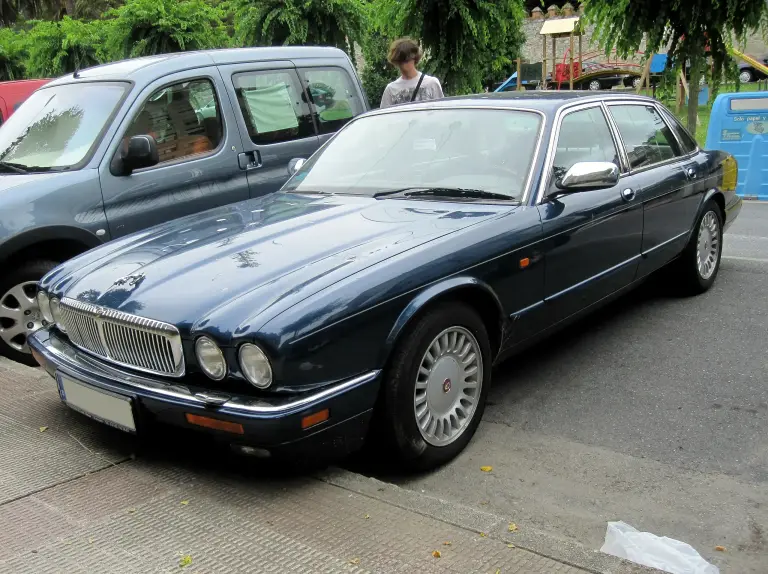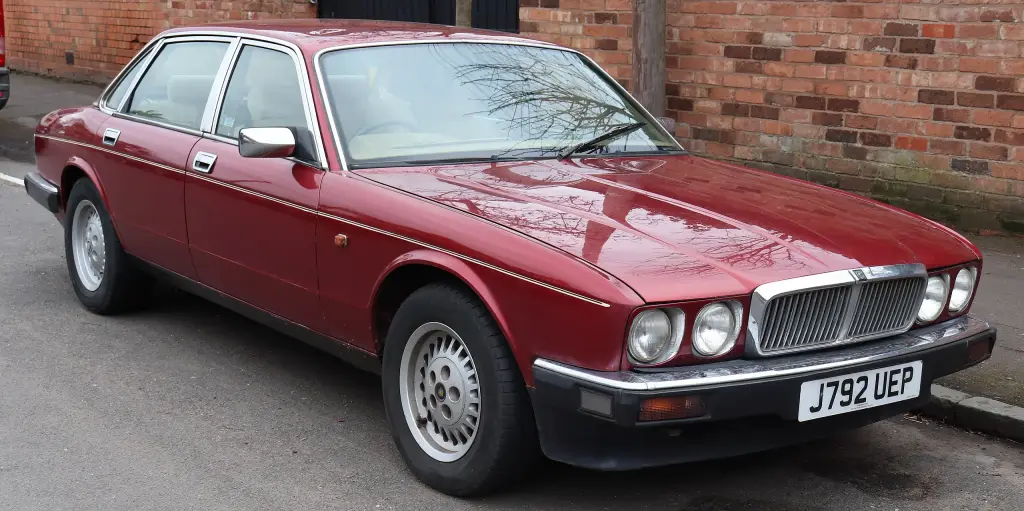
The Daimler XJ40 was the most luxurious version of Jaguar’s XJ40, the full-size saloon unveiled in October 1986. The XJ40 was the last Jaguar developed independently before Ford took over in 1990 and the last with a strong claim to Sir William Lyons’s involvement. In Daimler form it sat at the top of the range, with the composite headlamps and the traditional fluted grille.
Daimler XJ40 at a glance
| Maker | Jaguar Cars, under the Daimler badge |
|---|---|
| Production | 1986–1994 |
| Unveiled | 8 October 1986 |
| Engines at launch | 2.9 and 3.6-litre AJ6 six |
| Later engines | 4.0-litre from 1990, 3.2-litre from 1991, V12 from 1993 |
| Gearboxes | ZF 4HP22, ZF 4HP24 on the 4.0, GM 4L80-E on the V12 |
| Manual | Getrag 265, later Getrag 290 |
| Headlamps | composite rectangular units on Sovereign and Daimler |
| Suspension | Jaguar independent rear suspension |
| Replaced by | Jaguar XJ (X300) in 1994 |
Based on one source: the English Wikipedia article on the Jaguar XJ (XJ40) covers the generation; the Daimler version is described from its place in that range.
History of the Daimler XJ40
Project XJ40
Jaguar worked on Project XJ40 throughout the 1970s as an all-new replacement for the original XJ6, with scale models being built as early as 1972. The 1973 oil crisis and the troubles of parent company British Leyland delayed it again and again, and proposals came from both Jaguar’s own designers and Pininfarina before an internal design was chosen. In February 1981 the British Leyland board approved £80 million for the car, with a launch planned for 1984. After Jaguar was demerged and privatised that year, chief executive John Egan used the resurgence of the Series III XJ6, especially in North America, to delay the launch by two more years for extra development.
The XJ40 was the most extensively tested car Jaguar had ever developed, and its design cut the number of body panels per car by 25 per cent — one pressing for an XJ40 door against three for a Series III — which made assembly more efficient and the structure lighter and stiffer. Even so, early cars suffered reliability problems, particularly with the electrical systems and build quality, which damaged the car’s reputation. Its long development also made it date quickly, and it was overtaken technologically by the BMW 7-Series of 1986, the Lexus LS400 of 1989 and the Mercedes-Benz S-Class of 1991. Sir William Lyons, who had advised in the early phase, was shown the final prototype shortly before his death in 1985 and approved of it, so the XJ40 is widely regarded as the last Jaguar with his involvement.
The car itself
The XJ40 replaced the curving lines of the Series XJ with a more angular, geometric shape. It kept Jaguar’s independent rear suspension and introduced technology such as an electronic instrument cluster. Headlamps were either two round lamps in a chrome housing with painted bezels or form-fitting composite rectangular units with power-wash sprayers; the lower trim level had painted bezels without chrome, while the composite lamps went to the higher trim levels, Sovereign and Daimler. The XJ40 was also the basis of the long-wheelbase Jaguar Majestic of 1989–1990, of which only 121 were built.
At first only two engines were offered, the 2.9 and 3.6-litre versions of Jaguar’s AJ6 straight-six; the 3.6 became a 4.0 in 1990 and the 2.9 a 3.2 in 1991. British Leyland had considered supplying the Rover V8 for the car, and the XJ40 bodyshell was allegedly engineered to prevent V-configuration engines from being fitted, which delayed the V12 XJ12 until 1993 because the front structure had to be redesigned; the Series III stayed in production in V12 form until 1992 as a result. Six-cylinder cars used the four-speed ZF 4HP22 automatic, the 4.0-litre the 4HP24, and V12 cars the stronger GM 4L80-E. Early manual cars had the Getrag 265, later ones the Getrag 290. The transmission selector was redesigned with the J-Gate so forward gears could be chosen without slipping into neutral or reverse.
The Daimler
As with earlier Jaguar-based Daimlers, the XJ40 Daimler was the best-equipped version of the range, with the Daimler grille and the composite headlamps reserved for the top trim levels. The 1993 XJ6 was named Safest Car in Britain in a government survey. The XJ40 gave way to the heavily revised X300 in 1994 and was replaced in turn by the X308 in 1997; with its derivatives the XJ40 platform ran for 17 years, the second longest of any XJ. After it, Jaguar intended an all-new V8 saloon, the XJ90, but Ford stopped that programme and put its new engine and front and rear ends onto the XJ40 centre section instead, a plan that produced the X300-based Daimler Six.
Design and features
- Top trim level: the Daimler was the most luxurious XJ40, with composite headlamps and the Daimler grille.
- Angular styling: a deliberate break from the curved Series XJ, with an electronic instrument cluster.
- AJ6 engines: 2.9 and 3.6 litres at launch, then 3.2 and 4.0, with the V12 added in 1993.
- J-Gate selector: a new automatic selector that prevented accidental selection of neutral or reverse.
- Last independent Jaguar: the final XJ developed before the Ford takeover of 1990.
Daimler XJ40 versions
- XJ40 (1986–1990): 2.9 and 3.6-litre six-cylinder cars.
- 1990 update: the 4.0-litre replaces the 3.6.
- 1991 update: the 3.2-litre replaces the 2.9.
- XJ12 (1993): the V12 version after the front structure was redesigned.
- Jaguar Majestic (1989–1990): special and long-wheelbase editions, 121 of the latter.
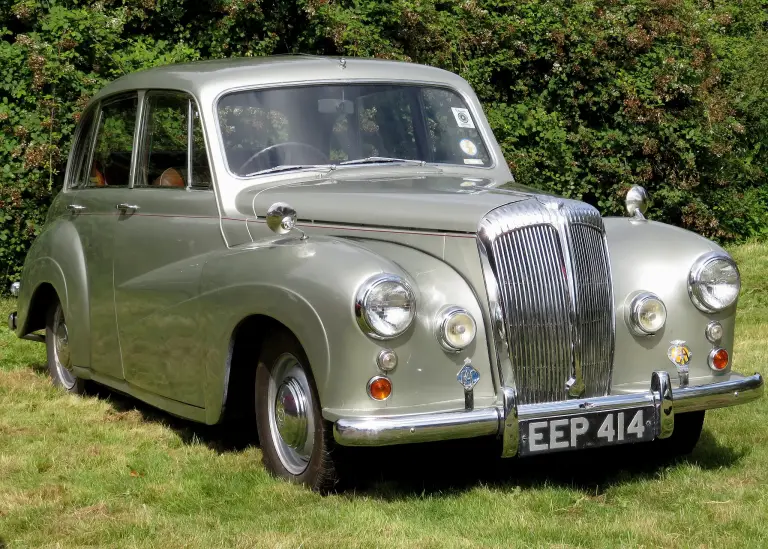
The XJ40 came after the Daimler Sovereign and before the Daimler Six, and its V12 cars were sold as the Double-Six. More cars are in the Daimler collection.
Sources
- Jaguar XJ (XJ40), English Wikipedia: development, engines, gearboxes, styling, trim levels