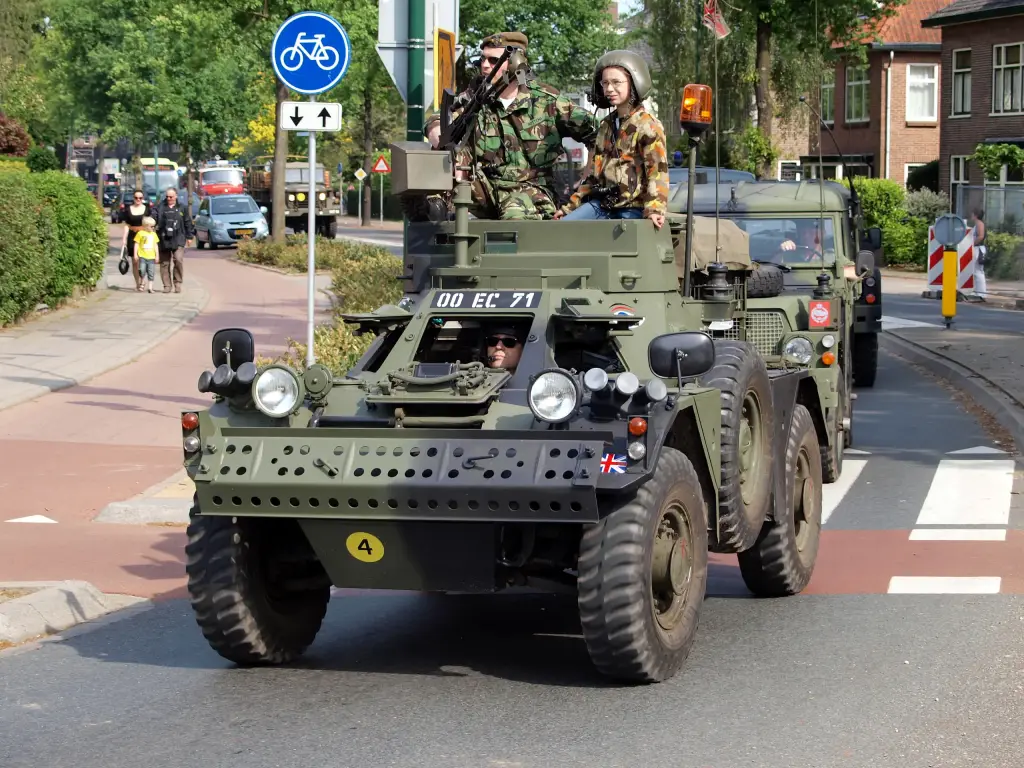
The Daimler Ferret, officially the Car, Scout, 4×4, Liaison, was the British Army’s light armoured scout car of the Cold War. Built by Daimler between 1952 and 1971 as the successor to the Dingo, it carried a Rolls-Royce B60 engine, a five-speed pre-selector gearbox and light armour, and it served with more than twenty armies.
Daimler Ferret at a glance
| Maker | Daimler, Coventry |
|---|---|
| Production | 1952–1971 |
| Role | light armoured scout and liaison car |
| Predecessor | Daimler Dingo |
| Designation | FV 701(C) for the Mark 1 |
| Engine | 4.26-litre Rolls-Royce B60 petrol six |
| Power | 116 bhp at 3,300 rpm, 129 bhp in final form |
| Gearbox | five-speed pre-selector, all gears in reverse |
| Armour | 6–16 mm steel plate |
| Wheelbase | 2.29 m |
| Built | 4,409 in 16 sub-models |
History of the Daimler Ferret
From the Dingo
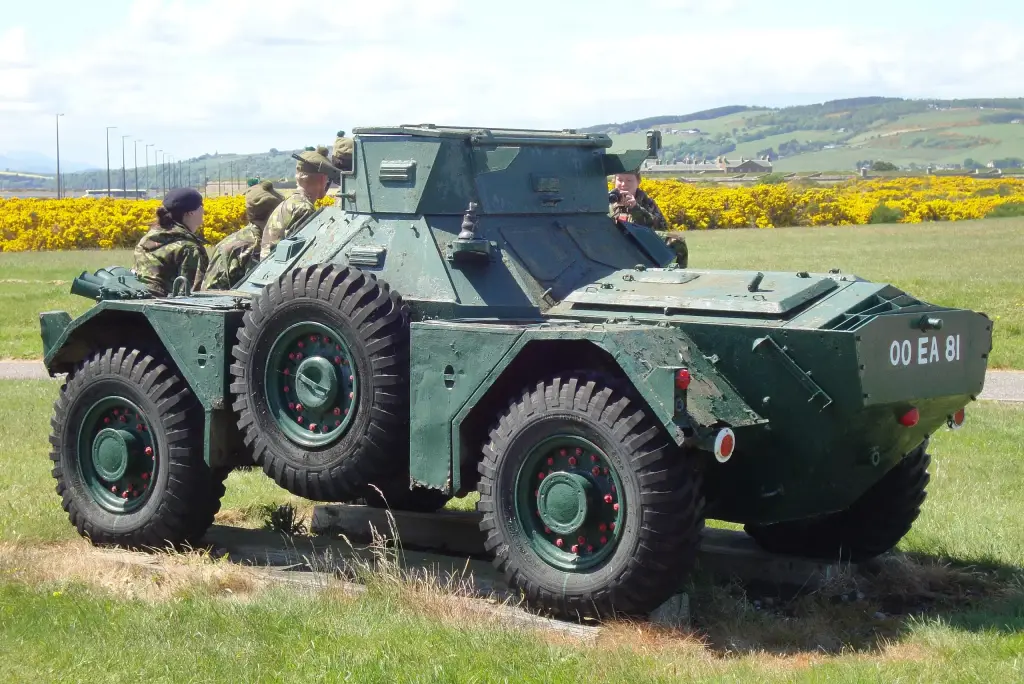
The British Army issued a requirement for a light reconnaissance car in 1947, and the Ferret was developed from 1949 to meet it. Daimler had built the wartime Dingo scout car, of which 6,626 were made, and on the strength of that experience it was given a development contract in October 1948. The first prototype, the Car, Scout, 4×4, Liaison (Ferret) Mark 1, was delivered in June 1950 and designated FV 701(C).
The Ferret kept the Dingo’s H-shaped drivetrain, in which a central differential avoids loss of traction through wheel slip and parallel drive shafts keep the hull low, about the height of a tracked vehicle. Suspension was by pairs of transverse links and single coil springs, with Tracta constant-velocity joints at the wheels, and epicyclic reduction gears cut the torque loads of the larger engine. That engine was the six-cylinder 4.26-litre Rolls-Royce B60, coupled through a fluid coupling to a five-speed pre-selector gearbox with every gear available in reverse. A longer wheelbase than the Dingo’s 1.98 m and 9.00×16 run-flat tyres improved speed and mobility over broken ground.
The vehicle
Steel plate between 6 and 16 mm thick protected the crew from shell splinters at most angles except straight overhead, because the basic vehicle was open-topped. It was unarmed apart from six forward-firing grenade launchers over the front wheels, normally loaded with smoke, a feature kept on all later marks; in service the crew also carried a .303 Bren or a pintle-mounted .30 Browning. The cabin was larger than the Dingo’s and mounted directly on the hull, which made the Ferret much noisier. The German account adds that the hull was welded from roughly 10 to 18 mm plate with a 4 mm engine cover, that the 100-litre tank sat between commander and engine, that fuel consumption was 30 to 50 litres per 100 km, and that the five-speed pre-selector gearbox and fluid coupling allowed the gears to be used in either direction; top speed was quoted as 93 km/h even though the speedometer read only to 50 mph.
Marks and service
The Mark 2 was designed from the outset to carry a .30 Browning in a one-person traversable turret, at the cost of a crew member; the turret gave the gunner protection but raised the height of the vehicle. Later marks added armour, amphibious sealing, Vigilant and Swingfire anti-tank missiles and other equipment, and the German account counts more than sixty types including trials vehicles. Production ran from 1952 to 1971 and came to 4,409 Ferrets in 16 sub-models. Australia used Mark 1 and Mark 2 cars from 1953 to 1970 and sold them at auction; Sri Lanka used them from 1955 to 1999, keeping a few Mark 1s for ceremonies. According to the US military, twenty national armies still operated the Ferret in 1996. In 2025 a video showed a Mark 1 with added drone defences in action in Ukraine, and Jordan’s design bureau developed a modernised version called the Stallion 1 in 2005.
Design and features
- H-drive: a central differential and parallel drive shafts gave the Ferret the low silhouette of a tracked vehicle.
- Rolls-Royce B60: a 4.26-litre petrol six of 116 to 129 bhp.
- Pre-selector gearbox: five speeds, all of them available in reverse.
- Open top: light 6–16 mm armour against splinters, with smoke grenade launchers as standard.
- Long service: sold to more than twenty armies and still in ceremonial use in several countries.
Daimler Ferret versions
- Mk 1 (FV 701): the basic open liaison car without a turret.
- Mk 1/1: heavier armour and a sealed hull for wading.
- Mk 1/2: fixed turret with a higher crew compartment and a Bren or GPMG.
- Mk 2: one-person traversable turret with a .30 Browning.
- Mk 2/6 and 2/7 (FV 703): two Vigilant anti-tank missiles.
- Mk 4 and Mk 5 (FV 711, FV 712): strengthened suspension, wading skirt and Swingfire missiles on the Mk 5.
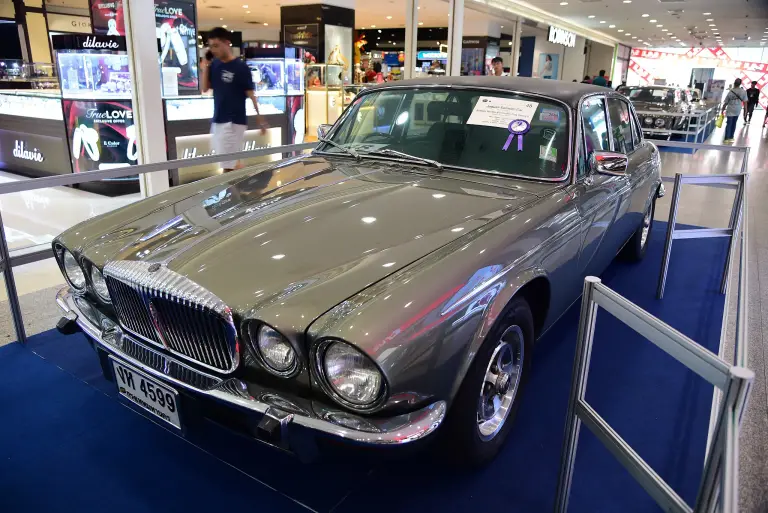
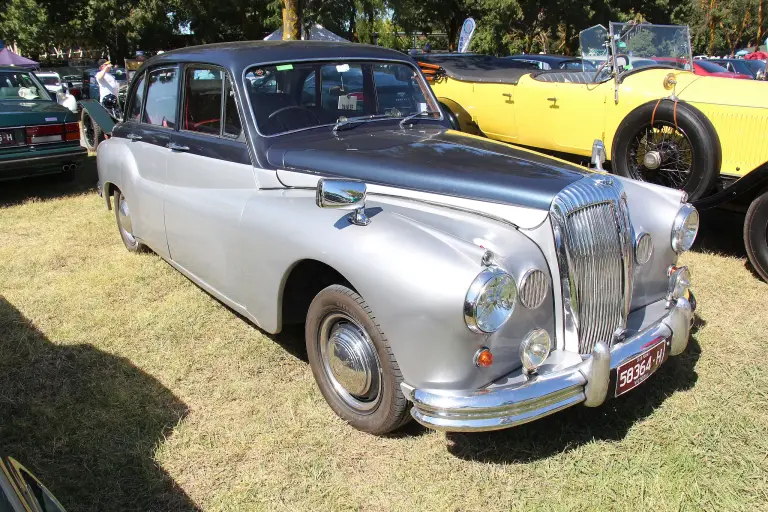
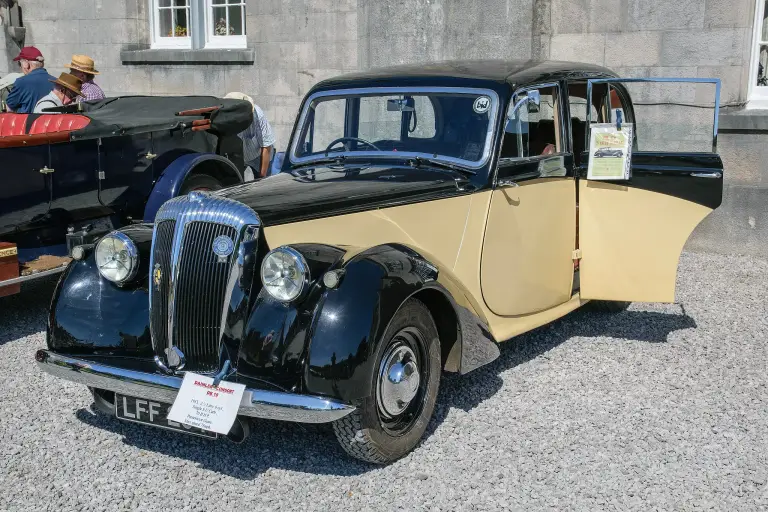
The Ferret was built by the same firm as the Daimler collection’s cars and replaced the wartime Dingo; the later Daimler buses such as the Fleetline show the other side of the company’s work.
Sources
- Ferret armoured car, English Wikipedia: development, design, marks, operators, production
- Ferret (Radpanzer), German Wikipedia: hull, fuel system, gearbox details, versions