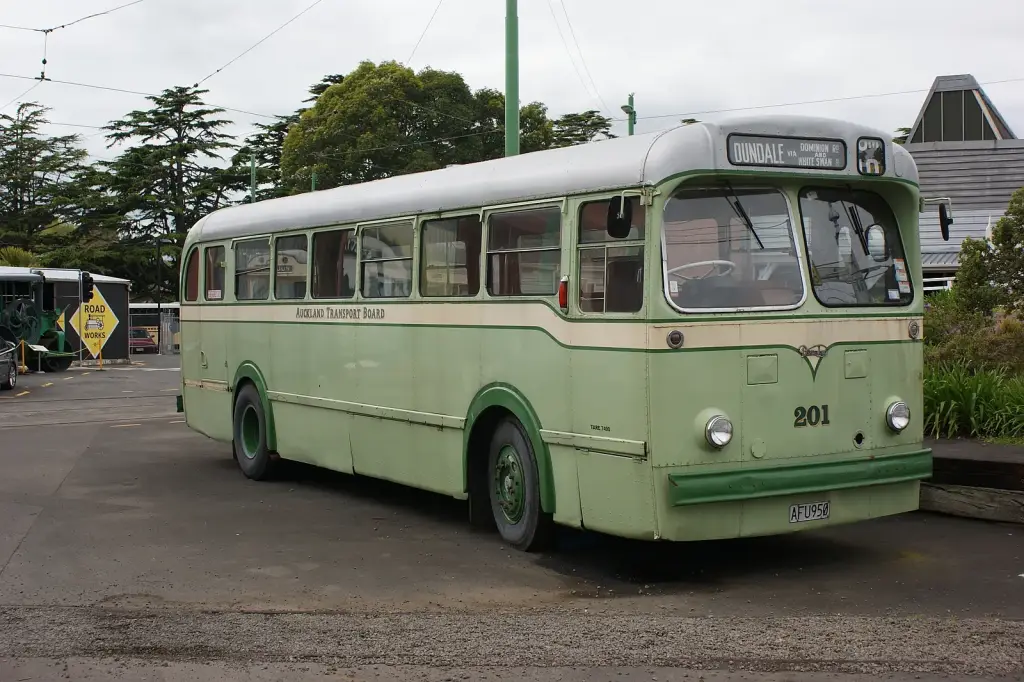
The Daimler Freeline was the company’s first underfloor-engined bus and coach chassis, built from 1951 to 1964. It was the first of only three Daimler public service vehicles to carry a name as well as a code, before the Fleetline and Roadliner. Too heavy for the British market, it sold badly at home and well abroad.
Daimler Freeline at a glance
| Maker | Daimler, Coventry |
|---|---|
| Production | 1951–1964 |
| Type | underfloor-engined bus and coach chassis |
| Frame | high straight ladder frame, steel channel |
| Gardner engines | 5HLW 7-litre, 87 then 94 bhp; 6HLW 8.4-litre, 102 then 112 bhp |
| Daimler engine | D650H 10.6-litre, 125 then 150 bhp |
| Model codes | G5HS, G6HS and D650HS |
| Gearbox | five-speed pre-selector, Daimatic semi-automatic from 1957 |
| Home wheelbase | 16 ft 4 in for 30 ft bodies |
| Built for UK corporations | 19 chassis |
Based on one source.
History of the Daimler Freeline
The underfloor layout arrives
The first British underfloor-engined bus and coach chassis were built by Leyland, Tilling-Stevens and AEC just before the war, and Midland Red built prototypes of the layout during it, putting more than 400 of its own buses into service by 1952. Sentinel of Shrewsbury was the first to sell such a design generally, from 1947, followed by the integral Leyland-MCW Olympic in 1948, the AEC Regal IV in 1949 and Leyland’s Royal Tiger chassis in 1950. Daimler had done well after the war with the half-cab CVD6 single-decker, especially among coach and independent operators, but half-cabs were going out of fashion at home, and when the permitted length of single-deckers rose to 30 feet in 1950 the company offered a long-body CVD6 while announcing, in April 1950, an underfloor-engined chassis of its own: the Freeline.
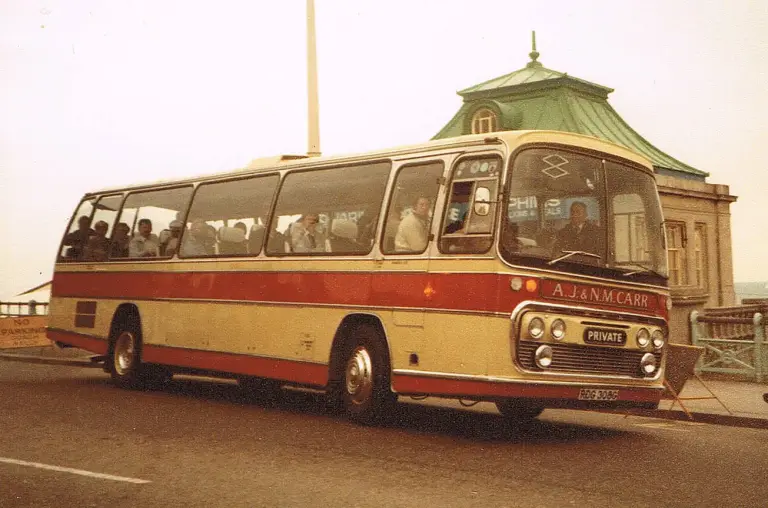
The first two were demonstrators. The first, a D650HS, went to H V Burlingham in March 1951 to be bodied in the Seagull coach style; the second was bodied by Duple in Hendon and shown on the Daimler stand at the 1951 Scottish Motor Show at Kelvin Hall in Glasgow, in the livery of Edinburgh Corporation, whose general manager was keen to try standee single-deckers on busy routes.
Chassis and engines
Like its Leyland and AEC rivals the Freeline had a high, straight ladder frame of substantial steel channel, with an optional rear drop-frame for coach luggage boots or urban standee platforms. Three power units were listed. Gardner’s 5HLW five-cylinder 7-litre gave 87 bhp, later 94, and the 6HLW 8.4-litre six gave 102 bhp, later 112; these were coded G5HS and G6HS, and the same Gardner engines were used by Guy, Bristol and Atkinson and in the Saunders-Roe integral. Daimler also offered its own D650H, a horizontal 10.6-litre engine derived from the D650 of the rare post-war CD650 double-decker, differing mainly in its sump casting; output was 125 bhp at 1,650 rpm, soon raised to 150 bhp at 2,000 rpm, which was class-leading in 1953. That version was the D650HS, and parts commonality was such that CD650 operators used the horizontal engine’s top end when vertical spares ran short.
The rear axle was a substantial underslung worm unit with the differential offset to the left, as on the CD650. Braking was originally full-power hydraulic on Lockheed’s controversial continuous-flow system, which could also assist the steering and the gear-selection pedal; operators disliked it and air braking was quietly offered from 1952. At home there was one wheelbase, 16 ft 4 in for 30 by 8 ft bodies; for export a 17 ft 6 in wheelbase for 33 ft bodies was standard, and a 20 ft 4 in version for 36 ft bodies followed in 1954. Transmission was a Daimler five-speed pre-selector, overdrive-top or close-ratio, with four speeds optional; from 1957 the Daimatic semi-automatic with four speeds became available and soon standard, driven through a remotely mounted fluid flywheel.
Too heavy for Britain
It soon became clear that the Freeline, like the Regal IV, Royal Tiger and Guy Arab UF, was over-engineered for British conditions: a typical 39-seat coach could weigh more than a 60-seat half-cab double-decker. Leyland, AEC and Guy developed lightweight chassis for the home market, but Daimler never offered an equivalent to the Tiger Cub, Reliance or Arab LUF. Only 19 chassis went to British municipal fleets, a result described as little short of disastrous in Daimler’s core market, and Edinburgh Corporation returned the demonstrator it had on extended loan rather than buy it; the bus later passed to Samuel Ledgard. Abroad, however, the Freeline became a substantial export success, and production continued until 1964.
Design and features
- Underfloor engine: a flat floor for standee single-deckers, ahead of most British rivals.
- Three power units: Gardner 5HLW and 6HLW, or Daimler’s own 10.6-litre D650H.
- Export wheelbases: 16 ft 4 in at home, 17 ft 6 in and 20 ft 4 in for longer bodies abroad.
- Daimatic transmission: the semi-automatic gearbox offered from 1957.
- Named chassis: the first of three Daimler bus chassis with a name, with the Fleetline and Roadliner.
Daimler Freeline versions
- G5HS: Gardner 5HLW five-cylinder engine.
- G6HS: Gardner 6HLW six-cylinder engine.
- D650HS: Daimler’s own 10.6-litre horizontal engine.
- Seagull coach: the first demonstrator, bodied by H V Burlingham.
- Edinburgh demonstrator: a G6HS with Duple dual-door standee body.
The Freeline was replaced by the rear-engined Roadliner and shared its name-only chassis idea with the Fleetline. More vehicles are in the Daimler collection.
Sources
- Daimler Freeline, English Wikipedia: background, description, engines, sales