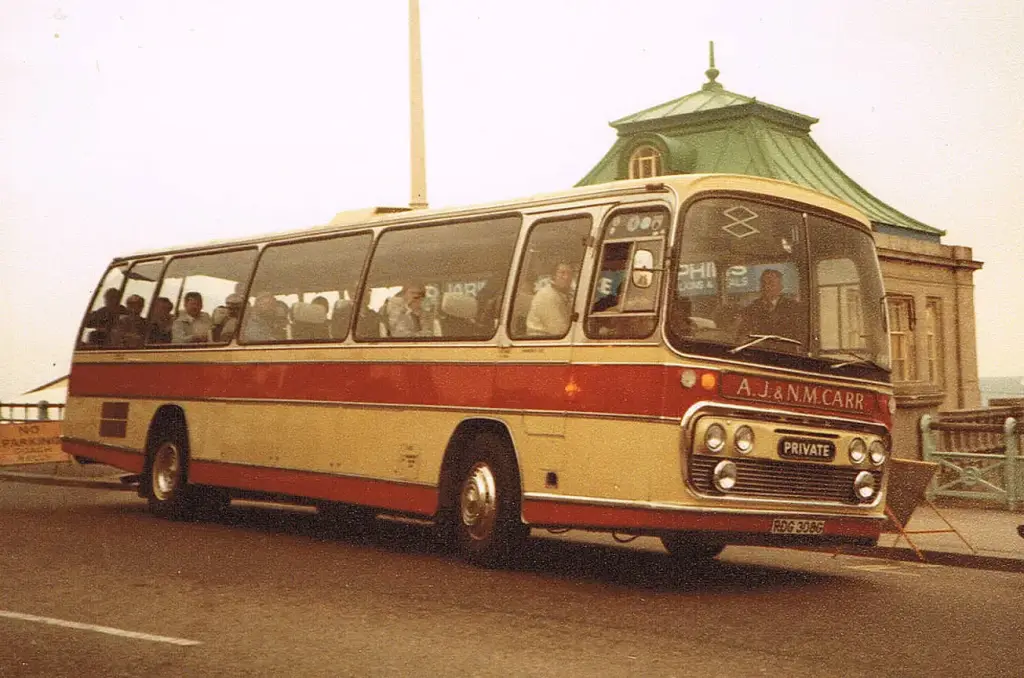
The Daimler Roadliner was a single-deck bus and coach chassis of 1962 to 1972, and the third and last Daimler bus to carry a name as well as a code, after the Freeline and Fleetline. It was remarkably advanced, with a low step-free floor and air suspension, but it became notorious for unreliability and in 1993 readers of Classic Bus voted it the worst bus type ever built.
Daimler Roadliner at a glance
| Maker | Daimler, Coventry |
|---|---|
| Production | 1962–1972 |
| Type | single-deck bus and coach chassis |
| Model code | SRC6-36 |
| Engine | 9.6-litre Cummins VIM V6-200 |
| Power | 192 bhp at 2,600 rpm |
| Gearbox | Daimler SCG Daimatic four-speed semi-automatic |
| Rear axle | Eaton spiral bevel, optional two-speed |
| Suspension | air as standard, rubber or steel leaf optional |
| Length | 36 ft (11 m) |
| Built | 333 |
Based on one source.
History of the Daimler Roadliner
From the Fleetline
In 1960 Transport Vehicles (Daimler) Ltd, the commercial vehicle arm of Daimler, launched the Fleetline double-decker at the Earls Court show, the second British rear-engined double-decker. Its advantage over the Leyland Atlantean was a patented concentric-drive gearbox that allowed a dropped-centre rear axle as standard, so a body low enough for 13 ft 5 in bridges could still have a centre gangway the full length of both decks. The standard Fleetline engine was the 150 bhp Gardner 6LX, then regarded as the most economical diesel in its class and by many engineers as more reliable than Leyland’s O.600. By the end of 1962, 125 Fleetlines had been delivered and over 300 were on order, which pleased Daimler’s new owner Jaguar, and Sir William Lyons allowed work to start in mid-1962 on a single-decker to replace the underfloor-engined Freeline.
Two prototypes were built to the new maximum dimensions of 36 feet long and 8 ft 2½ in wide, with the Fleetline’s drive layout and a transverse rear engine, in this case a turbocharged horizontal Daimler CD6 in the rear nearside corner with the radiator at the front. One was shown on the Daimler stand at the 1962 Commercial Motor Show and a brochure was printed, but the Daimler engine had gone out of production and the project stalled until customer interest persuaded Lyons to approve a production bus.
The production SRC6-36
The production version dropped the transverse horizontal drive for a vertical longitudinal rear-engined layout. The chassis was slightly higher at the front and ramped gently upward and outward toward the rear, where the Cummins VIM V6-200 was mounted: a 9.6-litre 90-degree V6 of 192 bhp at 2,600 rpm, compact enough to sit under the rear seat of a bodied bus and drive through a conventional Daimler SCG Daimatic four-speed semi-automatic gearbox to an Eaton spiral-bevel rear axle, with an electrically operated two-speed axle optional. All-round air suspension was standard, with rubber and steel leaf options. The radiator sat at the rear offside as on the Fleetline, and the front axle, steering, brakes and driving controls were similar to the Fleetline’s.
A left-hand-drive chassis with a 51-seat Duple coach body was shown at the 1964 show alongside the first customer car, 6000EH of Potteries Motor Traction, which had a 50-seat Marshall body in British Electric Traction style with no steps and a slightly ramped floor up to the rear bench. The floor was so low that side-facing benches had to be fitted over both wheelarches, and a contemporary reviewer thought the footstools to the front benches rather high. The bus entered service in late 1964 and the union branch that operated it sent Daimler a letter of congratulation, an unprecedented step; the coach drew praise in road tests from early 1965.
Production and trouble
Daimler had intended to build the Cummins V6 in Britain in a Jaguar-Cummins joint venture at the former Henry Meadows factory in Wolverhampton, but the plan was not carried out and every UK engine came from Cummins in Columbus, Indiana. The engine also powered the Guy Big J lorry and Atkinson lorries. The first production Roadliners entered service during 1966, with early customers including Wolverhampton and Sunderland corporations, West Riding Automobile Company of Wakefield and AA Motors of Ayr. By the end of production in 1972, 333 had been built, and besides the UK they went to Australia, Belgium, Canada, Poland, South Africa, Spain and Switzerland; Plaxton bodied the most, the largest export market was South Africa, which took the last examples, and the Municipal Tramways Trust in Adelaide bought 35.
The Roadliner’s reputation came from its engineering rather than its layout: the Cummins V6 used that maker’s intermediate-pressure fuel pump and governor system, and the combination of an unfamiliar engine, a semi-automatic gearbox and a low floor gave operators trouble in service. Its place in history was sealed by the 1993 Classic Bus readers’ poll, which named it the worst bus type ever, ahead of the Guy Wulfrunian, even though it offered step-free access about twenty years before other buses and was thought by commentators to be ahead of contemporary British coach design.
Design and features
- Step-free floor: a low floor and ramped gangway about twenty years before other British buses.
- Cummins V6: a 9.6-litre American V6 of 192 bhp, imported rather than built in Britain.
- Air suspension: standard all round, with rubber or steel leaf as options.
- Semi-automatic gearbox: Daimler’s SCG Daimatic with four speeds.
- Export success: sold to seven countries, with South Africa the largest market.
Daimler Roadliner versions
- Prototypes (1962): two chassis with transverse turbocharged Daimler CD6 engines.
- SRC6-36: the production chassis with the longitudinal Cummins V6.
- Bus bodies: Marshall and other bodybuilders, with 50-seat step-free layouts.
- Coach bodies: a Duple 51-seat demonstrator and Plaxton-bodied coaches.
- Two-speed axle option: an electrically operated Eaton rear axle.
The Roadliner replaced the underfloor-engined Freeline and shared its rear-engine thinking with the Fleetline double-decker. More vehicles are in the Daimler collection.
Sources
- Daimler Roadliner, English Wikipedia: background, prototypes, engineering, production, reputation