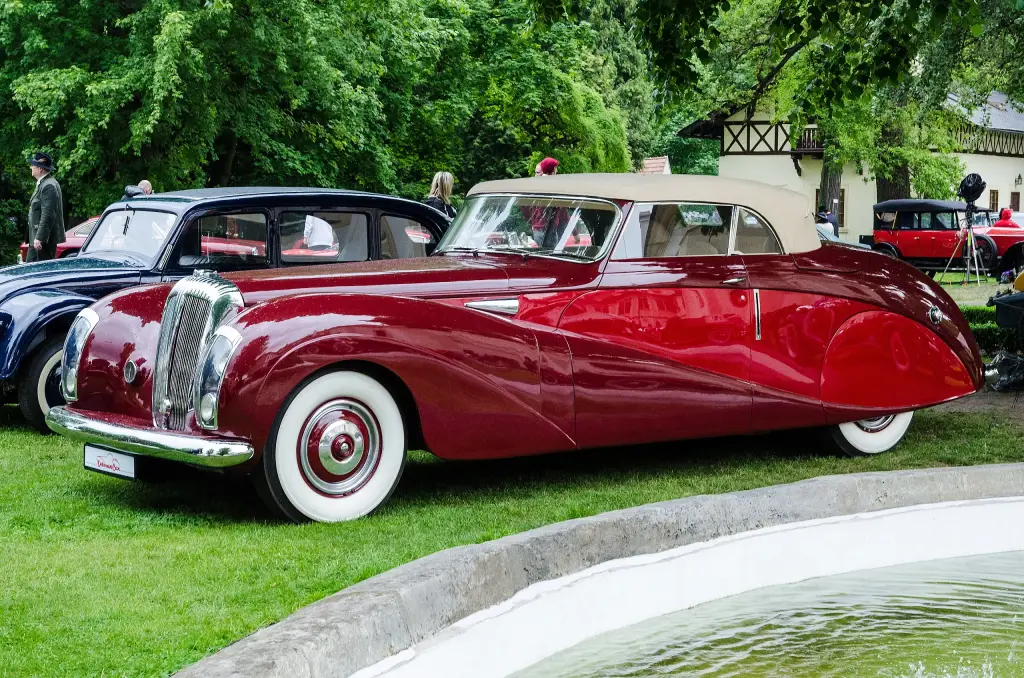
The Daimler DE was a chassis rather than a single model. Built from 1946 to 1953, it underpinned the largest and most expensive Daimlers of the period: the short-wheelbase DE 27 with the Twenty-seven six and the long-wheelbase DE 36, the last Daimler straight-eight and the last British straight-eight car offered to the public.
Daimler DE at a glance
| Maker | The Daimler Company, Coventry |
|---|---|
| Production | 1946–1953 |
| Types | DE 27 short wheelbase, DE 36 long wheelbase |
| DE 27 wheelbase | 3,515 mm |
| DE 36 wheelbase | 3,734 mm |
| DE 27 chassis weight | 1,778 kg |
| DE 27 engine | Twenty-seven straight-six |
| DE 36 engine | Thirty-six straight-eight |
| Front suspension | independent, coil springs, double wishbones |
| Brakes | Girling hydro-mechanical with Clayton-Dewandre servo |
| DE 36 built | 205 chassis |
| Related | DC 27 ambulance, DH 27 hire limousine |
Based on one source.
History of the Daimler DE
A chassis for coachbuilders
The DE chassis was designed by Daimler’s chief engineer, C. M. Simpson, on a separate steel frame, which allowed customers to buy a rolling chassis and have a body made to their own specification. The frame’s side rails were reinforced by X-braced crossmembers. The rear wheels were driven through a modified Hotchkiss system with control arms from the rear axle casing to pivots on the frame directly above the leaf springs’ true pivot, which limited lateral movement without disturbing the springs; final drive was by hypoid gears, replacing the worm drive Daimler had used since 1910. The rear track was 63 inches and the tyres 8.00 × 17 all round.
The front wheels were independently suspended on pairs of control arms, as on the DB18 chassis, with wide-based lower wishbones on coil springs and shorter upper arms working Luvax-Girling dampers, joined by an anti-roll bar; the front track was 60 inches. Steering used Marles roller gear but with the hub centre placed behind the kingpin instead of inclining the kingpin to create castor, which improved controllability. Braking was Girling hydro-mechanical, hydraulic at the front and mechanical at the rear, with a Clayton-Dewandre servo. Bodies available through Daimler included electric windows and a central divider, interior lights switched by the doors or boot lid, and warning lights on the rear wings while the boot was open.
DE 27
The DE 27 sat between the DB18 and the DE 36 and used the short chassis with the Twenty-seven engine, a straight-six developed for the Daimler Armoured Car and later used in the DE 27, the DC 27 ambulance and the DH 27 hire limousine. Its cylinders were cast with the upper crankcase, the four-bearing crankshaft had counterbalancing weights, and the big-end bearings were flanged over the sides of the crank to locate the rods against the webs, cutting engine noise. The chassis weighed 1,778 kg and carried 91 litres of petrol, 9.9 litres of oil and 17.6 litres of coolant. Production ended in 1951.
DE 36
The DE 36 was the last Daimler straight-eight and the last British straight-eight car made available to the public, offered as a saloon, limousine and drophead coupé. Besides British royalty, under the royal warrant Daimler had held since 1900, DE 36s went to the royalty of Afghanistan, Ethiopia, the Netherlands, Monaco, Saudi Arabia and Thailand. It used the Thirty-six straight-eight on a 147-inch wheelbase and was the last very big Daimler with an engine of more than 5 litres; 205 chassis were built before production ended in 1953. Daimler and its coachbuilding subsidiary Hooper built three show cars on DE 36 chassis for the Earls Court shows: the “Green Goddess”, a five-seat drophead coupé with a hydraulically operated hood, in 1947; the “Golden Daimler”, a touring limousine with gold foil trim and 7,000 gold stars on its sides, in 1951; and the “Blue Clover”, a five-seat fixed-head coupé, in 1952.
Ambulances and hire cars
The DE chassis also produced the DC ambulance chassis, on which Barker and Hooper built 500 Daimler DC 27 ambulances, and a variant of the DC became the DH chassis, used for fifty DH 27 limousines for Daimler Hire. After the war the London County Council commissioned a prototype ambulance and asked the industry for something similar; Daimler offered a vehicle with nearly all of its features and the requirements of the Ministry of Health advisory committee, and designed the DC 27 chassis for it. The DC 27 was the first purpose-built ambulance available in Britain after the war, noted for its low floor, which eased work for stretcher crews, and for the space in the working area, which was heated and air-conditioned; it had good headroom, a smooth ride and stable handling, but the crew could not reach the cab from the working area, and fuel consumption was high.
Design and features
- Separate chassis: customers could order a rolling chassis and have a body built to their own design.
- Straight-eight DE 36: the last Daimler straight-eight and the last British straight-eight sold to the public.
- Royal customers: sold to British royalty and to the royal houses of six other countries.
- Show cars: the Green Goddess, Golden Daimler and Blue Clover built for Earls Court.
- Working chassis: the basis of the DC 27 ambulance and the DH 27 hire limousine.
Daimler DE versions
- DE 27 (1946–1951): short-wheelbase six-cylinder chassis.
- DE 36 (1946–1953): long-wheelbase straight-eight, 205 chassis.
- Green Goddess (1947): Hooper five-seat drophead coupé show car.
- Golden Daimler (1951): touring limousine with gold foil and 7,000 gold stars.
- Blue Clover (1952): five-seat fixed-head coupé show car.
- DC 27 ambulance and DH 27 limousine: 500 ambulances and 50 Daimler Hire cars.
The DE sat above the Regency in the Daimler range, and its place among state cars was eventually taken by the DS420 limousine. More cars are in the Daimler collection.
Sources
- Daimler DE, English Wikipedia: chassis design, DE 27 and DE 36, show cars, ambulances