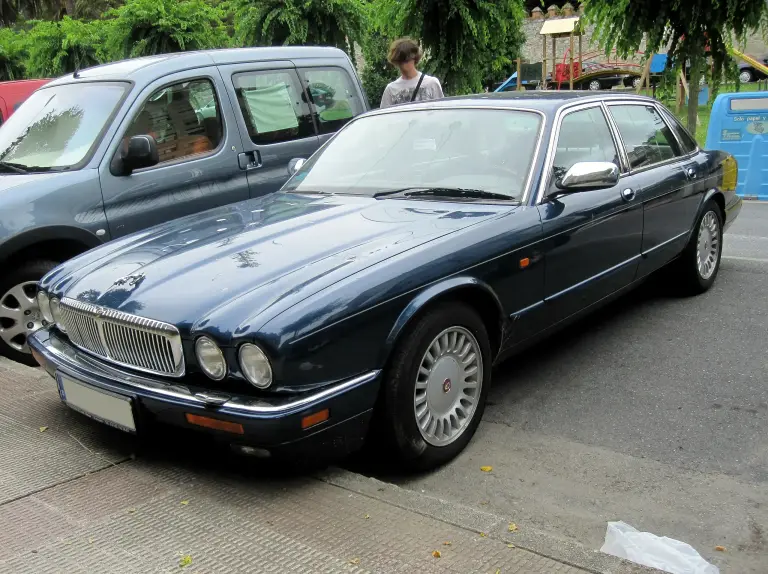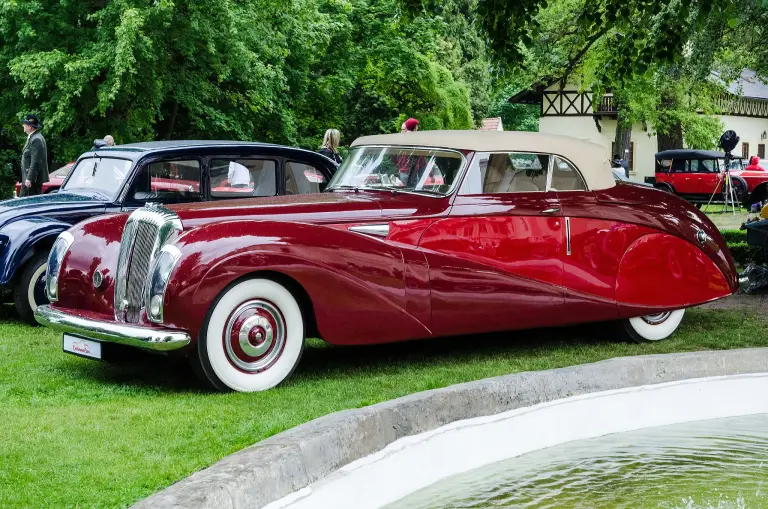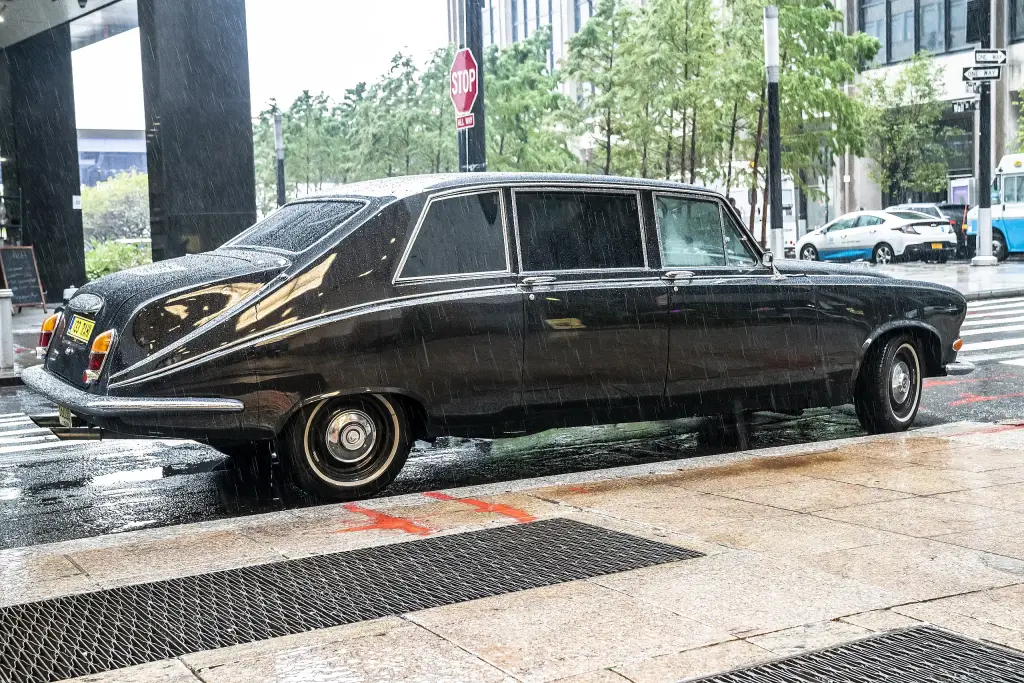
The Daimler DS420, also sold simply as the Daimler Limousine, was the company’s flagship from 1968 to 1992. Built on a Jaguar 420G floorpan stretched by 21 inches and powered by the 4.2-litre XK six, it was a seven-seat car for heads of state, hotels, chauffeur services and funeral directors, and it ended production as the last coach-built Daimler.
Daimler DS420 at a glance
| Maker | Daimler, built by Vanden Plas then Jaguar |
|---|---|
| Production | 1968–1992 |
| Based on | Jaguar 420G floorpan |
| Wheelbase | 533 mm (21 in) longer than the 420G |
| Engine | 4,235 cc Jaguar XK straight-six, DOHC |
| Power | 186 DIN hp at launch |
| Gearbox | three-speed General Motors automatic |
| Top speed | 180 km/h |
| Seats | seven, two of them folding |
| Weight | 2,100 kg |
| Built | 5,043, of which 4,116 by Vanden Plas |
| Last car | L420 YAC, late 1992 |
History of the Daimler DS420
One limousine instead of two
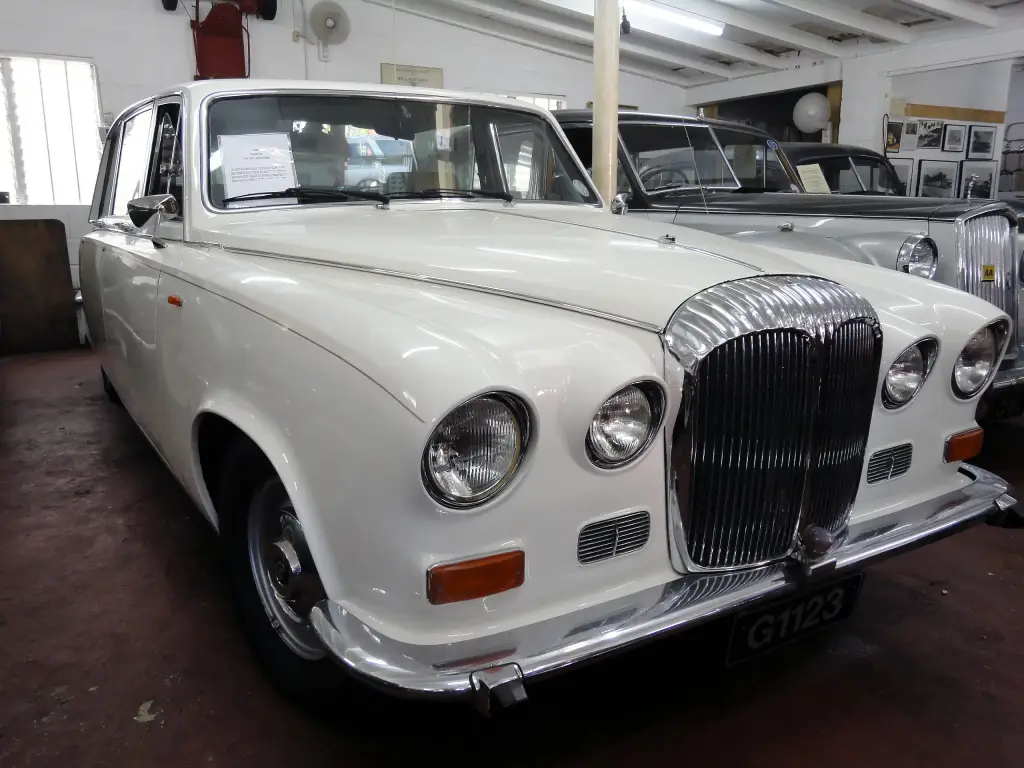
Daimler had been bought by Jaguar in 1960, Jaguar by the British Motor Corporation in 1966 and both were folded into British Leyland in 1968. BMC and Jaguar each had a limousine, the Vanden Plas Princess and the Daimler DR450, and rather than build two competing cars they consolidated production into a single model under the Daimler marque. Most of the engineering was Jaguar’s: the DS420 shared its engine, gearbox and suspension with the Jaguar 420G. Production was announced in June 1968 and the cars were built at the Vanden Plas works in Kingsbury. The name followed Daimler’s system: D for Daimler, S as the next letter after the DR450, and 420 for the 4.2-litre engine.
The body sat on the 420G floorpan with the wheelbase extended by 21 inches. The front carried the traditional fluted Daimler grille with Jaguar 420G headlights, and the car had the 420G’s twin ten-gallon fuel tanks in the rear wings, each with its own electric SU pump and a dashboard switch. The driver sat on a fixed full-width bench with only 2.75 inches of steering-column adjustment, separated from the passengers by a bulkhead with a sliding window. Three passengers faced forward on a bench more than six feet wide and three more used folding seats. Against a Rolls-Royce Phantom VI the Daimler was four inches shorter in the wheelbase and a foot shorter overall, about 350 kg lighter and less than half the price of a long-wheelbase Silver Wraith II.
Production and facelifts
Bodies were assembled from panels by Park Sheet Metal, Motor Panels of Coventry and Pressed Steel Fisher, and early cars carried “Daimler Vanden Plas” plates. The first facelift came in 1972, when the divided rear side glass became a single sliding window, which also dealt with corrosion around the division; the grille dimensions, badge placement and the amount of interior woodwork changed too. Kingsbury closed in 1979 and production moved to Jaguar in Coventry, bringing the largest facelift: bigger bumpers and a revised rear number-plate frame. The third and final change came in 1987 with plastic-coated bumpers and minor interior work; this Mk IV lasted until 1992.
Cars ranged from basic models with manually operated windows to a 1984 example built for Jaguar’s boss John Egan as a mobile boardroom with television, computer, printer and cocktail cabinet. Private owners tended to specify everything, while the funeral trade and limousine companies wanted few options; Daimler Hire, until its purchase by Hertz in the early 1980s, was one of the largest customers, with air conditioning, an electric division window, matching leather and a bonnet flag mount. The factory also supplied part-bodies so outside coachbuilders could build hearses, and two landaulettes were made at the works, neither of which survives.
Royal customers
No other limousine has been delivered to more reigning monarchs. King Frederik IX of Denmark used the first pre-production car in London and took delivery of a black example in March 1970; it stayed in the Danish royal fleet and carried Crown Prince Frederik at his 2004 wedding. Prince Rainier III of Monaco flew to England to collect his in November 1970, a car in gold-silver-green “Silk” and black that served him until 2005 and is now in his Monaco museum. Queen Elizabeth The Queen Mother had five in succession between 1970 and 2002, all in black over royal claret with the plate NLT 2, and left the last to the Jaguar Daimler Heritage Trust. King Hussein of Jordan ordered one in sand in 1970, and King Carl XVI Gustaf of Sweden still uses the model.
By 1992 the DS420 was the only Jaguar-group model still using the XK engine and the last production car ever built with one. The final example, L420 YAC, was completed at Browns Lane late in 1992 and is kept by the Jaguar Daimler Heritage Trust. No direct replacement followed.
Design and features
- State-room body: a bulkhead and sliding window separated three forward-facing and three folding seats from the driver.
- Jaguar engineering: 420G floorpan, XK 4.2 engine, suspension and General Motors three-speed automatic.
- Built to order: about 250 cars a year, from basic manual-window cars to a mobile boardroom.
- Hearse and landaulette bodies: part-bodies were supplied to coachbuilders, and two works landaulettes were made.
- Royal favourite: bought by more reigning monarchs than any other limousine.
Daimler DS420 versions
- DS420 (1968–1972): the original with divided rear side glass.
- 1972 facelift: single sliding rear windows and a revised grille.
- 1979 Coventry cars: larger bumpers and a new number-plate frame.
- Mk IV (1987–1992): plastic-coated bumpers and minor interior changes.
- Hearses: conversions by coachbuilders such as Startin and Woodall Nicholson.
- Landaulette: two works cars of 1973, neither surviving.
The DS420 replaced the DR450, a Pullman version of the Majestic line, and shared its engine with the Daimler Sovereign. More cars are in the Daimler collection.
Sources
- Daimler DS420, English Wikipedia: origins, description, production, options
- Daimler DS420, German Wikipedia: production totals, technical data, royal owners