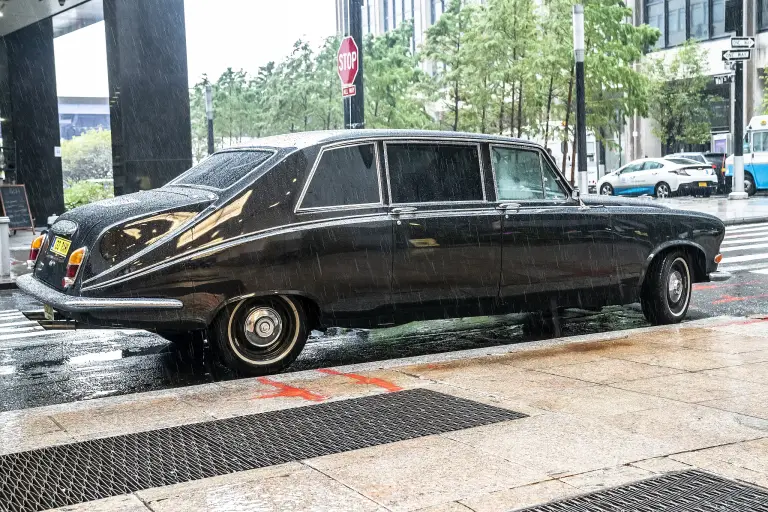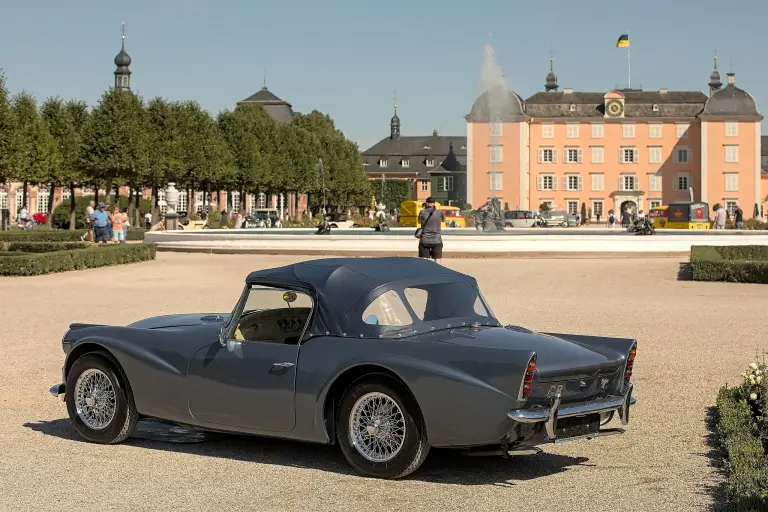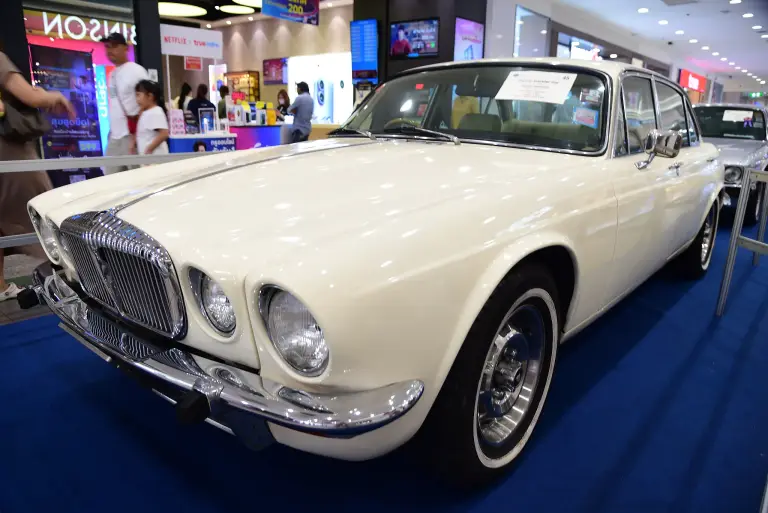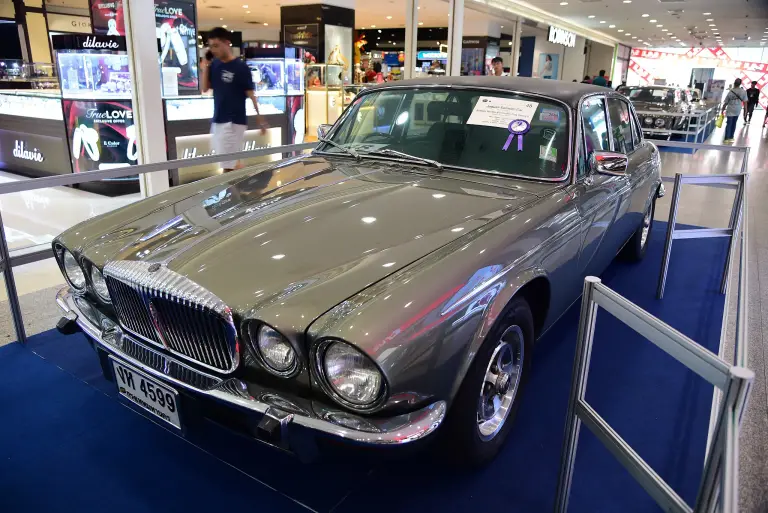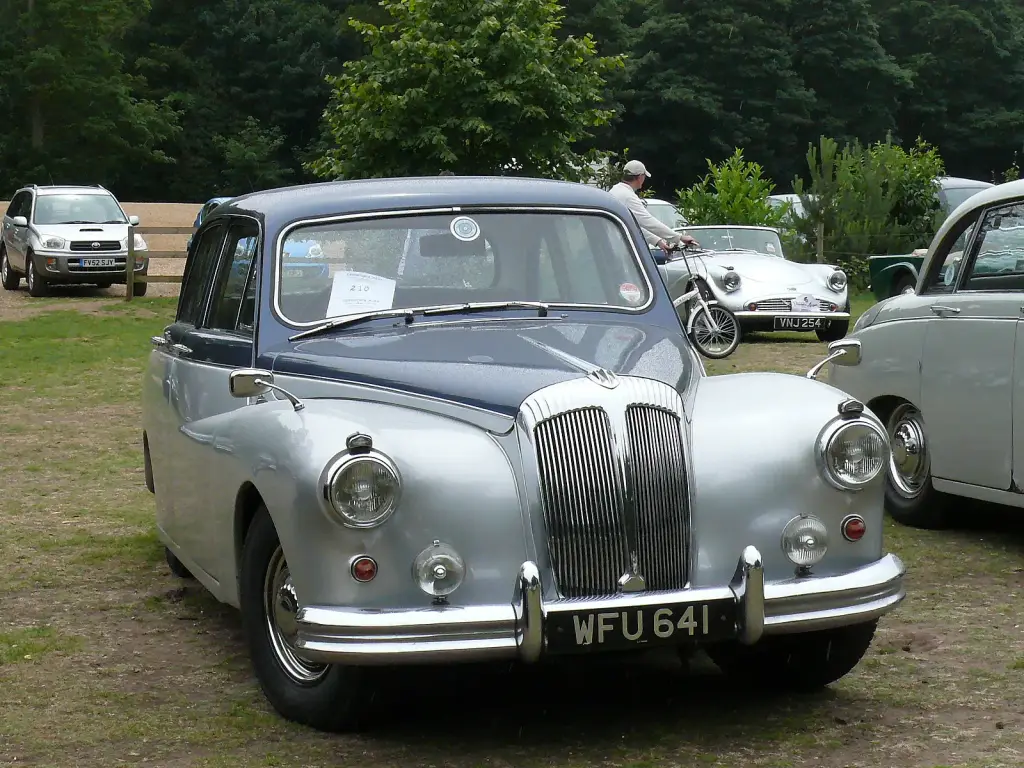
The Daimler Majestic was launched in July 1958 as the company’s new luxury saloon. Technically it was up to date, with a 3.8-litre six, a three-speed Borg-Warner automatic, power steering and vacuum-servo disc brakes on all four wheels; but it carried a heavy coachbuilt body on a separate chassis, and the styling was already dated when it appeared. It was the last Daimler developed before Jaguar bought the company.
Daimler Majestic at a glance
| Maker | The Daimler Company, Coventry |
|---|---|
| Production | 1958–1962 |
| Designations | DF316/7 and DF318/9 |
| Engine | 3,794 cc straight-six, aluminium head |
| Power | over 147 bhp at 4,400 rpm |
| Torque | 209 lb·ft at 2,800 rpm |
| Transmission | three-speed Borg-Warner automatic |
| Brakes | servo-assisted Dunlop discs all round |
| Top speed | 100.6 mph |
| 0–60 mph | 14.2 seconds |
| Price | £2,495 including taxes |
| Built | 1,490 |
History of the Daimler Majestic
A new flagship for 1958
Edward Turner had been appointed chief executive of BSA Automotive in 1957 and promised new products; the Majestic was meant to carry his new V8, still under development, but it reached the market with a six-cylinder engine in July 1958, replacing the automatic version of the One-O-Four, which stayed in production with the pre-selector gearbox. The car was Daimler’s answer to a falling share of the luxury market, where Bentley and Rolls-Royce had been gaining through the 1950s, and to the damage done to the marque’s reputation by the extrovert behaviour of Norah Docker, wife of BSA director Bernard Docker.
The Majestic was an evolution of the One-O-Four and used the same massive cruciform-braced box-section chassis that Daimler had designed for the 1937 New Fifteen, with coil-sprung independent front suspension and a live rear axle on semi-elliptic springs. Its four-wheel Lockheed servo-assisted Dunlop disc brakes were regarded as a first for a British production car, and the first on a saloon with no sporting claim; the handbrake used special pads on the rear discs worked by cables and rods.
Engine and body
The engine was a 3.8-litre (3,794 cc) straight-six based on earlier Daimler sixes, with pushrod overhead valves and the same 107.95 mm stroke as before but a bore increased from 82.55 to 86.36 mm. It gave over 147 bhp at 4,400 rpm and 209 lb·ft at 2,800 rpm. The block was enlarged to take new liners, and the Borg-Warner transmission required the starter motor to be moved and the crankcase and block castings changed. The crankshaft had four main bearings, integral balance weights and a torsional vibration damper. The radiator top sat two inches lower than the One-O-Four’s, the body was wider with smoother lines and about four inches more interior width, with a high waistline, narrow windows and a rounded rear window.
Bodies were built by Carbodies of Coventry, part of the BSA group since 1954. To save money the panels were pressed on the tooling used for the One-O-Four, with Kirksite inserts for the altered sections; press quality was poor and panels needed regular hand finishing. A few individual bodies were also built, mainly by Hooper. Standard equipment included heating and ventilation, a windscreen washer, cigar lighter, lockable glove compartment, courtesy lights and passenger reading lights.
On the road and on the market
The Motor tested a Majestic in 1958: 100.6 mph, 0–60 mph in 14.2 seconds and 19.3 mpg, at £2,495 including £832 of tax. The rival Jaguar Mark IX cost £1,995 with a similar specification but 220 bhp. Daimler’s own customers regarded Jaguars as cars for “cops and robbers”, while Jaguar buyers thought Daimlers staid, and the market split accordingly: 1,490 Majestics were built in four years against more than 10,000 Jaguar Mark IXs. Stirling Moss praised the Majestic’s handling at high speed, finding no sway even in fast corners.
Turner’s 4.5-litre V8 Majestic Major joined the range in the same body, announced at the 1959 motor show but delayed into the following year, and the six-cylinder car remained the more popular despite a production run half as long. A preliminary announcement on 26 May 1960 confirmed that Jaguar was close to buying Daimler and its factory; the V8 Major stayed in the range under Jaguar until 1968 alongside the Daimler 250 V8. In 1989 and 1990 Jaguar revived the name for a leather-trimmed XJ40 special edition, first in the United States, and for a long-wheelbase XJ40 of which only 121 were built.
Design and features
- All-disc brakes: servo-assisted Dunlop discs on all four wheels, a first for a British production saloon.
- Modern drivetrain: 3.8-litre six and a three-speed Borg-Warner automatic, the first post-war Daimler without a pre-selector option.
- Old-fashioned chassis: the 1937-designed separate frame and a heavy coachbuilt body kept the weight high.
- Carbodies coachwork: panels pressed on the One-O-Four’s old tooling, hand-finished where they did not fit.
- Name revived in 1989: Jaguar used Majestic for a special XJ40 edition.
Daimler Majestic versions
- Majestic (1958–1962): the standard six-cylinder saloon, DF316/7 and DF318/9.
- Majestic Major (1959–1968): Turner’s 4.5-litre V8 in the same body.
- Hooper bodies: a small number of individually styled cars.
- Jaguar Majestic (1989–1990): a US-market XJ40 special edition with leather trim.
- Long-wheelbase XJ40 Majestic: 121 cars at the end of XJ40 production.
The Majestic replaced the One-O-Four in the Regency line, and its V8 stablemate stayed in production alongside the Daimler 250 V8 after the Jaguar takeover. More cars are in the Daimler collection.
Sources
- Daimler Majestic, English Wikipedia: construction, engine, performance, pricing, Jaguar Majestic
- Daimler Majestic, German Wikipedia: background, Carbodies bodies, production total, market comparison