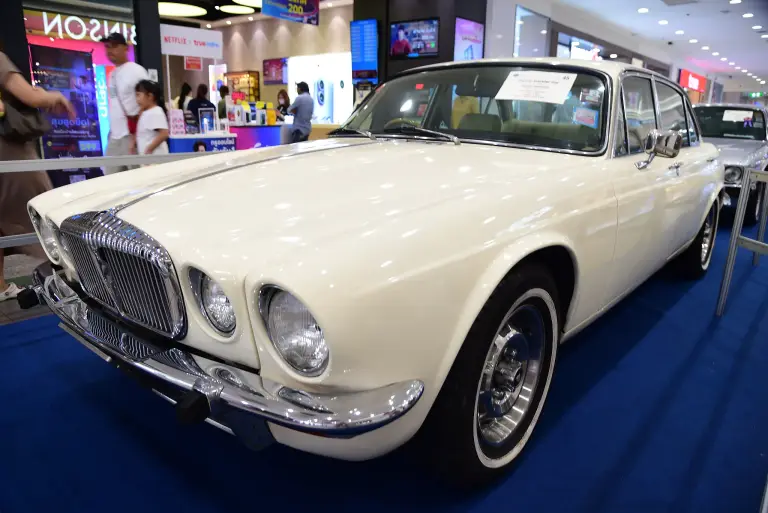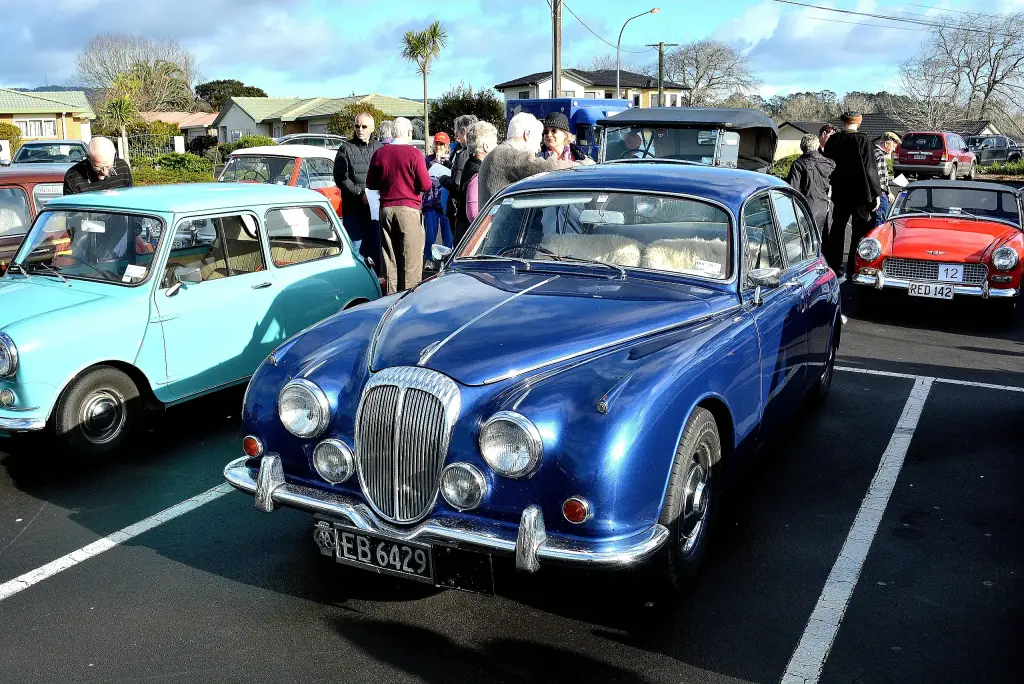
The Daimler 2.5 V8 was the first Daimler built on a Jaguar platform and the last to use an engine of Daimler’s own design. Sold from late 1962 to 1969, it was a Jaguar Mark 2 with the hemispherical-head V8 from the SP250, a fluted Daimler grille and a richer interior. It became the most popular model the company ever made.
Daimler 250 at a glance
| Maker | The Daimler Company, Coventry |
|---|---|
| Production | 1962–1969 |
| Body | four-door saloon, unit construction |
| Based on | Jaguar Mark 2 |
| Engine | 2,548 cc V8, hemispherical heads |
| Power | 140 bhp |
| Transmission | Borg-Warner automatic; manual from 1967 |
| Top speed | 112 mph (Autocar, 1966) |
| 0–60 mph | 13.6 seconds |
| Price, 1966 | £1,647 including taxes |
| Renamed | Daimler V8-250, October 1967 |
| Built | 12,999 of the 2.5 V8, 4,885 of the V8-250 |
History of the Daimler 250
A Jaguar under the Daimler badge
Daimler had sold medium-sized saloons from the Daimler Fifteen of 1932 until the Conquest went out of production in 1957, and two attempts to return with Edward Turner’s 2.5-litre V8 had already been abandoned: the DN250 on a Vauxhall Cresta floorpan, dropped before Jaguar bought Daimler, and the two-door DP250 based on the SP250, dropped afterwards. Jaguar had bought Daimler in 1960 mainly for its factory space and did little to develop new Daimler models; it was the dealer chain Stratstone, Daimler agents since 1921, that pressed for a medium saloon to replace the Conquest, offering to give up its Volkswagen franchise in exchange.
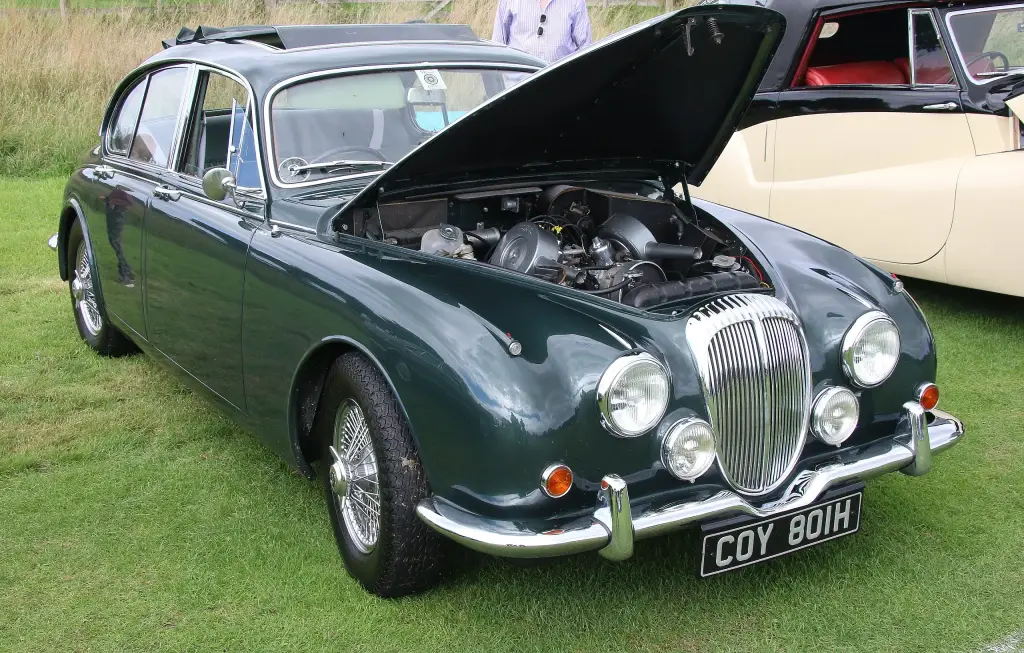
The project began with few resources. The first prototype used an old Jaguar Mark 1 body shell that had been left outside a factory building after suspension experiments; once the idea worked, a new prototype was built on a Mark 2 shell. The Daimler V8 was more compact and about 51 kg lighter than Jaguar’s XK six, so springs and dampers were re-tuned, the sump was reshaped to clear the front suspension and a crossmember, new exhaust manifolds were designed, the water pump and fan were moved, the cylinder-head fasteners were changed from studs to set bolts so the heads could come off in the car, and the fan ran through a viscous coupling that slipped as engine speed rose. The Borg-Warner Type 35 automatic was smaller and lighter than the Mark 2 unit and gave strong engine braking in every range.
The 2.5 V8
Launched late in 1962, the car was essentially a rebadged Mark 2 with Daimler’s engine and drivetrain, a fluted grille and rear number-plate surround, its own wheel trims and badges, a split-bench front seat taken from the Mark 1 and a black enamel steering wheel. Special interior and exterior colours were listed, power steering was fitted to most cars but remained optional, and automatic transmission was standard; a manual gearbox, with or without overdrive, became an option in 1967. In April 1964 the Type 35 automatic gave way to Borg-Warner’s D1/D2 type.
Autocar tested a 2.5-litre saloon with automatic transmission in May 1966: 112 mph, 0–60 mph in 13.6 seconds and 19.0 mpg. The testers found it refined, quiet and well equipped, with efficient if heavy brakes and an engine and gearbox that suited each other, though low-speed torque was poor. At the end of 1965 the final drive had been changed from 4.55:1 to 4.27:1 after complaints that early cars had to exceed their recommended rev limit to reach top speed.
V8-250
From October 1967 the car was renamed V8-250 after a light facelift: slimline bumpers and over-riders shared with the relabelled Jaguar 240 and 340, a negative-earth electrical system, an alternator instead of a dynamo, twin air cleaners, padding over the instrument panel and door cappings, ventilated leather upholstery, reclining split-bench seats and a heated rear window. Production ended in 1969.
Design and features
- Daimler’s own V8: the 2,548 cc Turner engine with hemispherical heads, first seen in the SP250.
- Mark 2 body: the first Daimler with unit construction and no separate chassis.
- Fluted grille: the shell-shaped Daimler grille and rear number-plate surround marked it out from a Jaguar.
- Luxury interior: special colours, a split-bench front seat and a black enamel steering wheel.
- Automatic as standard: manual and overdrive came only in 1967.
Daimler 250 versions
- 2.5 V8 (1962–1967): the original car with the Type 35 automatic.
- 1964 cars: Borg-Warner D1/D2 automatic.
- Manual cars (1967): four-speed gearbox with or without overdrive.
- V8-250 (1967–1969): slimline bumpers, alternator, ventilated leather and a heated rear window.
- Daimler 250: the shorter name used for the same car in later listings.
The V8 came from the Daimler SP250 sports car, and the 250 replaced the Conquest as Daimler’s medium saloon. More cars are in the Daimler collection.
Sources
- Daimler 250, English Wikipedia: development, specifications, Autocar test, V8-250 changes
- Daimler 250 V8, German Wikipedia: production figures, dimensions, performance