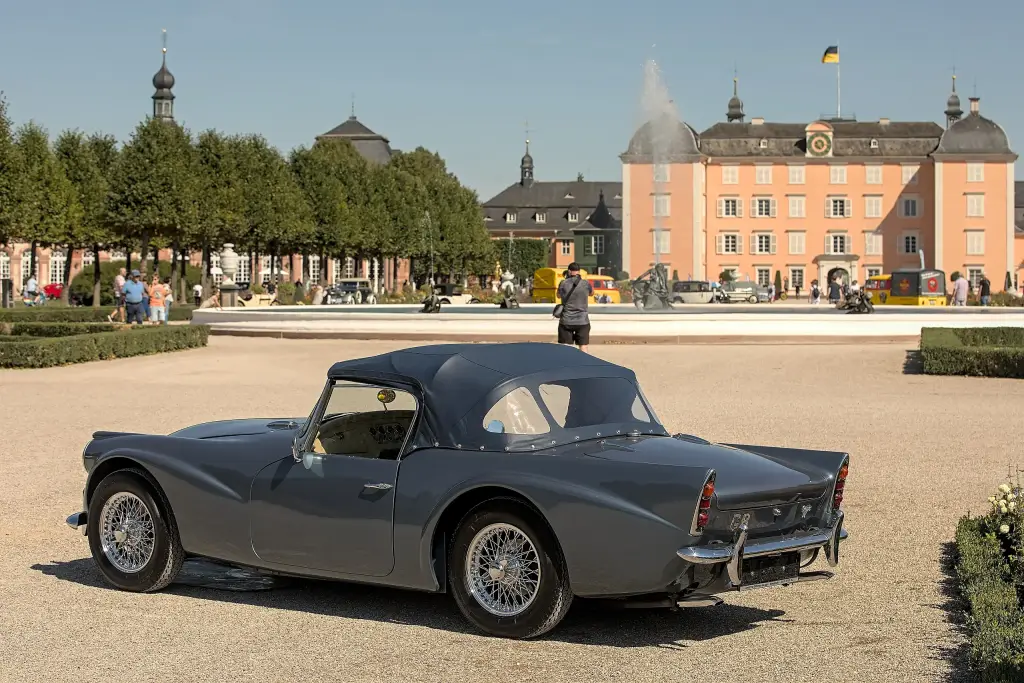
The Daimler SP250 was the last car Daimler launched before BSA sold the company to Jaguar in 1960. A fibreglass-bodied two-seater with Edward Turner’s 2.5-litre V8, four-wheel disc brakes and a top speed near 120 mph, it was quick and distinctive, but its flexible chassis and polarising styling kept it from selling in the numbers Daimler had forecast.
Daimler SP250 at a glance
| Maker | The Daimler Company, Coventry |
|---|---|
| Production | 1959–1964 |
| Body | fibreglass, two-seater roadster, described as a 2+2 |
| Engine | 2,547 cc V8, aluminium hemispherical heads |
| Bore and stroke | 76 × 70 mm |
| Power | 140 bhp at 5,800 rpm |
| Torque | 155 lb·ft at 3,600 rpm |
| Transmission | four-speed manual with overdrive provision; automatic optional |
| Brakes | Girling discs on all four wheels |
| Top speed | 120 mph (193 km/h) |
| Built | about 2,500 |
History of the Daimler SP250
A V8 from Edward Turner
When Edward Turner became managing director of BSA’s automotive division in 1956 he was asked to design a saloon powered by a V8. The engine drawings were finished by March 1958, but the saloon prototype, project DN250, was not ready when a committee was formed that year to judge whether the V8 cars were viable; its assessment centred on the sports car prototypes then running, the SP250. The study expected a profit of more than £700,000 on sales of 1,500 cars in the first year and 3,000 a year in the second and third, with two-thirds of sales in the United States. It also decided the body should be fibreglass: production could start sooner, tooling cost £16,000 against £120,000 for steel, and restyling would be cheaper.
The engine was a V8 of 2,547 cc with a cast-iron block, a single central camshaft working short pushrods, double valve springs and aluminium hemispherical heads, fed by twin SU carburettors at 8.2:1 compression. A stiff five-bearing crankshaft was dynamically balanced. The car had a four-speed gearbox with synchromesh on the top three ratios and provision for overdrive, later also an optional automatic, a 3.58:1 hypoid rear axle, cam-and-follower steering, independent front suspension on coil springs, a live rear axle on half-elliptic springs, and Girling disc brakes on all four wheels.
A-spec, B-spec and C-spec
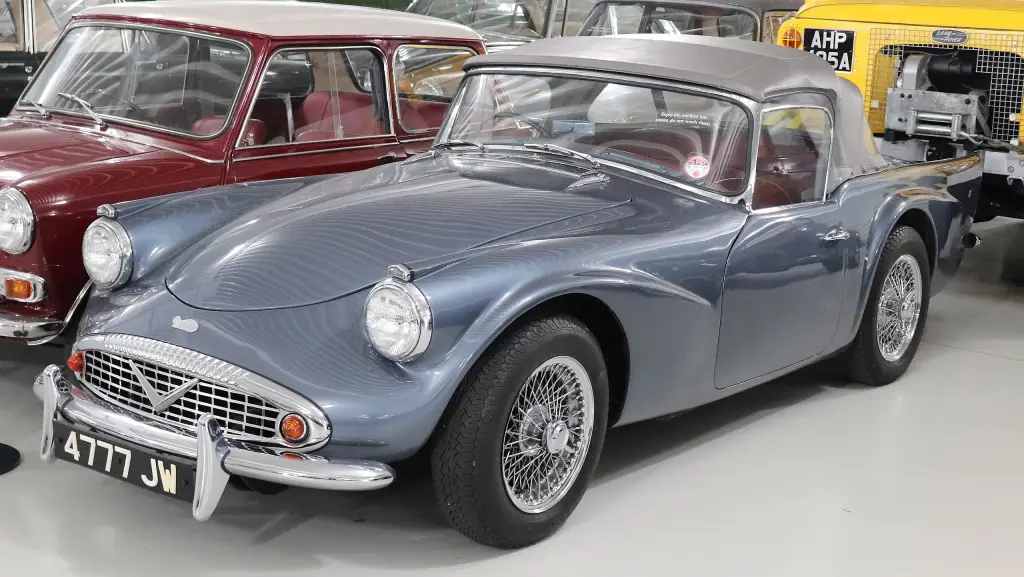
The original A-spec car could reach 120 mph, but its chassis, a 14-gauge ladder frame with cruciform bracing based on the Triumph TR3, flexed so much that the doors occasionally came open, which damaged its reputation. Bumpers were an optional extra, so standard cars had two short chromium “whiskers” beside the front grille and two small over-riders at the rear. The manual gearbox was the first Daimler had used since the pre-selector became standard in the 1930s, and it was reverse-engineered from the Standard gearbox of the Triumph TR3A.
Jaguar bought Daimler in 1960 and was immediately worried by the chassis flex. The B-spec version added outriggers to the frame and a strengthening hoop between the A-posts, along with an adjustable steering column. The C-spec of April 1963 made a trickle-charger socket, a heater and demister unit and a cigarette lighter standard. Daimler also made many features optional because American import duty did not apply to optional extras: wire wheels, whitewall tyres, hard top, bumpers, windscreen washers, heater, fog lights, seat belts and overdrive or automatic were all on the list.
The name and the police
The car was launched as the Daimler Dart at the New York Motor Show in April 1959, where it was unofficially voted the ugliest car at the show. Chrysler, whose Dodge division owned the Dart name, threatened legal action, and with little time to find another name Daimler used the project number, SP250.
Between 26 and 30 black SP250s served with the Metropolitan Police in London, used by the traffic department against speeding motorcyclists. The police chose the Borg-Warner Model 8 three-speed automatic, better for town work and high-speed chases and more economical than a manual car wearing out clutches over 18 to 24-hour days. Bristol, Cambridge, Liverpool, Manchester, Southend and Surrey traffic police used the car, as did forces in Australia and New Zealand, and Bedfordshire police patrolled the new M1 with it from 1959. The German account adds that Ogle Design built the 1962 Ogle SX250 concept on an SP250 base, which later led to the Reliant Scimitar GT.
Design and features
- Turner V8: a 2,547 cc hemi-head V8 of 140 bhp, the engine later used in the Daimler 2.5 V8 saloon.
- Fibreglass body: chosen for cheap tooling and quick restyling, with a top speed of about 120 mph.
- Disc brakes all round: Girling discs with hydraulic operation, unusual for a 1959 British sports car.
- Police favourite: used by the Metropolitan Police and several county forces for traffic patrol.
- Developed into B and C spec: a strengthened chassis and more standard equipment after the Jaguar takeover.
Daimler SP250 versions
- A-spec (1959–1960): the original car with the flexible chassis and “whisker” bumpers.
- B-spec (from 1960): chassis outriggers and an A-post hoop added by Jaguar.
- C-spec (from April 1963): trickle charger, heater and cigarette lighter as standard.
- Police cars: black cars with the Borg-Warner Model 8 automatic.
- Ogle SX250: a 1962 concept on SP250 mechanicals that led to the Reliant Scimitar GT.
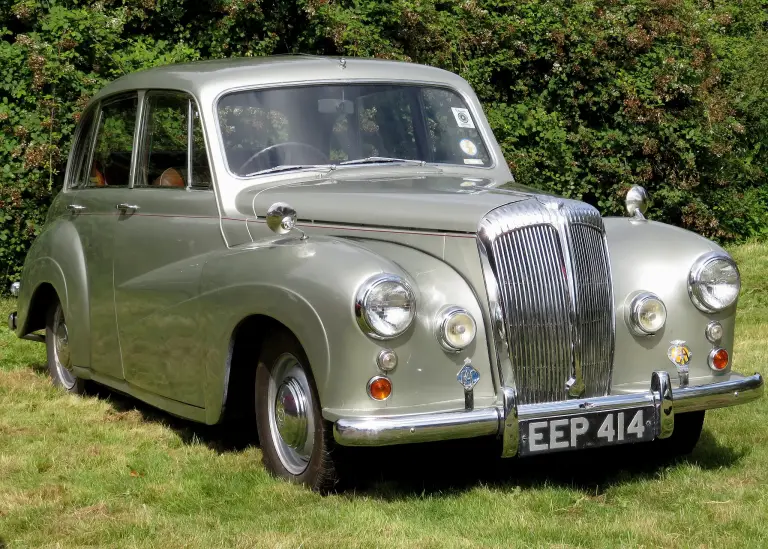
The SP250’s V8 went into the Daimler 250 saloon, and the car was the last Daimler launched before the Jaguar takeover that produced the Sovereign. More cars are in the Daimler collection.
Sources
- Daimler SP250, English Wikipedia: design, specification, options, police use, B and C spec
- Daimler SP 250, German Wikipedia: production total, top speed, Ogle SX250