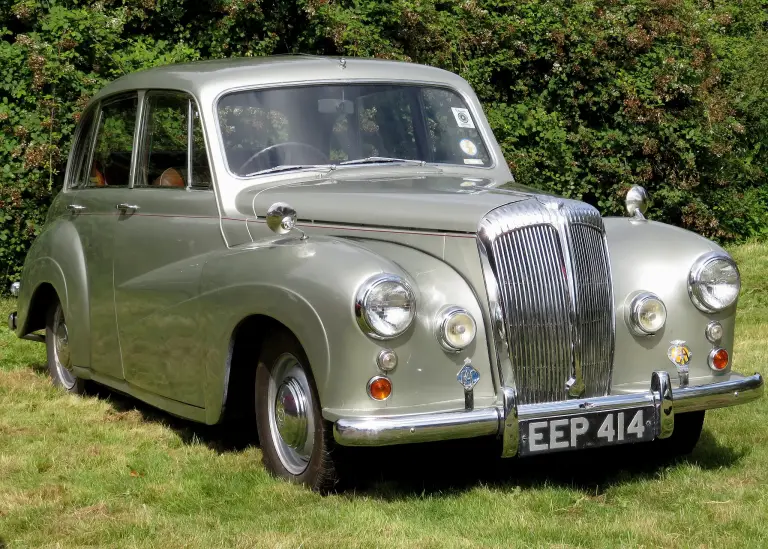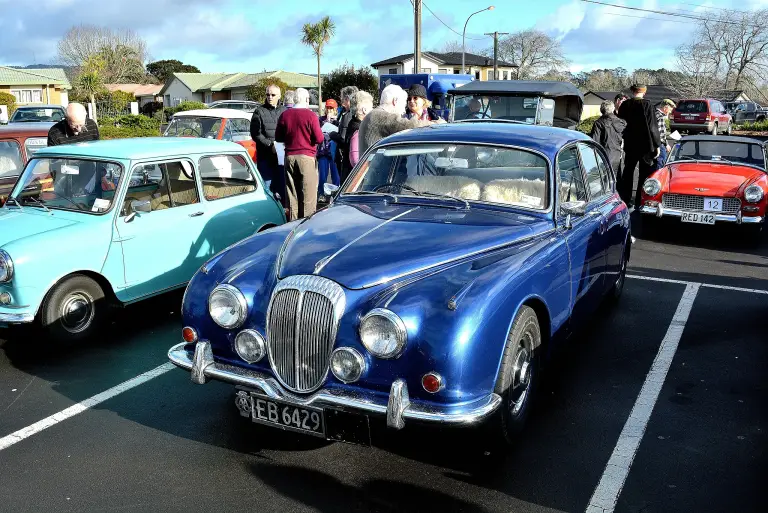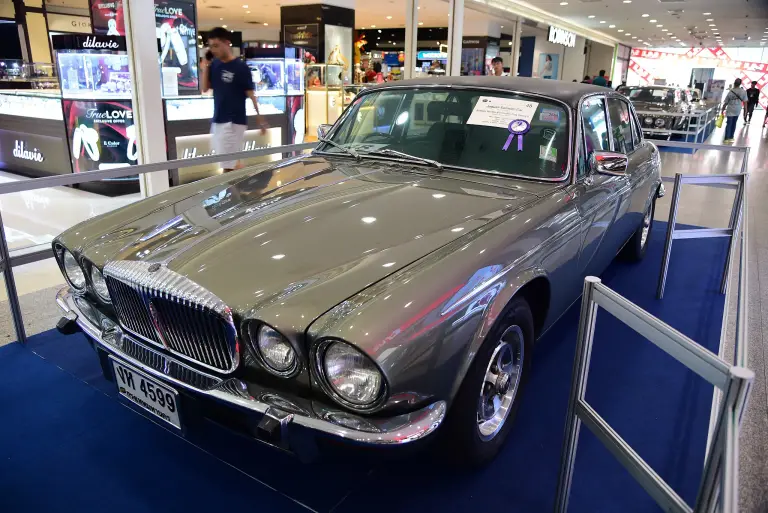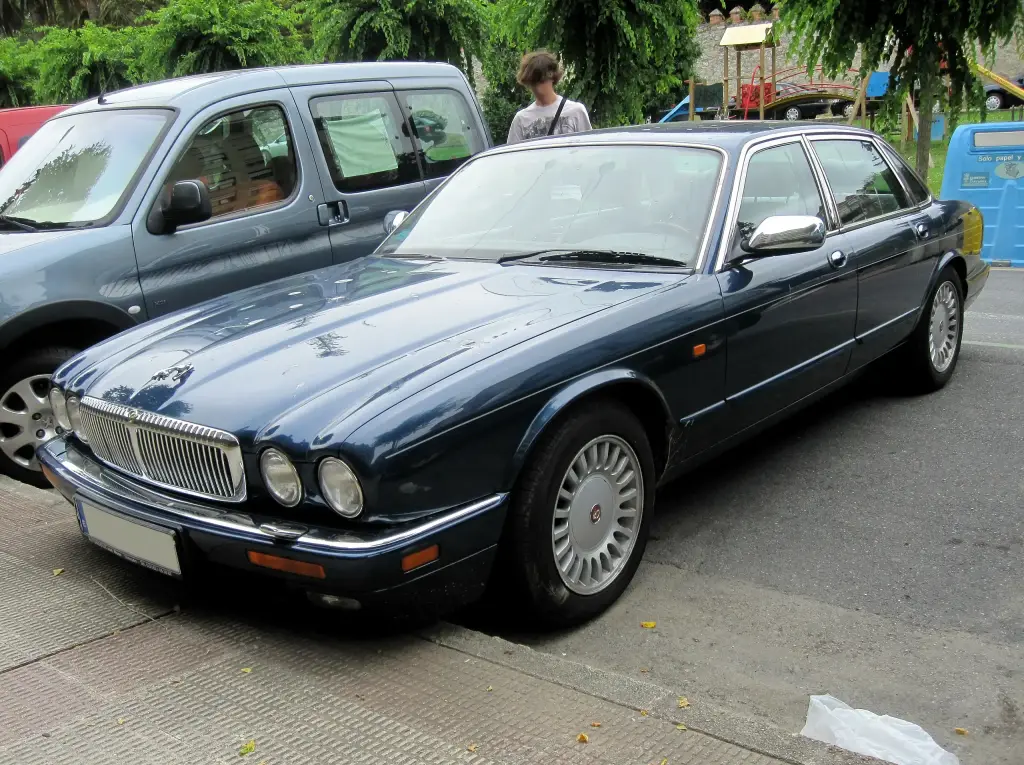
The Daimler Six belongs to the X300 generation of the Jaguar XJ, the full-size luxury saloon Jaguar built from 1994 to 1997. It was the first XJ produced entirely under Ford ownership, the result of a £200 million factory renewal, and it returned to traditional Jaguar styling after the angular XJ40. In Daimler form it was the most luxurious six-cylinder car of the range.
Daimler Six at a glance
| Maker | Jaguar Cars, under the Daimler badge |
|---|---|
| Production | 1994–1997 |
| Generation | X300 |
| Launched | October 1994, Paris Motor Show |
| Engines | AJ16 3.2 and 4.0-litre six; 6.0-litre V12 |
| Gearboxes | ZF 4HP-22 and 4HP-24 automatics; Getrag 290 manual |
| Suspension | Jaguar independent rear suspension |
| Body styles | short and long wheelbase |
| Factory | £200 million renewal under Ford |
| Design lead | Geoff Lawson, 1991 refresh |
Based on one source: the English Wikipedia article on the Jaguar XJ (X300) covers the generation; the Daimler version is described here from its place in that range.
History of the Daimler Six
The X300 generation
The X300 was an evolution of the XJ40 rather than an all-new car. Jaguar had intended to replace the XJ40 with a completely new saloon, the XJ90, using a new V8, but Ford halted that programme and proposed putting its new engine and new front and rear ends onto the centre section of the XJ40. The V8 was not ready in time and did not arrive until the X300’s successor, the X308, so the X300 kept Jaguar’s own engines. In October 1994, at the Paris Motor Show, Jaguar called the car the “New Series XJ”; it was the result of a £200 million facilities renewal by Ford, with automated body-welding robots made by Nissan, intended to show the future direction of the British car industry. The X300 became one of Jaguar’s most successful models.
Styling and interior
The design refresh was led by Geoff Lawson from 1991. The XJ40’s mostly flat bonnet gave way to a fluted, curvaceous shape that set off four separate round headlamps, the rear wings were reshaped for wrap-around light clusters, and the separate black-rubber bumper bar was replaced by a fully integrated body-coloured bumper. The leaping Jaguar mascot was fitted only to cars for non-European markets. Inside, the seats had a more rounded profile, the wood trim gained bevelled edges and the steering wheel was redesigned; early cars had no front passenger glovebox because the new passenger airbag took the space.
Engines and gearboxes
The X300 was offered with Jaguar’s AJ6 inline-six, updated and renamed AJ16, and with the V12, both with distributorless electronic engine management. The V12’s system was designed by Nippon Denso, with two packs of three coils in the valley of the engine, and its crankshaft changed from a forging to a chill casting. The six gained magnesium-alloy valve covers and revised pistons and was also built in 4.0-litre supercharged form for the XJR. Normally aspirated six-cylinder cars used a ZF four-speed automatic, the 4HP-22 on the 3.2-litre and the electronically controlled 4HP-24 on the 4.0-litre, which gave Normal and Sport modes; a Getrag 290 five-speed manual was also listed. The supercharged XJR usually came with the GM 4L80-E automatic, as did every V12 car. North America received no manual gearbox at all.
Ford’s influence was felt more in product development than in parts, according to Automotive News: the traction control system came via the Mondeo programme and the air conditioning was a Nippondenso unit bought through Ford’s purchasing channels. The X300 came in short and long wheelbases and several trim levels. The base XJ6 used the 3.2-litre AJ16 with alloy wheels, leather and air conditioning as extra-cost options, later gaining the 4.0-litre; the Sovereign came with ten-way electric leather seats with three-way memory among its standard equipment. The Daimler version sat at the top of the six-cylinder range, with the fluted Daimler grille and the fullest trim, and the V12 cars were sold as the Double-Six. Production ended in 1997, when the X308 replaced the X300.
Design and features
- Traditional Jaguar styling: a fluted bonnet, four round headlamps and an integrated bumper after the angular XJ40.
- AJ16 six: updated 3.2 and 4.0-litre engines with magnesium valve covers and distributorless ignition.
- Ford-funded factory: a £200 million renewal with automated welding robots.
- Trim hierarchy: XJ6, Sovereign and the Daimler at the top of the six-cylinder range.
- Two wheelbases: short and long, with market-specific equipment lists.
Daimler Six versions
- XJ6: the base model with the 3.2-litre AJ16, later also the 4.0.
- Sovereign: 3.2 or 4.0-litre with ten-way electric memory seats and full equipment.
- Daimler Six: the most luxurious six-cylinder car, with the Daimler grille.
- XJR: supercharged 4.0-litre six, usually with the GM 4L80-E automatic.
- V12 cars: sold as the Daimler Double-Six, all with the GM automatic.
The Daimler Six came after the Daimler XJ40 and alongside the V12 Double-Six, and its place was later taken by later XJ generations. More cars are in the Daimler collection.
Sources
- Jaguar XJ (X300), English Wikipedia: launch, styling, engines, gearboxes, trim levels