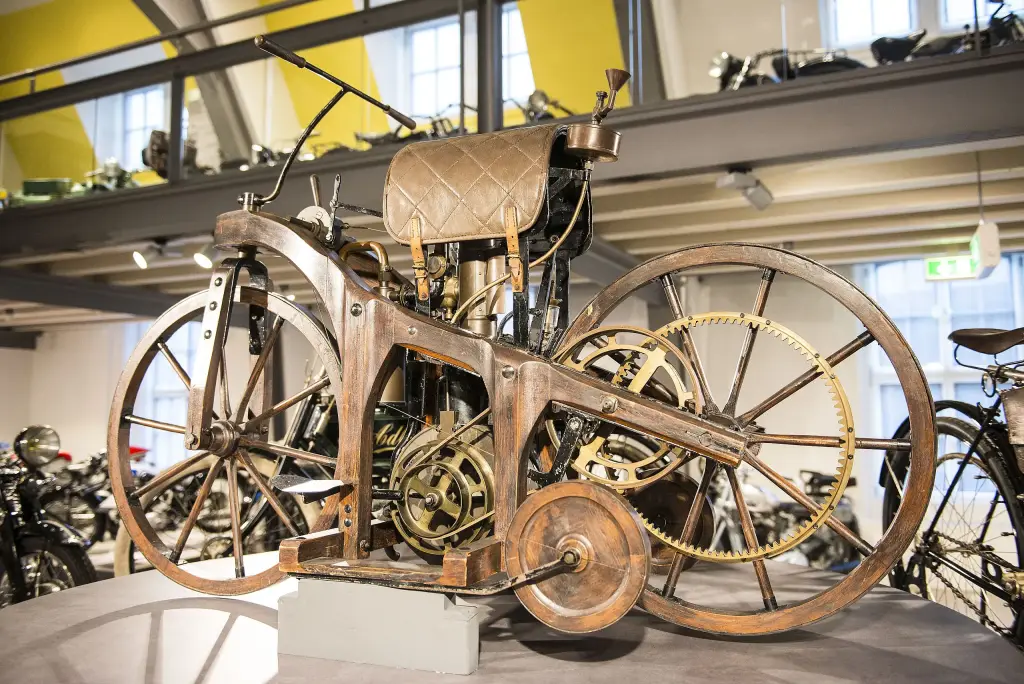
The Daimler Reitwagen, or “riding car”, was built in 1885 by Gottlieb Daimler and Wilhelm Maybach in a workshop behind Daimler’s house in Cannstatt. A two-wheeled frame with small outrigger wheels and a single-cylinder petrol engine, it is widely regarded as the first motorcycle, and it proved the engine that would power cars, boats and aircraft.
Daimler Reitwagen at a glance
| Builders | Gottlieb Daimler and Wilhelm Maybach |
|---|---|
| Year | 1885 |
| Place | Cannstatt, near Stuttgart |
| Also called | Einspur, “single track”, or Petroleum Reitwagen |
| Engine | single-cylinder, “grandfather clock” |
| Ignition | hot-tube, a platinum tube heated by an open flame |
| Carburettor | float metered |
| Crankcase | aluminium |
| Wheels | two, with outriggers for stability |
| Patent | 3 April 1885 |
Based on one source.
History of the Daimler Reitwagen
From Otto to Cannstatt
Gottlieb Daimler visited Paris in 1861 and watched Etienne Lenoir’s first internal combustion engine at work, an experience that served him later when he joined Nikolaus August Otto’s company, N.A. Otto & Cie. By 1872 Daimler was director of that company, the world’s largest engine maker, which had built the first successful gas engine in 1864 and in 1876, under Daimler’s direction and with his plant engineer Wilhelm Maybach, produced the first compressed-charge gas and petroleum engine. The company was renamed Gasmotoren Fabrik Deutz the next year, when the works moved.
Otto had no interest in engines small enough for transport. After a dispute over the direction engine design should take, Daimler left Deutz and took Maybach with him, and the two moved to Cannstatt to work on a high-speed explosion engine. They reached that goal in 1883 with a horizontal cylinder engine running on petroleum naphtha. Otto engines could barely exceed 150 to 200 rpm and were not designed to be throttled; Daimler wanted at least 600 rpm so that an engine could power any kind of vehicle. The 1884 vertical-cylinder version, known as the grandfather clock engine, reached 700 rpm and soon 900, made possible by hot-tube ignition developed by an Englishman named Watson, since the electrical systems of the day were too unreliable and too slow.
The riding car
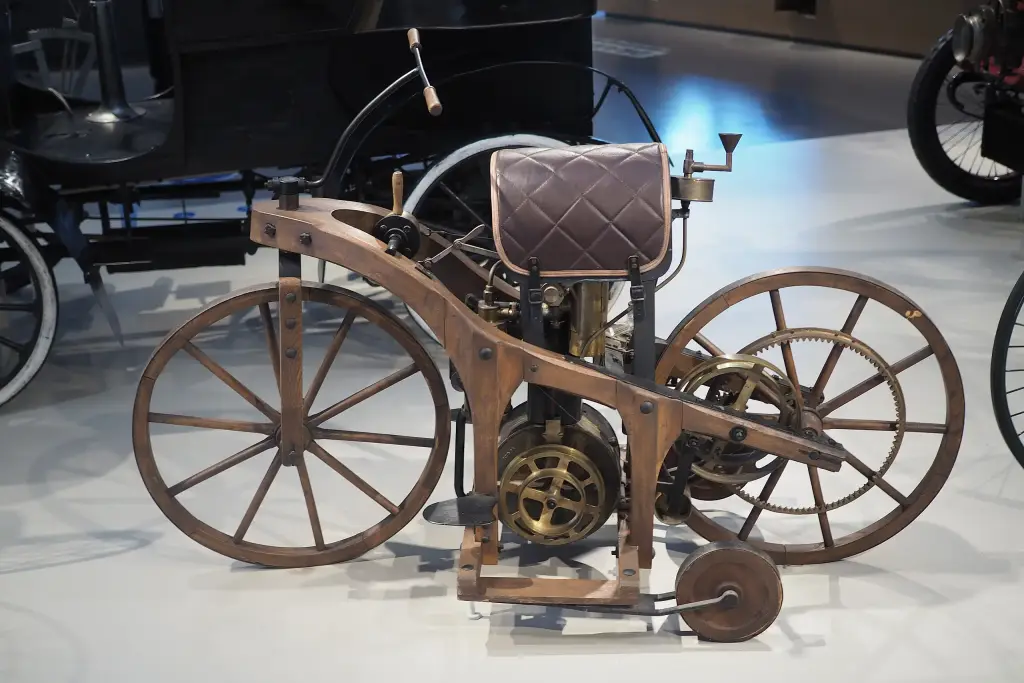
With an engine small and fast enough, Daimler and Maybach built the 1884 unit into a two-wheeled test frame patented as the Petroleum Reitwagen. The engine had a float-metered carburettor, mushroom inlet valves opened by piston suction, hot-tube ignition using a platinum tube running into the combustion chamber and heated by an external flame, twin flywheels and an aluminium crankcase; it could also run on coal gas. The aim was to learn what the engine could do in a vehicle rather than to create a motorcycle: the Reitwagen was a test bed on the way to Daimler’s real goal, a four-wheeled car.
Was it the first motorcycle?
The claim depends on whether a motorcycle must have an internal combustion engine, which is the Oxford English Dictionary’s criterion. Even then, the use of outrigger wheels instead of two raises doubts: accepted as stabilisers, they point to the machine needing training wheels because it did not use the rake and trail already understood by bicycle designers. Motoring author David Burgess-Wise called the Daimler-Maybach “a crude makeshift” and said that “as a bicycle, it was 20 years out of date”. Cycle World’s technical editor Kevin Cameron argues the opposite, that steam power was a dead end and the Reitwagen was the first motorcycle because it used the engine type that succeeded: “History follows things that succeed, not things that fail.”
Steam two-wheelers had come earlier, the Michaux-Perreaux and Roper machines of 1867–1869 and the Copeland of 1884, and Enrico Bernardi’s 1884 petrol tricycle, the Motrice Pia, is treated by a few sources as the first petrol-powered motorcycle. Bernardi mounted his engine on his son’s tricycle, while Daimler designed and built a chassis to suit his engine, which is why the Reitwagen is counted as the first complete motorcycle; the Motrice Pia appears in no mainstream source. Whatever the arguments, it was the Reitwagen that inspired later designs and started the motorcycle industry, and Daimler has been called the father of the motorcycle ever since.
Design and features
- Grandfather clock engine: a fast single-cylinder of 1884 with an aluminium crankcase and twin flywheels.
- Hot-tube ignition: a platinum tube heated by an open flame, because electric ignition was too slow.
- Outriggers: small stabiliser wheels that make its status as a true two-wheeler debatable.
- A test bed, not a product: built to prove the engine for a future four-wheeled car.
- Starting point: the machine that inspired later designs and began the motorcycle industry.
Daimler Reitwagen versions
- 1883 horizontal engine: the first Daimler-Maybach high-speed engine, on naphtha.
- 1884 grandfather clock engine: the vertical unit that went into the Reitwagen.
- Petroleum Reitwagen: the patented two-wheeled test frame of 1885.
- Replicas: several modern copies are shown in museums, including Hockenheim.
The engine work behind the Reitwagen led to the cars of the Daimler collection, and the same firm’s later Double-Six revived a name from its V12 history.
Sources
- Daimler Reitwagen, English Wikipedia: status as first motorcycle, development, engine details