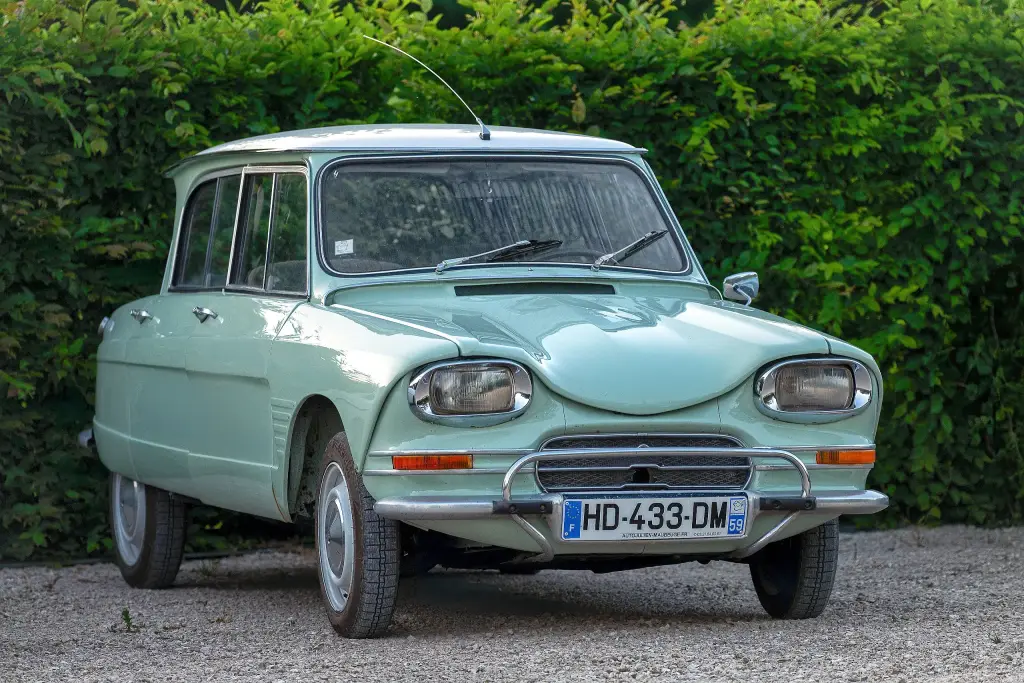
The Citroën Ami is an economy car made from 1961 to 1978 in two generations, the Ami 6 and the Ami 8. It was a family car, front-wheel drive, built as a saloon and as an estate, and over its life 1,840,396 were manufactured.
Citroën Ami at a glance
| Maker | Citroën, France |
|---|---|
| Production | 1961–1978 |
| Generations | Ami 6, Ami 8 |
| Launched | 25 April 1961 in France |
| Nickname | 3CV, from its three fiscal horsepower |
| Engine | air-cooled 602 cc flat twin |
| Layout | front-wheel drive, platform chassis from the 2CV |
| Bodies | saloon and estate (Break) |
| Flat-four version | Ami Super, also called Ami 10, 1973–1976 |
| Built | 1,840,396 |
| Replaced by | Citroën Visa and Citroën Axel |
Based on one source (English Wikipedia).
History of the Citroën Ami
1961: a bigger, less rustic 2CV
The Ami had its formal French launch on 25 April 1961, four months before the Renault 4 arrived. Both cars answered the same need for something slightly larger and less rustic than the 2CV. The Ami was a rebodied 2CV with mechanical upgrades, above all a larger engine to compensate for the extra weight: at launch every car used an air-cooled 602 cc flat twin, an engine that would also be offered at extra cost in the 2CV from 1970. Its engine capacity sat fractionally above the limit for the 2CV designation, so the car was nicknamed the 3CV — three fiscal horsepower — to distinguish it from the 2CV. The platform and the independent suspension with leading and trailing arms and front-to-rear interconnected springs came straight from the 2CV, and the seats were easily removable, with sales material showing them used as picnic chairs.
The Ami 6 and its rear window
The 1961 Ami 6 saloon is recognised by its reverse-raked notchback rear window, a shape similar to the Ford Anglia 105E of 1959. In the American cars that inspired it, the opening rear window had been a way of ventilating the cabin before air conditioning became standard; on the Ami it was simply a striking piece of styling. The Ami and the Ford Taunus P3 were the first cars with rectangular, non-round headlights, developed with Cibie for the Citroën and Hella for the Ford.
Sales and the Ami 8
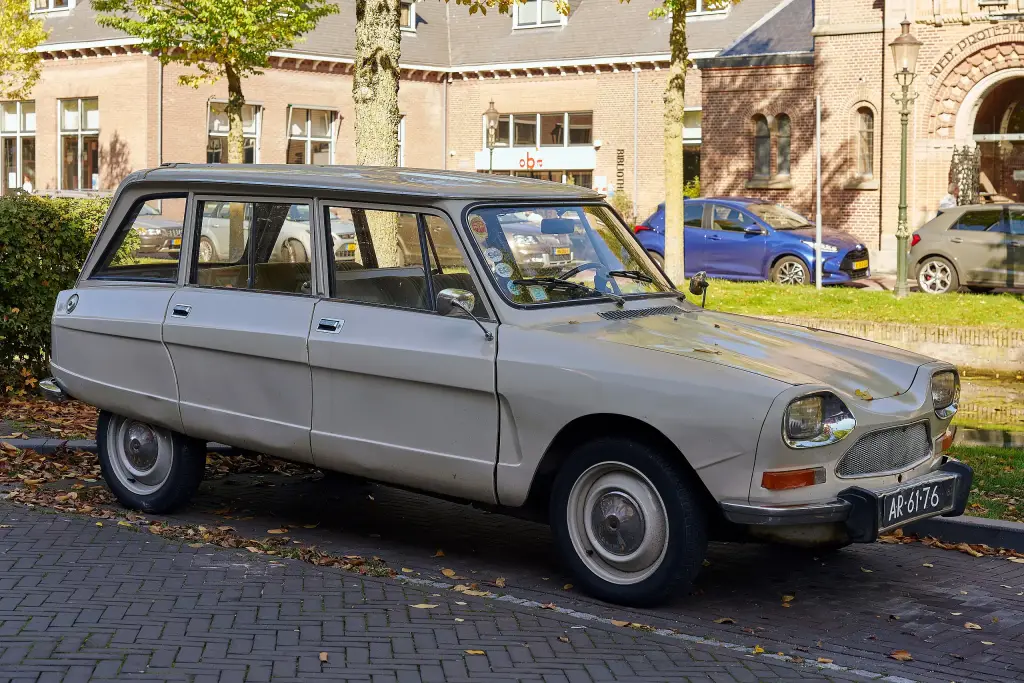
Sales were slower than the 2CV’s: in 1962, the Ami’s first full year, 85,358 were sold against 144,759 2CVs, and the Ami’s modern body sat on such minimalist underpinnings that its price at the end of 1961 was 35% higher. The later Ami 8 saloon replaced the reverse-raked window with a fastback, redesigned by the French bodywork company Heuliez, with a new front and bonnet; the estate version, the Break, kept a general appearance close to the Ami 6, with the tail lights integrated into the rear wings.
Ami Super: the quiet fast one
The Ami Super, sometimes called the Ami 10, was a flat-four variant powered by the engine of the GS and built between 1973 and 1976. It came in the same Luxe, Confort and Club trim levels as the Ami 8, the Club being the most luxurious with sound proofing, carpet and stainless window trim. With 55 hp against 32 hp for the Ami 8, it could surprise much bigger cars — Autocar called it a “Q car par excellence” — but in France its 5CV tax rating made little sense in a small car and sales stayed low, though production still reached close to 42,000. The Ami and the Dyane were eventually replaced by the Visa and the Axel.
Design and features
- 2CV underneath: platform chassis and interconnected independent suspension carried over.
- 602 cc flat twin: the engine that later became an option in the 2CV itself.
- Rectangular headlights: the Ami and the Ford Taunus P3 were the first cars to use them.
- Removable seats: they doubled as picnic chairs in Citroën’s own advertising.
- Ami Super: the GS’s flat four in a small body, 55 hp instead of 32.
Citroën Ami versions
- Ami 6 saloon (1961): reverse-raked notchback rear window.
- Ami 6 Break: the estate version.
- Ami 8 (from 1969): fastback body redesigned by Heuliez.
- Ami 8 Break: estate with tail lights in the rear wings.
- Ami Super / Ami 10 (1973–1976): flat-four engine from the GS.
- 3CV: the nickname, and the badge used on cars built in Argentina.
The Ami was a rebodied 2CV and the stablemate of the Dyane; both were replaced in the range by the Visa. More cars are in the Citroën collection.
Video: Driving a Citroën AMi8 Break 1972
Video by Kjell Kriminell on YouTube.
Sources
- Citroën Ami, English Wikipedia: launch, engines, Ami 6 and Ami 8 bodies, Ami Super, production