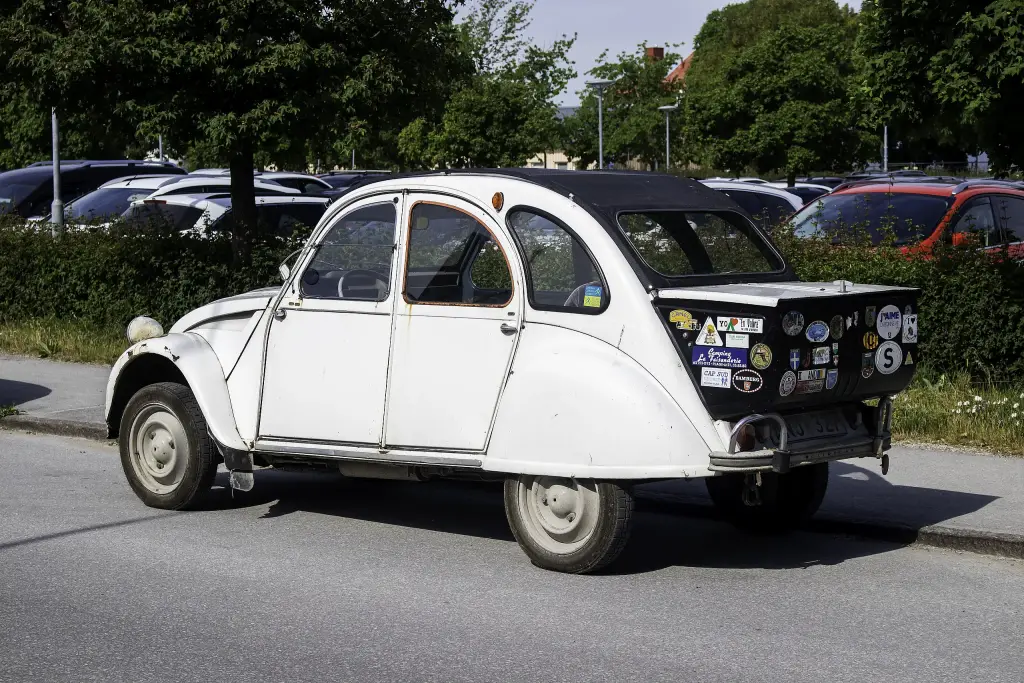
The Citroën 2CV was an economy car built from 1948 to 1990 and introduced at the 1948 Paris Salon. Its air-cooled engine sits in the front and drives the front wheels, and its body was designed to be as cheap and as simple as a car could be.
Citroën 2CV at a glance
| Maker | Citroën, France |
|---|---|
| Production | 1948–1990 |
| Engine | air-cooled flat twin, 9 hp (6.6 kW) at launch |
| Layout | front engine, front-wheel drive |
| Wheelbase | 2,400 mm (94.5 in) |
| Roof | full-width canvas, roll-back |
| Suspension | long-travel, front and rear interconnected |
| Tyres | Michelin radial, introduced with the car |
| Built | more than 3.8 million |
| Family | A-Series: 2CV, Ami, Dyane, Acadiane, Méhari |
Based on one source (English Wikipedia).
History of the Citroën 2CV
1936–1939: the TPV project
The car began as a design brief, not a sketch. In 1934 the Michelin family, Citroën’s largest creditor, took over the bankrupt company and commissioned a market survey; the answer was a cheap, rugged “umbrella on four wheels” that would let four people carry 50 kg of farm goods to market at 50 km/h, across muddy roads, using no more than 3 L/100 km. Vice-president Pierre-Jules Boulanger sent the brief to the team that had created the Traction Avant, and the Toute Petite Voiture, the “very small car”, was developed in secrecy at Michelin’s Clermont-Ferrand works and in Paris. Engineer André Lefèbvre, a former Grand Prix designer, was put in charge of the chassis. The first prototypes had no bodywork to speak of, and their test drivers wore leather flying suits. By the end of 1937 twenty had been built; by 1939, after 47 technically different prototypes, the car was judged ready. The seats were hammocks hung from the roof, and the suspension, designed by Alphonse Forceau, used eight torsion bars under the rear seat with an overload bar that came into play with three people aboard.
1948: the launch
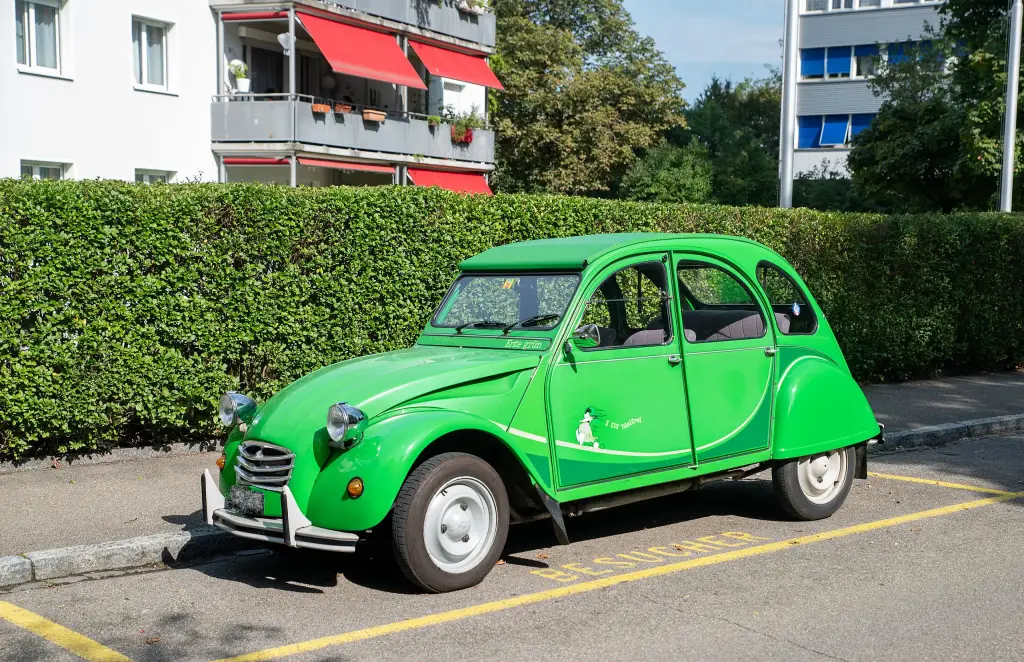
The war intervened, and the 2CV reached the public only at the 1948 Paris Salon. It arrived with a canvas roof that ran the full width of the body and rolled back, and until 1955 that roof stretched over the boot almost to the rear bumper, so that oversized loads could be carried standing up. Michelin used the car to introduce and commercialise its radial tyre. The press was impressed: a 1953 technical review in Autocar called the design “undoubtedly the most original since the Model T Ford”, and L. J. K. Setright later described the 2CV as “the most intelligent application of minimalism ever to succeed as a car”.
One generation for four decades
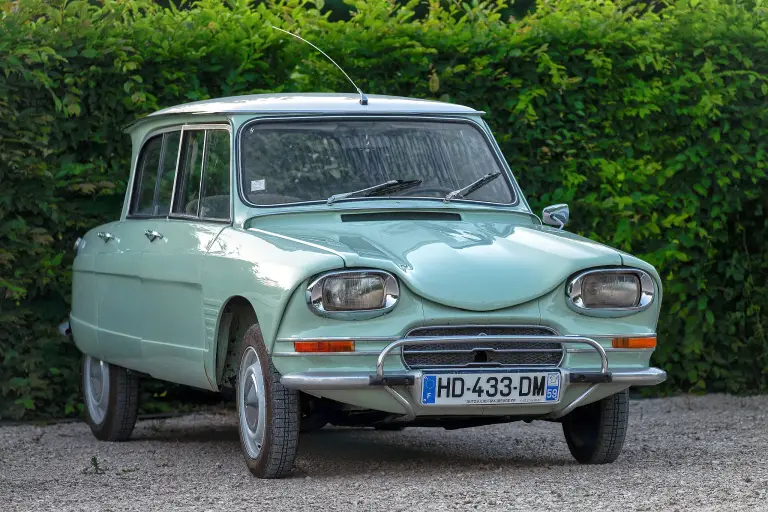
The 2CV stayed in production, essentially as one generation, for more than forty years — a feat it shares with the Volkswagen Beetle, which was conceived in the same years and also ran into the late 1980s on a 2,400 mm wheelbase with an air-cooled engine at the driven end. The two cars followed parallel logic: a platform chassis that made derivative models cheap to build, and running gear simple enough for a farmer to service. The 2CV platform produced the fourgonnette delivery vans, and then the Ami, the Dyane, the Acadiane and the Méhari; in total Citroën built more than 9 million 2CVs and their derivatives.
The end of the line
Production stopped in 1990. A prototype called the 2CV 2000 was developed in the late 1990s, but it never went into production. By then the car had become a European icon: The Globe and Mail called it “a car like no other” in 2011, and surviving cars are kept as everyday transport rather than as museum pieces.
Design and features
- Air-cooled flat twin: 9 hp at launch, mounted in front, driving the front wheels.
- Long-travel suspension: front and rear axles linked by torsion bars, soft enough for a ploughed field with a basket of eggs aboard.
- Canvas roll-back roof: full width, so that tall loads could be carried standing up; it covered the boot until 1955.
- Michelin radial tyres: the new tyre design was introduced and first sold on the 2CV.
- Frugality: the brief asked for no more than 3 L/100 km, and the production car was famous for close to it.
Citroën 2CV versions
- 2CV saloon: the standard car with the canvas roof.
- Fourgonnette: the 2CV-based delivery van.
- A-Series derivatives: Ami, Dyane, Acadiane and Méhari, all built on the same platform.
- Charleston, Club and Special: the trim versions that gave the car its late-life colours and equipment.
The 2CV was the root of the whole A-Series, which is why its Ami, Dyane and Méhari relatives have articles of their own. The 2CV replaced nothing less than the Traction Avant at the bottom of the Citroën range. More cars are in the Citroën collection.
Sources
- Citroën 2CV, English Wikipedia: design brief, prototypes, engineering, production, quotations