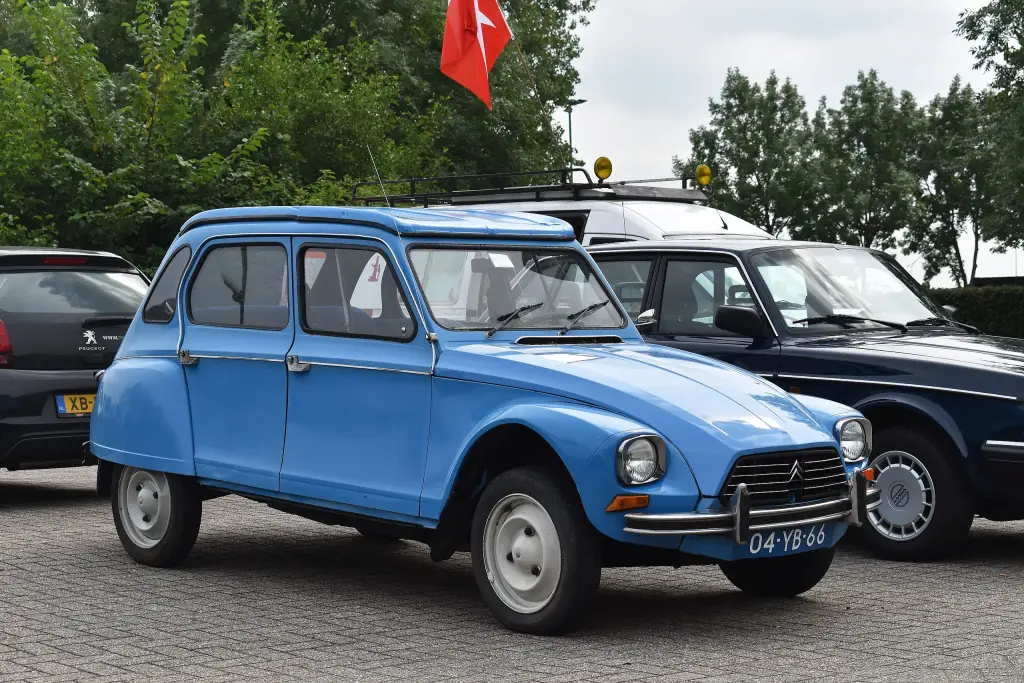
The Citroën Dyane is an economy family car produced from 1967 to 1983. Its design stayed almost completely based on the Citroën 2CV and its underpinnings, but it received almost all-new body panels with straighter, more angular features, a large hatchback at the rear and front wings that integrated the headlights.
Citroën Dyane at a glance
| Maker | Citroën, France |
|---|---|
| Production | 1967–1983 |
| Launched | August 1967 in France |
| Based on | Citroën 2CV, with new body panels |
| Original engine | 425 cc air-cooled flat twin |
| Dyane 6 | 602 cc, 28 bhp, 115 km/h, from January 1968 |
| Dyane 4 | 435 cc, 26 bhp, 105 km/h, from March 1968 |
| Body | hatchback, with integrated round headlights |
| Trim levels | Luxe and Confort |
| Built | nearly 1.45 million, plus 250,000 Acadianes |
| Van version | Citroën Acadiane |
Based on one source (English Wikipedia).
History of the Citroën Dyane
An answer to the Renault 4
The Dyane was a development of the 2CV, intended as an answer to the Renault 4, which after its launch in 1961 had eaten into 2CV sales. Like the Renault 4, it was designed from the start as a hatchback, with conventional round headlamps set into the front wing inside a squared stainless steel trim ring, rather than the separate old-fashioned units of the 2CV, and stainless steel wheel embellishments as standard. It is often said that the Dyane was meant to replace the 2CV, but it was actually aimed slightly higher, between the 2CV and the Ami, and attracted different buyers who wanted the versatility of a hatchback.
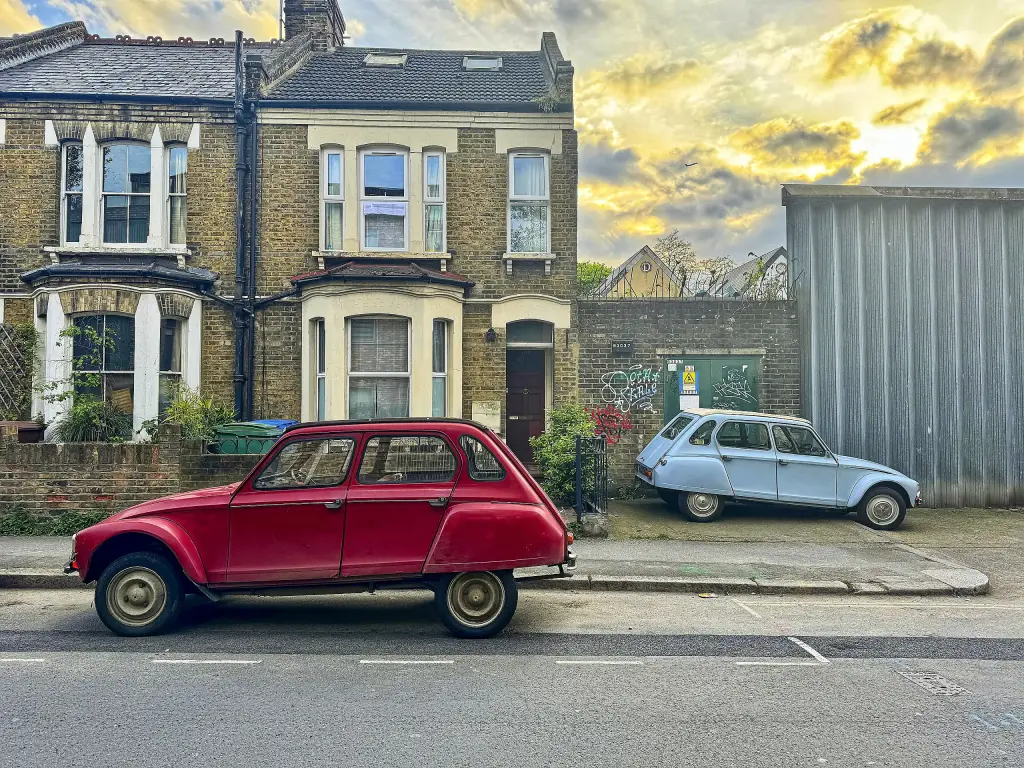
Drawn by Panhard
At the time the Citroën design department was busy with updates of the DS and the Ami, so the Dyane was first subcontracted to the Panhard design department, whose non-military business had been absorbed into Citroën in 1965. The Panhard team under Louis Bionier, who had designed every Panhard model from the late 1920s to the mid-1960s, produced a proposal that proved controversial in detail with Citroën’s design chief Robert Opron and was significantly reworked before launch. The Panhard link is also in the name: Panhard had registered Dyane along with Dyna, Dynavia and Dynamic.
Equipment and engines
At launch the car came in two levels, the basic Luxe and the better-equipped Confort, which was recognisable outside by its wheel hub caps. The spare wheel and jack sat in a cradle under the bonnet rather than loose in the luggage area, the Confort had moulded plastic door panels instead of vinyl-covered hardboard, and its steering wheel was less rustic than the one the Luxe shared with the 2CV; the Confort cost 615 francs more in 1967, just over 10%. The Dyane went on sale in France in August 1967, and for the first five months it used only the 2CV’s 425 cc engine. The Dyane 6 was announced at the Brussels Motor Show in January 1968 with the Ami’s 602 cc engine, 28 bhp and a claimed 115 km/h against 21 bhp and 100 km/h at launch. Two months later the 425 cc unit was replaced in the Dyane 4 by an improved 435 cc engine of 26 bhp and 105 km/h. In September 1968 the 602 cc engine was improved again with higher compression pistons and fan-fed induction.
Life and death
The engine stayed famously easy to work on: cylinder heads held by three studs, barrels slipped over the pistons, no head gasket, and wings that unbolted in minutes, so the top end could be rebuilt with a few tools. The ignition fired both cylinders at once, wasting a spark, and plugs were often changed at 6,000 miles. The Dyane was retired after more than fifteen years, with nearly 1.45 million built and some 250,000 Acadiane vans on top, but its predecessor, the 2CV, kept going and outlived the car meant to succeed it.
Design and features
- Hatchback body: the practical rear opening the 2CV never had.
- Integrated headlights: round lamps set into the wings with stainless trim rings.
- Panhard design: drawn by Louis Bionier’s team and reworked by Robert Opron.
- Two trim levels: Luxe and Confort, the latter with hub caps and a better interior.
- Easy engine work: three studs per head and no head gasket.
Citroën Dyane versions
- Dyane (1967): 425 cc, 21 bhp.
- Dyane 6 (January 1968): 602 cc, 28 bhp, 115 km/h.
- Dyane 4 (March 1968): 435 cc, 26 bhp, 105 km/h.
- Luxe and Confort: the two trim levels.
- Acadiane: the panel van derived from the Dyane.
The Dyane came from the 2CV and produced the Acadiane, and it sat below the Ami in the range. More cars are in the Citroën collection.
Video: Citroen Dyane 6 Test
Video by alteisenfahrer chevyfahrer on YouTube.
Sources
- Citroën Dyane, English Wikipedia: design, Panhard link, equipment, engines, production