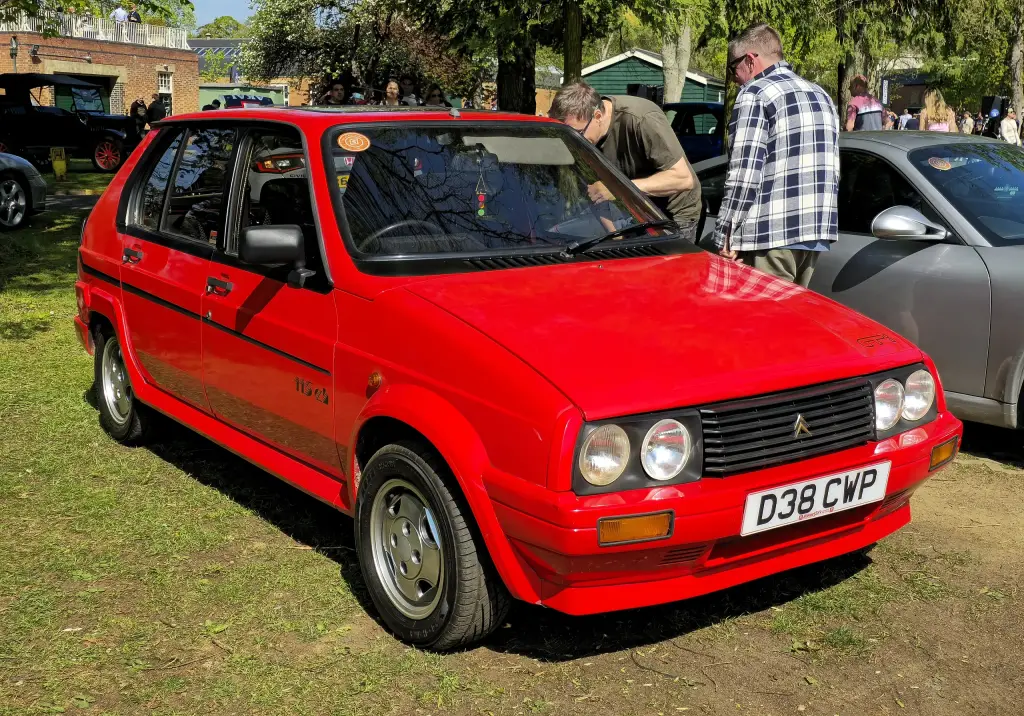
The Citroën Visa is a supermini built and marketed from 1978 to 1988, with a front engine and front-wheel drive and two body styles: a five-door hatchback and a four-door semi-convertible. Some 1,254,390 examples were made over a single generation with a single facelift in 1981.
Citroën Visa at a glance
| Maker | Citroën, France |
|---|---|
| Production | 1978–1988 |
| Built | 1,254,390 |
| Bodies | five-door hatchback, four-door semi-convertible |
| Platform | Peugeot 104 floorpan and powertrain |
| Engines | 652 cc flat twin; 954, 1,124, 1,219 and 1,360 cc fours; 1,769 cc diesel |
| Facelift | 1981 |
| Sporting model | Visa GT with 80 PS |
| Diesel | 17D and 17RD with the XUD engine from 1984 |
| Convertible | Décapotable by Heuliez, 1984 |
| Compact van | the C15, built from 1985 to 2005 |
Based on one source (English Wikipedia).
History of the Citroën Visa
From Project Y to the Visa
In 1965 Robert Opron began work on the Citroën G-mini prototype and project EN101, a replacement for the 2CV using its flat twin and intended for 1970; the advanced, compact designs with a drag coefficient of 0.32 were never fully developed because of negative feedback from potential customers. The Citroën Prototype Y followed in the early 1970s in cooperation with Fiat, using the Fiat 127 platform with its transverse front-engine, front-wheel-drive layout. When the Fiat cooperation ended Citroën designed its own platform, and after Peugeot took over Citroën in the wake of the 1974 oil crisis, the renamed Projet VD became the Visa, with the Peugeot 104 floorpan, engine, transmission and chassis. It was the first model under PSA Peugeot Citroën’s platform-sharing policy.
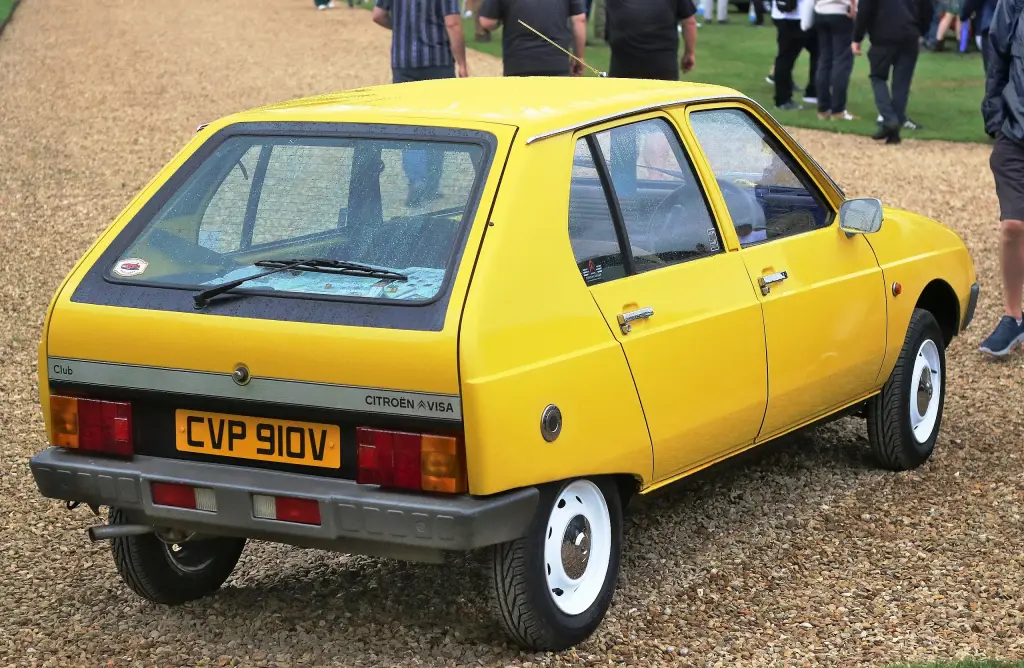
Engines from twins to Douvrin fours
From its launch in September 1978 the Visa came as the Spécial and Club with a mapped electronic ignition 652 cc two-cylinder, and as the Super E, the 11RE after 1984, with the advanced 1,124 cc Douvrin four — an all-alloy, chain-driven overhead-cam “suitcase engine” with the gearbox in the sump sharing engine oil. The twin was mounted longitudinally and the fours transversally. Later came 1,219 cc (Super X), 954 cc (10E after 1984) and 1,360 cc versions, the last used in the 1983 Visa GT and the 14TRS from 1985. The original engines, of Peugeot origin, were modified by Citroën engineers for economy and response, with limited results, and by the time of the 1.4 the units were taken from Peugeot unchanged.
Suspension, GT and diesel
The Visa had soft, well-damped, long-travel fully independent suspension — coil-sprung MacPherson struts at the front and coil-sprung trailing arms at the rear — giving a ride close to the 2CV’s with less body roll. For 1983 the Super E GL brought more equipment and a redesigned two-piece rear seat whose halves could be removed without tools. The 1983 Visa GT was the most powerful yet, with an 80 PS engine, alloy wheels on Michelin TRX tyres, spoilers, sideskirts and a more sporting suspension than was usual for Citroën. In early 1985 the limited Visa 14 S Tonic used the GT’s engine and transmission with an all-white appearance at little more than the price of an 11 RE; only 2,000 were made. In spring 1984 the diesel arrived: the 17D and 17RD used the 1,769 cc XUD engine and transmission from the Peugeot 205, which needed such a wide track that the front wings were extended with large black plastic arch panels.
Other bodies and the end
Citroën commissioned Heuliez to build a convertible, marketed as the Décapotable in 1984, and a box van version sold from 1985 to 2005 as the Citroën C15. A saloon was prototyped but never made. The car was also assembled in China as the Liuzhou Wuling LZW 7100 minicar from 1991 to 1994, and the original Citroën platform from Project Y finally emerged in Romania as the Oltcit Club, sold in Western Europe as the Citroën Axel.
Design and features
- PSA platform sharing: the first Citroën built on Peugeot 104 mechanicals.
- Two body styles: a five-door hatchback and a four-door semi-convertible.
- Douvrin four: the all-alloy suitcase engine with the gearbox in the sump.
- Visa GT: 80 PS, TRX tyres, spoilers and a firmer chassis.
- 17D diesel: the XUD engine with widened front wings to fit it.
Citroën Visa versions
- Spécial and Club: 652 cc flat twin with electronic ignition.
- Super E / 11RE: 1,124 cc Douvrin four.
- Super X and 10E: 1,219 cc and 954 cc versions.
- GT (1983): 1,360 cc, 80 PS.
- 14 S Tonic (1985): 2,000 cars, all white.
- 17D and 17RD (1984): 1,769 cc XUD diesel.
- Décapotable (1984): the Heuliez convertible.
The Visa replaced the Ami and LNA and was replaced by the AX; its van version is the C15. More cars are in the Citroën collection.
Sources
- Citroën Visa, English Wikipedia: development, engines, suspension, GT and diesel, other bodies