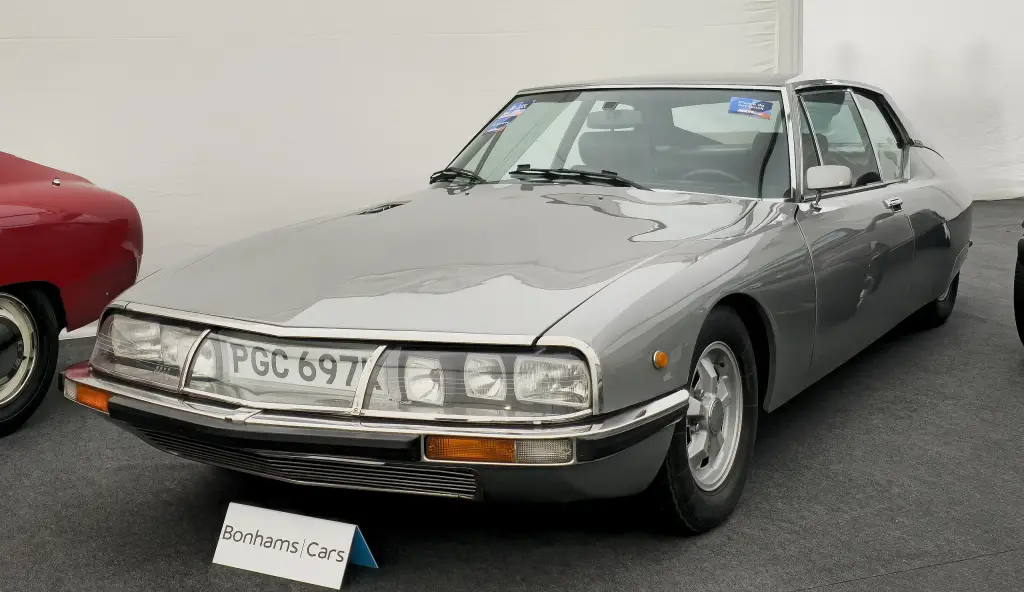
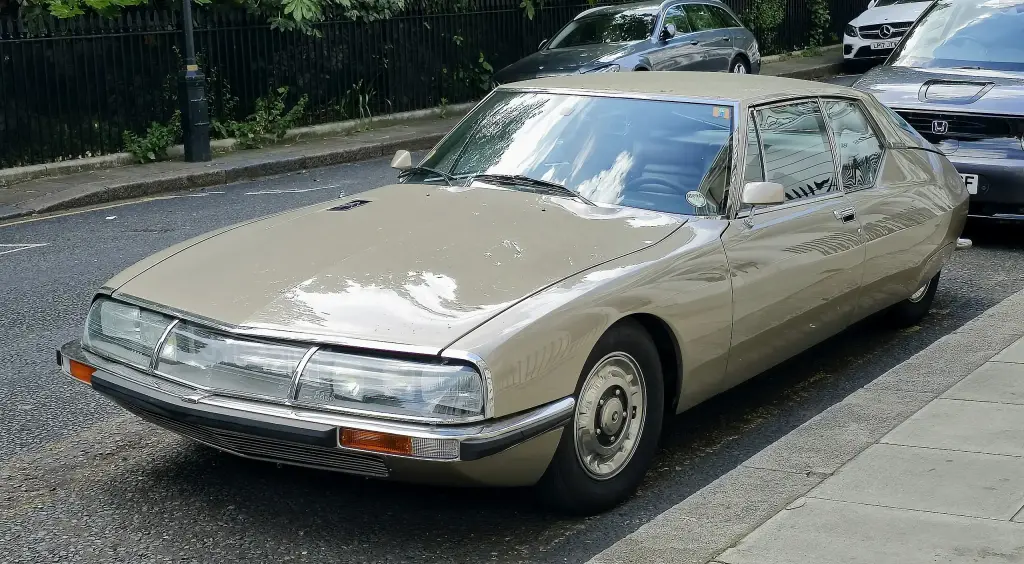
The Citroën SM is a high-performance coupé produced from 1970 to 1975. It placed third in the 1971 European Car of the Year contest behind its stablemate the Citroën GS, and won the 1972 Motor Trend Car of the Year award in the United States.
Citroën SM at a glance
| Maker | Citroën, France |
|---|---|
| Production | 1970–1975 |
| Shown | Geneva Motor Show, March 1970 |
| On sale in France | September 1970 |
| Engine | Maserati V6, 2.7 litres |
| Power | 170 PS (125 kW) |
| Suspension | hydropneumatic, self-levelling |
| Steering | DIRAVI, fully powered and speed-sensitive |
| Headlights | self-levelling, swivelling with the steering |
| Fuel tank | 90 litres |
| Award | Motor Trend Car of the Year 1972 |
Based on one source (English Wikipedia).
History of the Citroën SM
Project S and Maserati
In 1961 Citroën began work on Project S, a sports variant of the DS. Over nine years the project grew from a faster DS into an entirely new car, in engineering effort a replacement for the high-volume DS. Citroën bought Maserati in 1968 to harness its engine technology and build a true Gran Turismo combining Citroën suspension with a Maserati V6. The result was first shown at the Geneva Motor Show in March 1970 and went on sale in France that September. All factory cars were left-hand drive, though right-hand-drive conversions were done in Britain and Australia.
A French car in a class France had lost
The SM was unusual for France, where production of luxury cars had been heavily restricted since the war by the puissance fiscale horsepower tax, and the country had not had a production car in that sector since before 1939. The engine was only 2.7 litres because of those rules, and the SM competed with GTs from Jaguar, Ferrari, Aston Martin, Alfa Romeo, Mercedes-Benz, Porsche and Maserati’s own Merak. Even the name is uncertain: the S may come from Project S and the M from Maserati, giving “Sports Maserati” or “Série Maserati”, while others suggest Sa Majesté — her majesty — in the spirit of the DS’s nickname, la déesse.
How it drove
Journalists were effusive: the SM offered a combination of comfort, sharp handling and braking unavailable in any other car of the time, and Popular Science reported the shortest stopping distance of any car it had tested. Its long-legged ability to travel for hours at 200 km/h in comfort, with a 90-litre tank, was singled out by Motorsport in 1972. With 170 PS against larger-engined rivals the acceleration was adequate rather than exemplary, and some owners fitted the 220 PS Maserati Merak SS engine.
Technology
The SM borrowed heavily from the DS, with hydropneumatic self-levelling suspension and self-levelling lights that swivelled with the steering, except in the United States where they were illegal. It was also Citroën’s demonstration of how much power a front-wheel-drive car could take: torque steer was solved by removing road feedback altogether, so the driver points and goes. Much of the technology went into the CX of 1974, most obviously DIRAVI steering, and the same engine in 3.0-litre form powered the Maserati Merak and later the Biturbo.
Design and features
- Maserati V6: 2.7 litres and 170 PS, small only because of French tax rules.
- Hydropneumatic suspension: self-levelling comfort at 200 km/h.
- Swivelling headlights: self-levelling and linked to the steering, except in the US.
- DIRAVI steering: fully powered and speed-sensitive, later used on the CX.
- Braking: Popular Science recorded the shortest stopping distance it had tested.
Citroën SM versions
- SM (1970–1975): the standard coupé, left-hand drive from the factory.
- Right-hand-drive conversions: carried out in Britain and Australia.
- Merak SS engine conversions: a 220 PS upgrade fitted by some owners.
The SM grew out of the DS and handed its steering to the CX; its smaller stablemate of the same years is the GS. More cars are in the Citroën collection.
Video: mit stil: Citroen SM | motor mobil | DW Deutsch
Video by DW Deutsch on YouTube.
Sources
- Citroën SM, English Wikipedia: project history, Maserati link, performance, technology