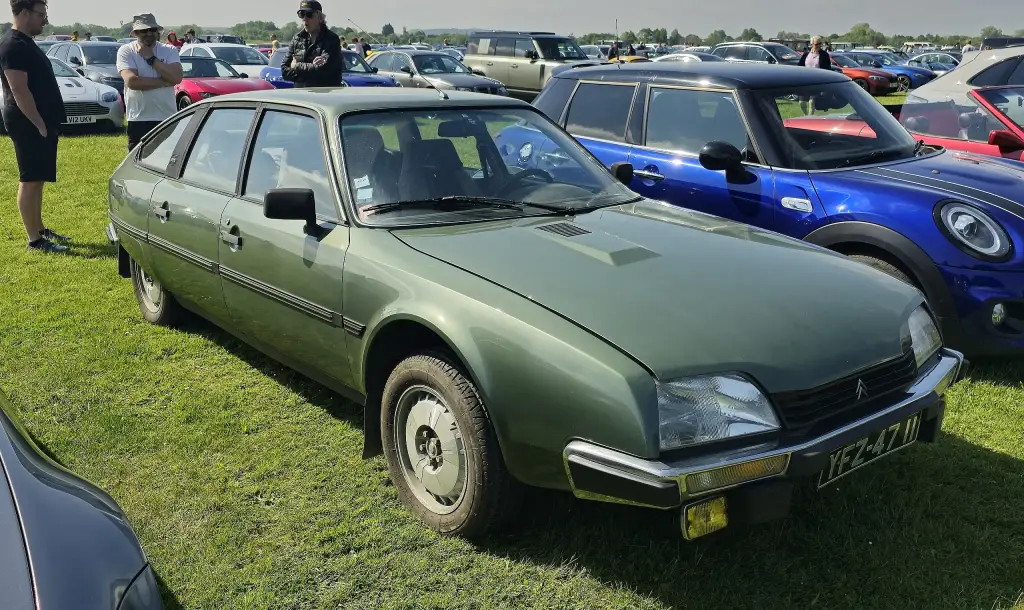
The Citroën CX is a large front-engined, front-wheel-drive executive car built from 1974 to 1991. It came as a standard or long-wheelbase fastback saloon and as an estate on the longer wheelbase, and it was voted European Car of the Year in 1975.
Citroën CX at a glance
| Maker | Citroën, France |
|---|---|
| Production | 1974–1991 |
| Launched | Paris Motor Show, 1974 |
| Designer | Robert Opron |
| Drag coefficient | 0.36 — the cx of the name |
| Suspension | hydropneumatic, self-levelling, on sub-frames |
| Steering | DIRAVI speed-sensitive fully powered steering |
| Bodies | saloon, long-wheelbase saloon, estate |
| Output in 1978 | more than 132,000 cars |
| Award | European Car of the Year 1975 |
| Most powerful version | GTi Turbo, 168 PS, 1985–1989 |
Based on one source (English Wikipedia).
History of the Citroën CX
A name taken from aerodynamics
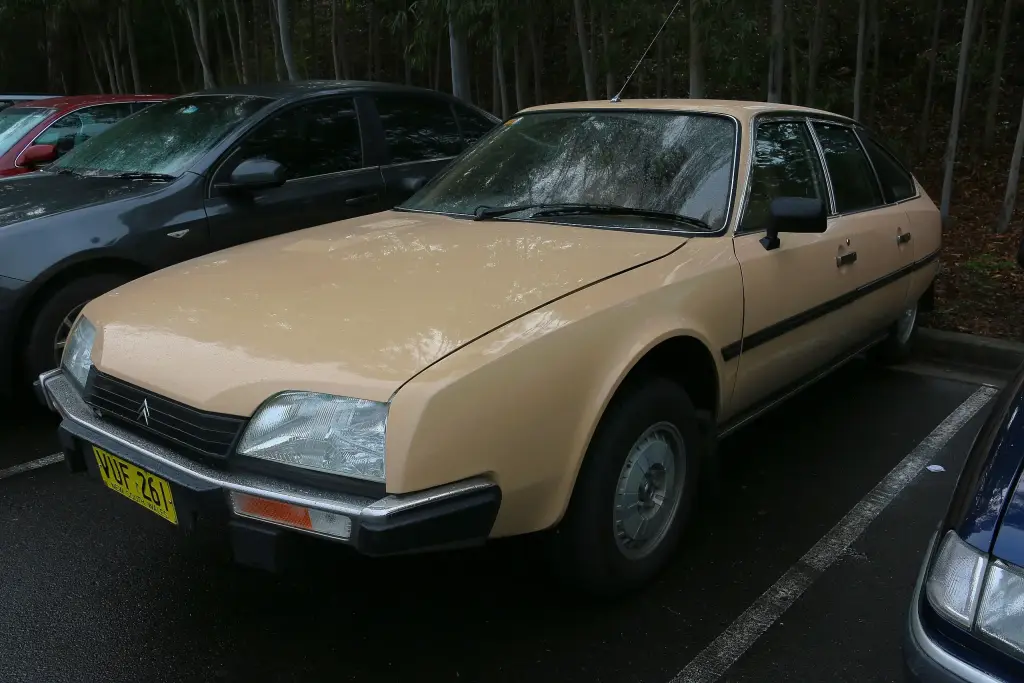
The CX was launched at the 1974 Paris Motor Show, although right-hand-drive production could not be scheduled until well into 1975. Its flowing lines and sharp Kammback rear were drawn by Robert Opron and resemble the smaller GS. Citroën had used a wind tunnel for years, and the CX was designed for low drag with a coefficient of 0.36; the name refers to the French term for the drag coefficient, cx. A notable detail is the concave rear window, shaped to clear rain from the glass without a rear wiper.
Engineering ahead of its time
The car combined hydropneumatic integral self-levelling suspension, speed-sensitive DIRAVI fully powered steering first seen on the SM, and an interior that did away with column stalks so the driver could reach every control with both hands on the wheel. Citroën also held that indicators should not cancel themselves but be switched off deliberately, a feature almost no other car shared. The suspension was attached to sub-frames mounted on flexible bushes to improve ride and reduce road noise; the constant ground clearance part of the system was licensed by Rolls-Royce for the Silver Shadow and Bentley T, and Mercedes-Benz copied the principles for the 450SEL 6.9. The engine was mounted transversely rather than longitudinally, which made the CX 20 cm shorter than the DS and cut engine noise in the cabin, though early cars without power steering were hard work because 70% of the weight sat over the front wheels.
Rotary plans and reality
The CX was originally developed as a rotary-engined car, which is why its engine bay is small, but the Comotor three-rotor unit was uneconomical and the rotary project was scrapped in the year the car was introduced; Citroën went bankrupt in 1974, partly because of investments like Comotor. Production cars used inline fours instead, and only the rare 168 PS GTi Turbo of 1985–1989 had the power to match the chassis. At launch the carburettor CX sat below the 142 PS DS 23 Pallas Injection Électronique and the 180 PS SM, with a 1,985 cc four of about 102 PS in the basic Normale.
Success and the end of an era
The CX was a huge success in Europe, with more than 132,000 built in 1978, and it found buyers beyond the loyal DS clientele. Enthusiasts have called it the last “real Citroën” before Peugeot took control of the company in 1976, and the final successful model of the “big Citroën” era that began in 1934. Unlike its main rivals it never had worldwide distribution, so the cost of development had to be recovered from a geographically small sales base.
Design and features
- Hydropneumatic suspension: self-levelling and mounted on sub-frames to isolate noise.
- DIRAVI steering: fully powered and speed-sensitive, from the SM.
- Cd 0.36: low drag for 1974, and the source of the model’s name.
- Concave rear window: keeps itself clear of rain without a wiper.
- Controls on the wheel: no column stalks, and indicators that do not self-cancel.
Citroën CX versions
- CX saloon: standard wheelbase fastback.
- CX Prestige: long-wheelbase, more luxurious saloon.
- CX estate: on the longer wheelbase.
- CX GTi Turbo: 168 PS, built 1985–1989.
- Hatchback conversions: aftermarket work by Caruna and Beutler.
The CX replaced the DS and came before the XM, with the smaller GS sharing its shape. More cars are in the Citroën collection.
Video: Citroen CX TRD Turbo 2 – Start nach langer Standzeit
Video by austroauto on YouTube.
Sources
- Citroën CX, English Wikipedia: launch, design, engineering, rotary history, production