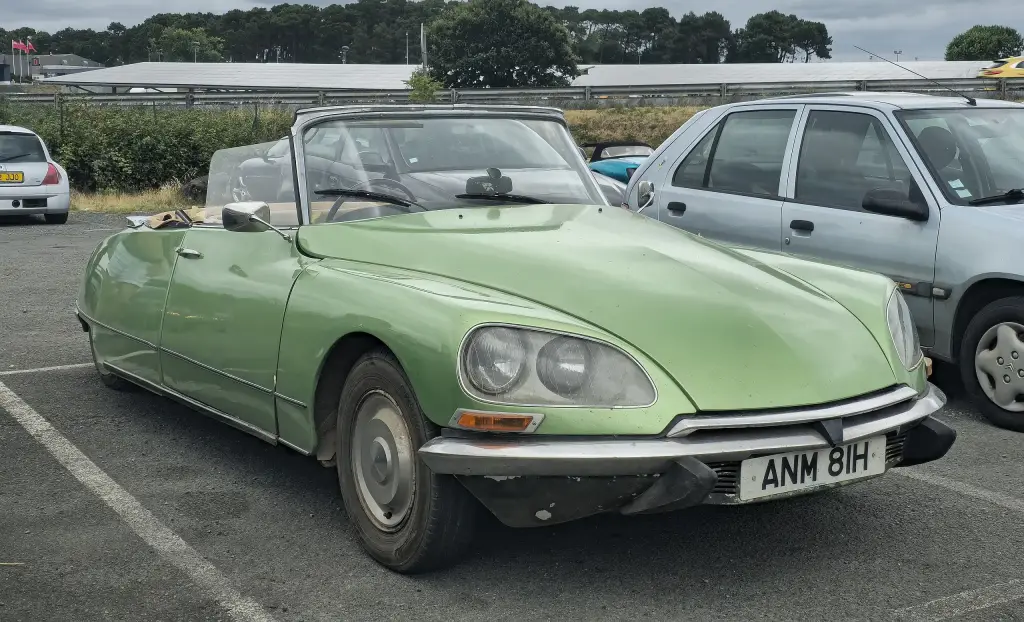
The Citroën DS is a front mid-engined, front-wheel-drive executive car built from 1955 to 1975 in fastback saloon, estate and convertible forms, over a single generation with three series. It was sold alongside a cheaper variant, the Citroën ID, and it set new standards for ride quality, handling and braking.
Citroën DS at a glance
| Maker | Citroën, France, and five other countries |
|---|---|
| Production | 1955–1975 |
| Introduced | 6 October 1955, Paris Motor Show |
| Designers | Flaminio Bertoni and André Lefèbvre; suspension by Paul Magès |
| Series 3 facelift | 1967, by Robert Opron |
| Built | 1,455,746, of which 1,330,755 at Quai de Javel |
| Suspension | hydropneumatic, self-levelling, driver-adjustable height |
| Brakes | disc brakes, inboard at the front |
| Cheaper variant | Citroën ID |
| Rally wins | Monte Carlo 1959 and 1966, 1000 Lakes 1962 |
Based on one source (English Wikipedia), which also covers the ID, D Spécial and D Super and the estates, all of which are included in this article.
History of the Citroën DS
1955: a car that fell from the sky
After 18 years of secret development as the successor to the Traction Avant, the DS 19 was introduced on 6 October 1955 at the Paris Motor Show. In the first 15 minutes 743 orders were taken and the first day brought 12,000; over the ten days of the show the car took 80,000 deposits, a record that stood for more than 60 years until the Tesla Model 3. The philosopher Roland Barthes wrote that it looked as if it had fallen from the sky, and an American advertisement summed up the appeal: “It takes a special person to drive a special car.” The Italian sculptor and industrial designer Flaminio Bertoni and the aeronautical engineer André Lefèbvre styled and engineered the car, Paul Magès developed the suspension, and Robert Opron designed the 1967 Series 3 facelift. The names are puns: DS is pronounced like déesse, goddess, and ID like idée, idea.
The hydraulics
The car used double wishbones at the front and trailing arms at the rear, with hydropneumatic spring and damper units giving automatic self-levelling and driver-adjustable ride height. The same hydraulics worked the suspension, the brakes, the clutch, the steering and the gearchange. The DS had a fibreglass roof that lowered the centre of gravity, inboard front disc brakes to reduce unsprung weight, different front and rear track widths to even out tyre loading, and centre-lock wheels with a captive Allen bolt so a puncture could be changed quickly. It was the first successful use of disc brakes on a mass-produced car, and it was the first mass-produced car with both disc brakes and hydropneumatic suspension. Being French, it was shaped by the tax horsepower system, and although Citroën planned an air-cooled flat-six, there was no money to put it into production.
The ID and the range
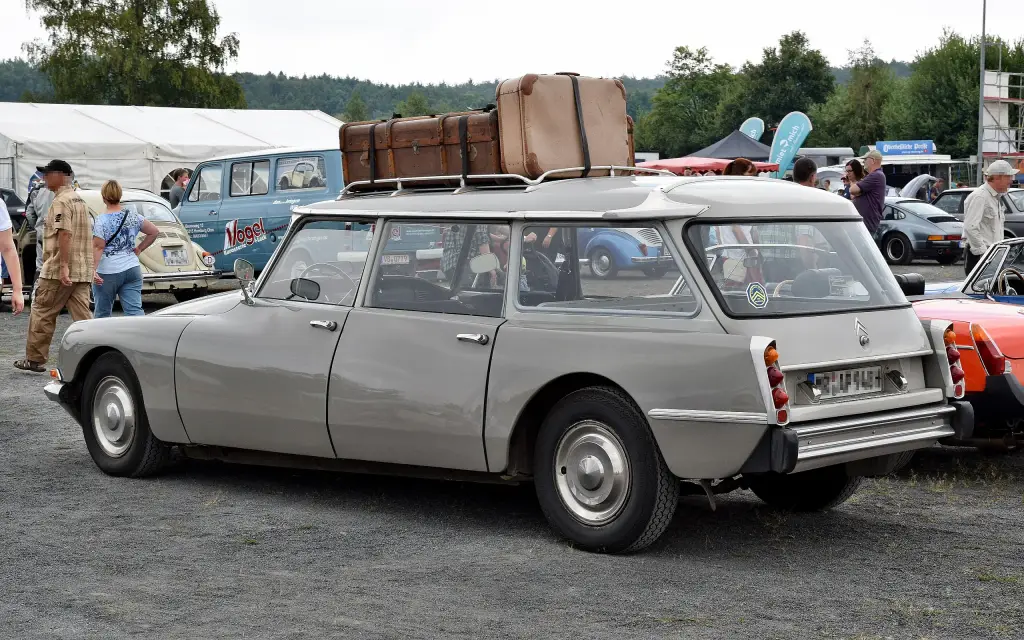
The DS was marketed with a less expensive variant, the ID, which shared the body and suspension but a simpler specification. A 1959 ID 19 listed at US$2,833. The range ran to estates, the Break and Familiale, and to convertibles, including coachbuilt cars such as the Chapron Majesty.
Rallying and reputation
The DS competed in rallying for almost its whole twenty-year production run, with major victories from 1959 to 1974: the Monte Carlo Rally in 1959 and again in 1966, the 1000 Lakes in 1962 with Pauli Toivonen, the Rallye du Maroc in 1969 and 1970 with Robert Neyret, and the 1974 London-Sahara-Munich World Cup Rally, where it beat more than 70 other cars of which only five finished. It was named the most beautiful car of all time by Classic & Sports Car magazine after a poll of twenty designers including Giorgetto Giugiaro, Ian Callum and Leonardo Fioravanti. Citroën built 1,455,746 examples in six countries.
Design and features
- Hydropneumatic suspension: self-levelling and adjustable, and it gave the car its floating ride.
- Disc brakes: inboard at the front, the first successful mass-production application.
- Directional headlights: introduced on the 1967 Series 3.
- Fibreglass roof: a lower centre of gravity and less weight transfer.
- Centre-lock wheels: one captive bolt for fast wheel changes.
Citroën DS versions
- DS 19 (1955): the original, with a semi-automatic transmission.
- ID: the cheaper variant with a simpler specification.
- DS 21 and DS 23: larger-engined versions, including the Pallas trim.
- Break and Familiale: the estates.
- Convertibles: including coachbuilt cars such as the Chapron Majesty.
- Series 3 (1967): the Opron facelift with directional headlights.
The DS replaced the Traction Avant and was replaced by the CX; the smaller relative with the same engineering is the SM. More cars are in the Citroën collection.
Sources
- Citroën DS, English Wikipedia: launch, engineering, ID, rallying, production, reputation