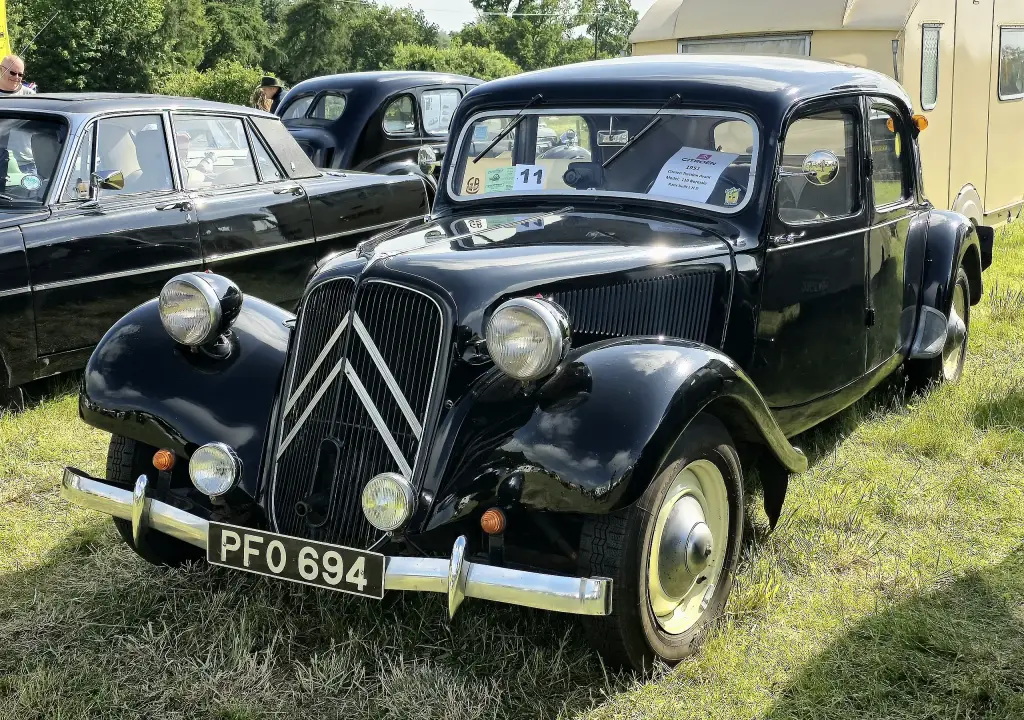
The Citroën Traction Avant is the world’s first mass-produced car with a semi-monocoque body and front-wheel drive. Citroën built about 760,000 between 1934 and 1957, in a range of mostly four-door saloons and executive cars, plus a longer-wheelbase Commerciale and a three-row Familiale, with four- and six-cylinder engines.
Citroën Traction Avant at a glance
| Maker | Citroën, France |
|---|---|
| Production | 1934–1957 |
| Designers | André Lefèbvre and Flaminio Bertoni |
| Built | about 760,000 |
| Structure | welded unitary body and chassis |
| Layout | front-wheel drive, four-wheel independent suspension |
| Steering | rack and pinion |
| Top speed | about 100 km/h |
| Consumption | about 10 l/100 km |
| Bodies | saloon, Commerciale, Familiale |
| Engines | four- and six-cylinder |
| British names | Light Fifteen for the 11, Big Six for the 15/6 |
Based on one source (English Wikipedia).
History of the Citroën Traction Avant
1934: a new kind of car
The Traction Avant was designed by André Lefèbvre and Flaminio Bertoni in late 1933 and early 1934. Front-wheel drive and four-wheel independent suspension had already appeared in production cars from Auto Union and others; the Traction’s achievement was to integrate them into a mass-production car with a crash-resistant, largely unitary body, and it was also an early adopter of rack and pinion steering. The welded unitary body saved 70 kg of steel per car compared with a separate frame, using technology bought from the American Budd Company. The method was viewed with suspicion, and Citroën staged a kind of crash test by driving the car off a cliff to show how strong it was.
Low, light and quick for its day
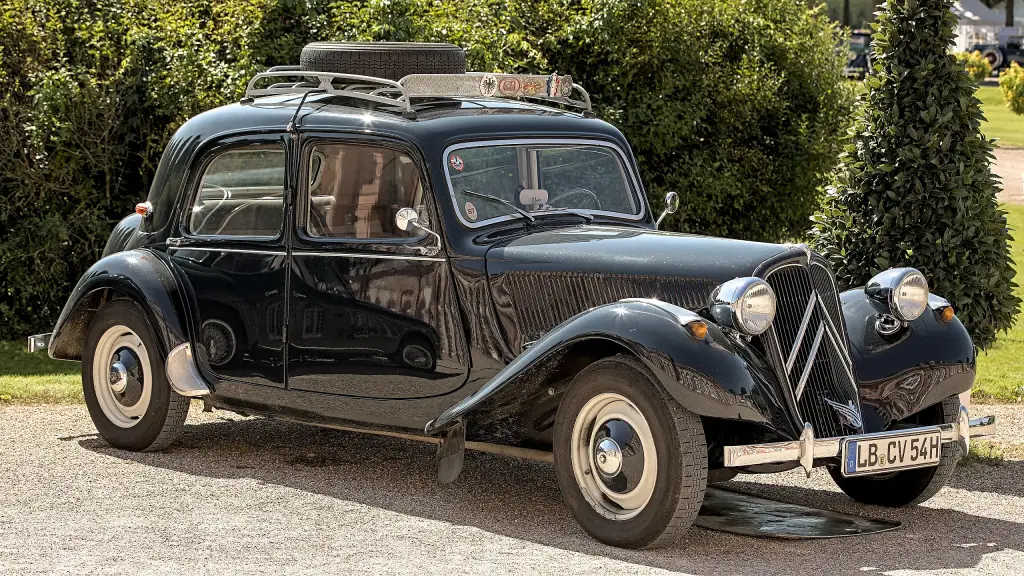
Without a separate chassis the car sat much lower than its contemporaries, which made it look rakish in 1934 and old-fashioned by 1955. The front wheels were independently sprung on torsion bars and wishbones, where most rivals still used a live axle and leaf springs, and the rear had a simple steel beam axle with a Panhard rod, trailing arms and torsion bars on a 75 mm steel tube. Being considerably lighter than conventional designs, it could reach 100 km/h on about 10 l/100 km.
The factory and the gamble
André Citroën’s investment matched his ambition. Site preparation began in the winter of 1932/33, demolition of the existing 30,000 m² factory started on 15 March 1933 and construction on 21 April; by the end of August the shell of a building four times the size of the old one was up, using 5,000 tonnes of structural steel, all while several hundred Rosalies were still being built every day. On 8 October 1933 Citroën invited 6,000 guests, mostly dealers, to a banquet in the still-empty factory, a gesture that soon looked hubristic as the following months became a race to finish the car before investors lost patience.
Names and versions
The car was sold under many names. In Britain the 11 was the Light Fifteen and the six-cylinder 15/6 the Big Six, while in Spain and France the lighter 11 was the Légère and the Ligero. The range included the Commerciale on a longer wheelbase and the three-row Familiale, and both four- and six-cylinder engines were offered. Production ran until 1957, when the DS took over, and the Traction remained in service long afterwards as a taxi, a police car and, in the films, a gangster’s limousine.
Design and features
- Unitary body: no separate chassis, 70 kg of steel lighter and much lower than its rivals.
- Front-wheel drive: the first car of its kind built in six-figure numbers.
- Torsion-bar front suspension: independent wishbones where rivals used live axles.
- Rack and pinion steering: an early production use of the system.
- Familiale and Commerciale: long-wheelbase and three-row versions for families and trade.
Citroën Traction Avant versions
- 11 Légère and Ligero: the light four-cylinder cars.
- Light Fifteen: the British name for the 11.
- 15/6 and Big Six: the six-cylinder cars.
- Commerciale: the longer-wheelbase model.
- Familiale: three rows of seats.
- Cabriolet and Roadster: open versions.
The Traction Avant replaced the Rosalie and was replaced by the DS; its engines later went into the H Van. More cars are in the Citroën collection.
Video: Citroen Traction Avant Commerciale Gangsterlimousine
Video by Gang des Traction Avant on YouTube.
Sources
- Citroën Traction Avant, English Wikipedia: design, structure, suspension, factory, production