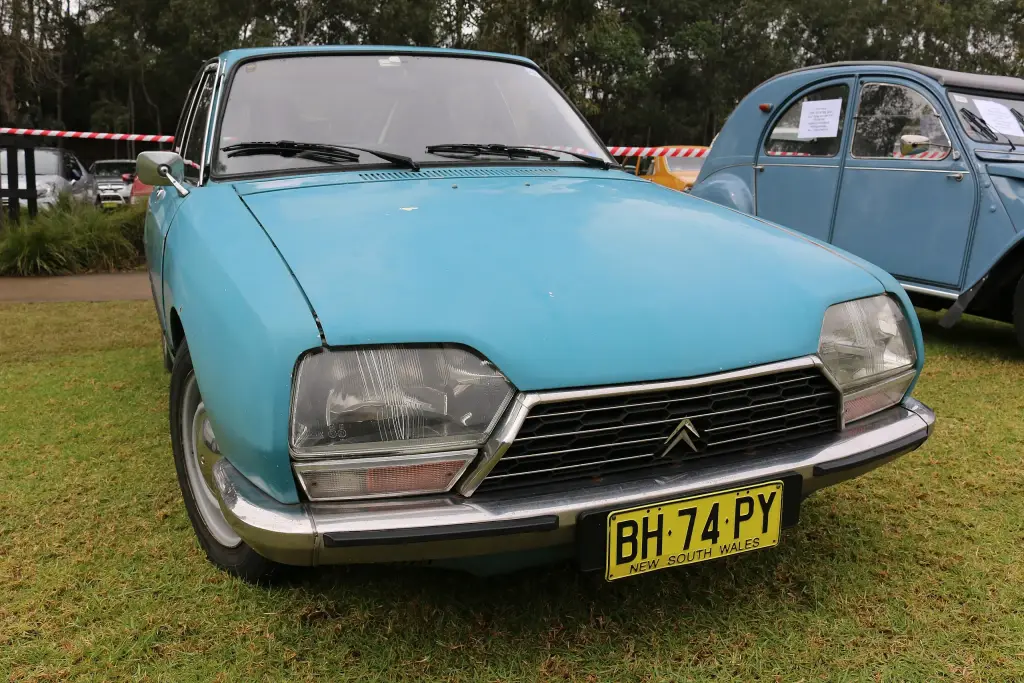
The Citroën GS is a small family car built from 1970 to 1986 over two series. From 1970 to 1979 it was a fastback four-door saloon and a five-door estate; the revised GSA came from late 1979 as a five-door hatchback or estate, and combined production reached about 2.5 million.
Citroën GS at a glance
| Maker | Citroën, France |
|---|---|
| Production | 1970–1986 |
| Launched | 24 August 1970 |
| Designer | Robert Opron |
| Drag coefficient | 0.318 |
| Suspension | hydropneumatic, self-levelling |
| Engine | air-cooled flat four |
| Built | 1,896,742 GS and 576,757 GSA |
| Award | European Car of the Year 1971 |
| GSA | facelift with hatchback, late 1979–1986 |
| Trims | G Special, Club, X and Pallas |
Based on one source (English Wikipedia), which covers both the GS and the GSA.
History of the Citroën GS
Fourteen years to fill a gap
The GS took fourteen years from first idea to launch. The DS 19 of 1955 cost 65% more than the Traction Avant it replaced, leaving a large hole in the middle of the market. In 1956 Citroën built the C10 bubble car to fill it, and development continued through ideas including a Wankel engine and hydropneumatic suspension, then the C60, which looked like an Ami 6 with a long smooth nose. By 1963 the work had moved to Project F, close to production, but Citroën judged it too similar to the 1965 Renault 16 and suspended it in 1967; much of its engineering carried over to Project G, which became the GS, designed by Robert Opron with a smooth two-box shape resembling Pininfarina’s 1967 Berlina Aerodinamica study.
1970: aerodynamics and hydropneumatics
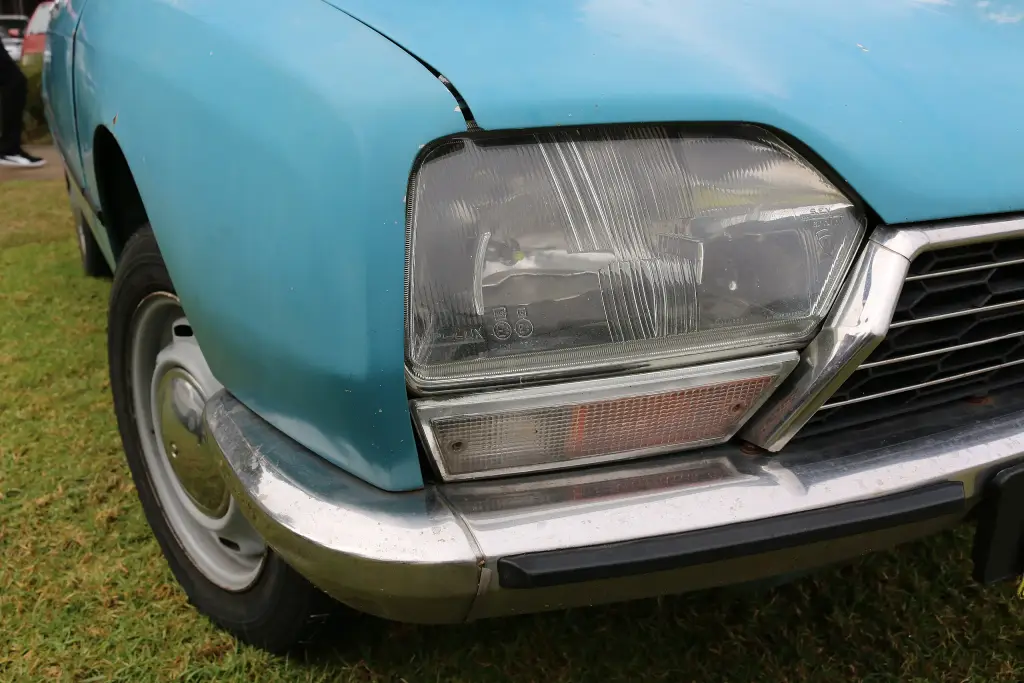
The GS was launched on 24 August 1970 as a fastback four-door saloon with three side windows and a sharp Kamm tail, one of the most aerodynamic cars of its time at Cd 0.318. It had fully independent hydropneumatic brakes and self-levelling suspension, an air-cooled flat four, and a low nose with semi-enclosed rear wheels. Its rivals in Europe included the Fiat 128, Ford Escort, Renault 6 and Vauxhall Viva. The aerodynamics made the most of the available power, but the car was considered underpowered, so in September 1972 an optional 1,222 cc engine raised power from 55.5 to 60 PS and torque from 7.2 to 8.9 kg·m, with revised second gear and final drive and larger front discs. The GS was named European Car of the Year for 1971 for its comfort, safety and aerodynamics, and it became Citroën’s best-selling model for years.
Bodies and details
CEO Pierre Bercot thought a hatchback too utilitarian, so the early GS had a separate boot, large partly because the spare wheel sat in the engine compartment. From September 1971 a five-door estate and a two-door service van were offered, and Citroën built several coupé and three-door prototypes, the best known being the 1972 GS Camargue by Bertone. Early cars and the GSA had a rotating drum speedometer like a bathroom scale; later GS models from 1977 used conventional dials. The radio sat between the seats, the parking brake was on the dashboard, the suspension height lever was next to the radio, and the single-spoke steering wheel limited intrusion in a crash. Trims were G Special, Club, X and Pallas.
1979: the GSA
The GS was facelifted in 1979, given a hatchback and renamed GSA, produced until 1986 in hatchback and estate form; its controls were grouped in flanking satellites with a diagram of the car showing warning lights. The GSA used the same hydropneumatic engineering, and the flat-four engine was also the basis of the rotary experiments that produced the GS Birotor.
Design and features
- Cd 0.318: one of the most slippery shapes of its era.
- Hydropneumatic suspension: self-levelling, with the brakes on the same system.
- Air-cooled flat four: 1,015 cc at launch, 1,222 cc from 1972.
- Single-spoke wheel: less intrusion into the cabin in a crash.
- GSA hatchback: the 1979 facelift that finally added a fifth door.
Citroën GS versions
- GS saloon (1970): fastback four-door.
- GS estate (1971): five-door station wagon.
- GS service van: a two-door commercial version.
- GS Camargue (1972): Bertone coupé prototype.
- GS Birotor: the rotary-engined version.
- GSA (1979–1986): facelifted hatchback and estate.
The GS sat between the Ami and the DS, and was replaced by the BX; its shape led to the CX. More cars are in the Citroën collection.
Video: Oldtimer: Der Citroen GS
Video by Kölner Stadt-Anzeiger on YouTube.
Sources
- Citroën GS, English Wikipedia: development, launch, engineering, bodies, GSA, production