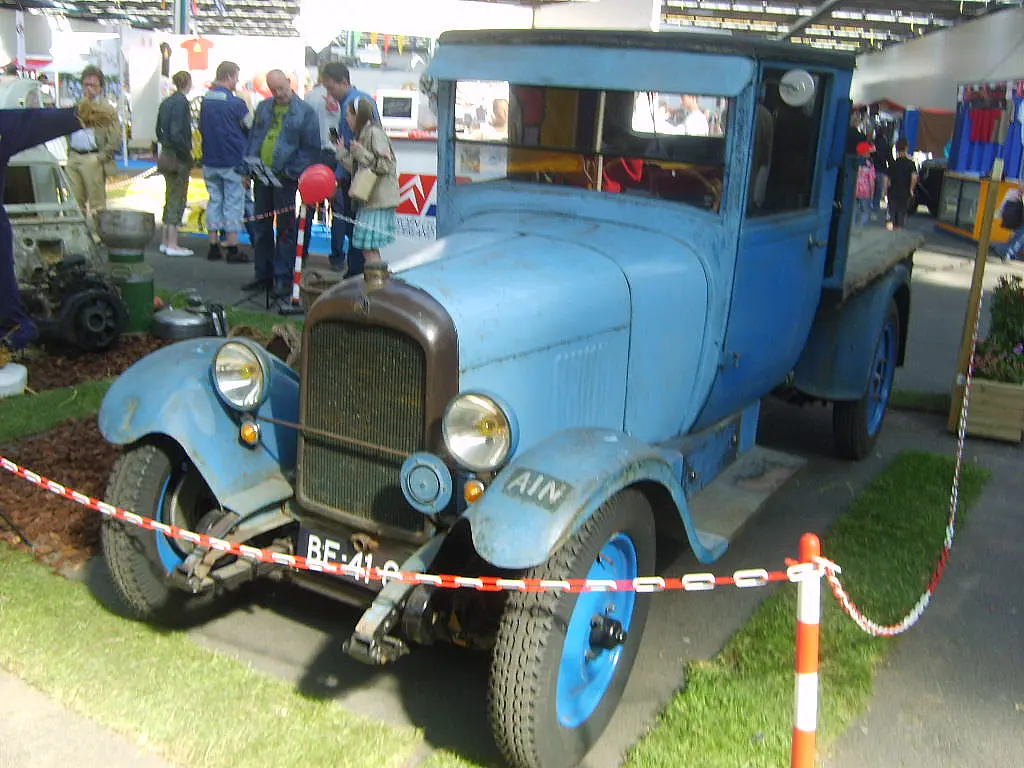
The Citroën B15 is a light commercial vehicle built by Citroën and type-approved on 28 September 1926. It was shown at the Paris Salon in October 1926 alongside the B14 berline, whose front end, bonnet, radiator grille, wings and engine it used.
Citroën B15 at a glance
| Maker | Citroën, France |
|---|---|
| Type-approved | 28 September 1926 |
| Production | 1926–August 1928 |
| Based on | Citroën B14 berline |
| Payload | 1,000 kg on a reinforced chassis |
| Engine | four-cylinder inline, 1,539 cc, 22 hp |
| Top speed | 80 km/h empty |
| Gearbox | three-speed, unsynchronised |
| Rear wheels | 6.00 x 20, larger than the 13 x 45 front tyres, six nuts instead of four |
| Built | 12,566 |
| Notable | the first French utility with a closed cab |
Based on one source (French Wikipedia); there is no English article on the B15.
History of the Citroën B15
A van made from a saloon
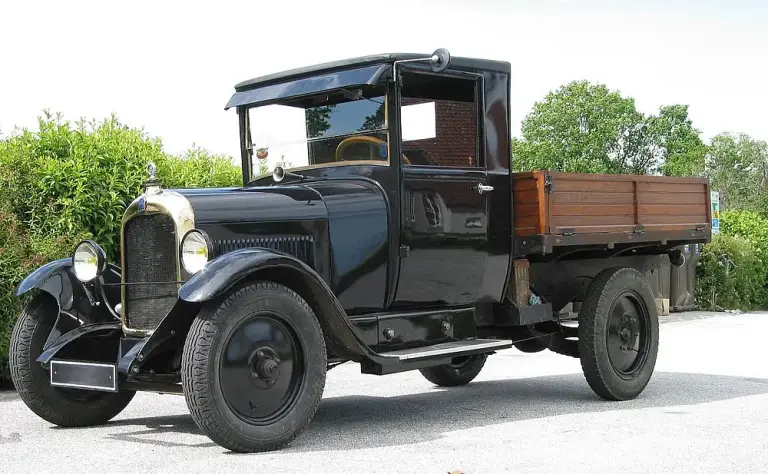
The B15 was developed on the basis of the B14 berline and took over its front end — bonnet, grille and wings — and its engine. It was the first French light commercial vehicle with a closed cab, at a time when most rivals still left the driver out in the weather.
What the conversion changed
The chassis was reinforced to carry a payload of 1,000 kg, the rear of the frame was strengthened and the rear axle received six-stud rims with 6.00 x 20 wheels, larger than the 13 x 45 front tyres. The engine was given a governor to stop it running away on descents. The mechanical specification was otherwise identical to the B14: a 1,539 cc four-cylinder of 22 hp, a top speed of 80 km/h empty and a three-speed unsynchronised gearbox.
Bare chassis and coachbuilders
As was normal at the time, the B15 was often delivered as a bare chassis to be bodied by coachbuilders, receiving anything from a flatbed to a hearse, a fire pump or a hotel minibus. Sold from its presentation, it was updated in April 1927 as the B15F with the changes made to the B14F, including Westinghouse servo-assisted brakes; in September 1927 it became the B15G with a more refined body. Citroën stopped production in August 1928 after 12,566 examples.
Design and features
- Closed cab: the first such utility built in France.
- One-tonne chassis: a reinforced B14 frame with a strengthened rear section.
- Governed engine: a regulator kept the 1,539 cc four from overspeeding on long descents.
- Bigger rear wheels: 6.00 x 20 with six nuts, against 13 x 45 at the front.
- Coachbuilder ready: usually supplied as a bare chassis.
Citroën B15 versions
- B15 (1926): the original one-tonne model.
- B15F (April 1927): Westinghouse servo brakes.
- B15G (September 1927): more refined bodywork.
The B15 was built on the B14, and it belongs to the same early family as the Type B2. More vehicles are in the Citroën collection.
Video: B-15 backar ut.
Video by Lennart Ohlsson on YouTube.
Sources
- Citroën B15, French Wikipedia: chassis, engine, wheels, versions, production