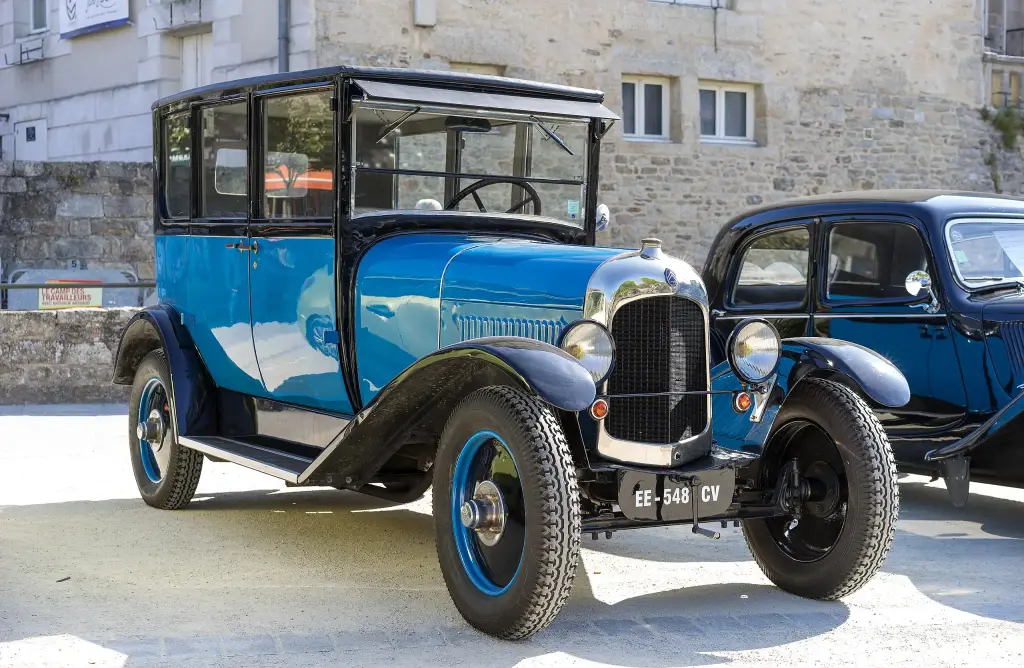
The Citroën B2 is the second model produced by Citroën and therefore the second European car built according to modern mass-production methods. It was made at André Citroën’s factory in central Paris between May 1921 and July 1926.
Citroën Type B2 at a glance
| Maker | Citroën, Quai de Javel, Paris |
|---|---|
| Production | May 1921–July 1926 |
| Built | 89,841 |
| Replaced | Citroën Type A |
| Also known as | Citroën 10CV (10HP) |
| Engine | four-cylinder, 1,452 cc, 20 hp at 2,100 rpm |
| Top speed | 72 km/h |
| Gearbox | three-speed manual, no synchromesh |
| Consumption | 8 l/100 km |
| Output by 1925 | 200 cars a day |
Based on one source (English Wikipedia).
History of the Citroën Type B2
1921: more power than the Type A
The B2 replaced the Type A in June 1921, although the Type A stayed on the price list until December 1921. It offered more power, the four-cylinder engine growing to 1,452 cc, and it was sometimes called the Citroën 10CV, the suffix referring to its fiscal power, computed from the cylinder diameters and used to define its tax class. Maximum output was 20 hp at 2,100 rpm, giving a claimed 72 km/h, with a three-speed manual gearbox and no synchromesh. Advertised consumption was 8 l/100 km, and the car quickly gained a reputation for robustness and economy.
Building cars five minutes from the Eiffel Tower
The B2 was manufactured in the 15th arrondissement of Paris at the Quai de Javel factory, which by 1925 was producing 200 cars a day using the techniques known as Taylorism that André Citroën had studied personally during a wartime visit to Dearborn, where he learned the methods Henry Ford applied to the Model T. In 1925 no other manufacturer in Europe had production techniques or single-model volumes close to the B2’s, and 89,841 cars were built in five years.
B2, B10 and B12
At the Paris Motor Show in October 1924 Citroën exhibited a 10CV with all-steel bodywork, initially only as a closed Conduite Intérieure, with a Torpedo added in the spring of 1925. For the 1925 model year the all-steel car was designated B10, while cars with bodies built the traditional way, with panels attached to a hand-crafted timber frame, remained B2. The split was far from simple, and both models were produced in parallel in 1925 and 1926, until the B12 unveiled in October 1925 replaced both by the end of 1926.
Vans and half-tracks
The van models were called Boulangère, a box van, and Normande, a flatbed with a tarpaulin, for both the B2 and the B14. The half-track cars that crossed the Sahara Desert in 1922 were based on the B2, the first crossing of the Sahara by that method, and eight B2-based half-tracks were used for the celebrated Croisière noire expedition across central Africa.
Design and features
- 1,452 cc four: 20 hp at 2,100 rpm and a claimed 72 km/h.
- Economy: 8 l/100 km advertised, and a reputation for toughness.
- Mass production: 200 cars a day by 1925 at Quai de Javel.
- Half-track expeditions: the 1922 Sahara crossing and the Croisière noire used B2-based vehicles.
- Boulangère and Normande vans: box and flatbed commercial bodies.
Citroën Type B2 versions
- B2 (1921–1926): the standard car with coachbuilt bodywork.
- B10 (1925): the all-steel-bodied version sold alongside it.
- Torpedo and Conduite Intérieure: open and closed bodies.
- Boulangère and Normande: the box van and the flatbed.
- Half-track: expedition vehicles built on the B2.
The B2 followed the Type A and was succeeded by the B14 through the B10 and B12. More cars are in the Citroën collection.
Video: un petit tour en Citroen B2
Video by alaincx on YouTube.
Sources
- Citroën Type B2, English Wikipedia: engine, production, B10 and B12, vans, half-tracks