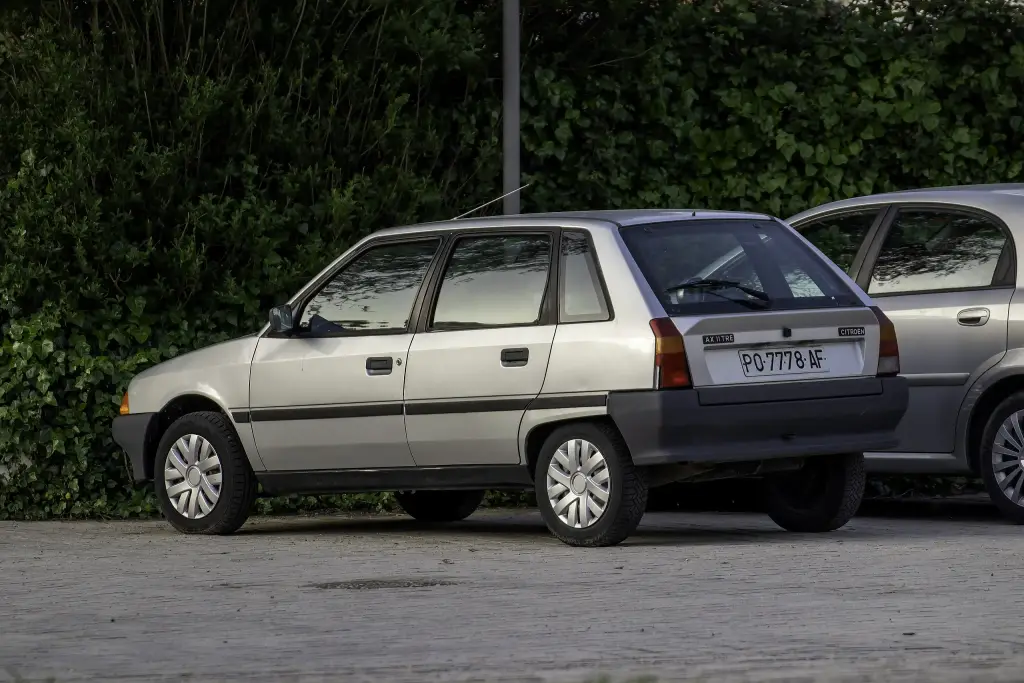
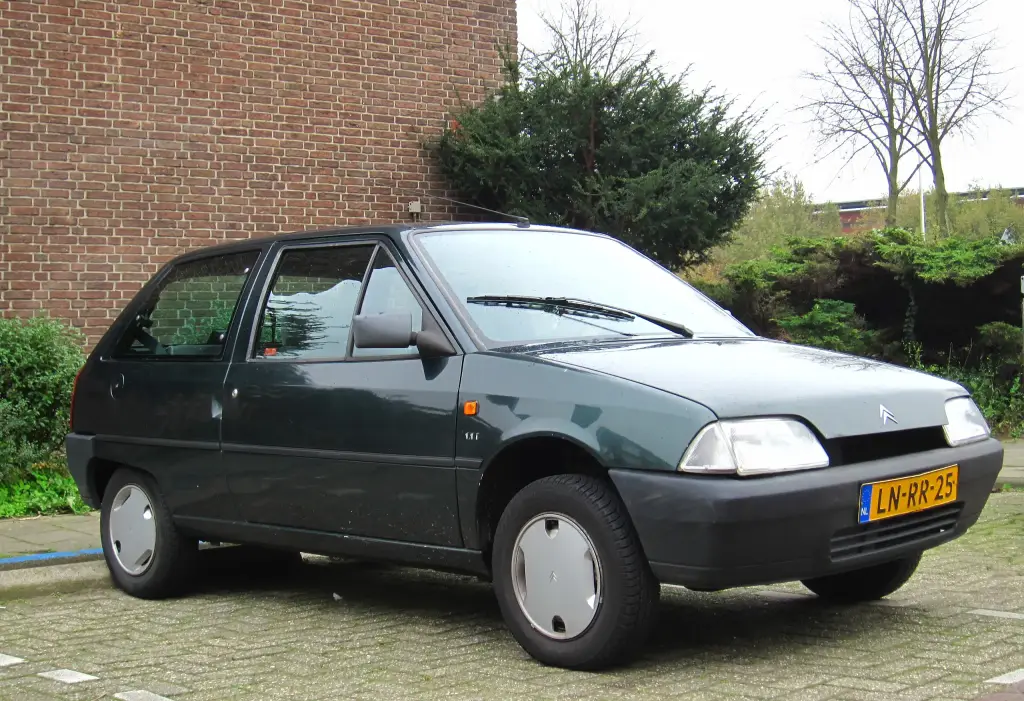
The Citroën AX is a supermini built from 1986 to 1998. It was launched at the 1986 Paris Motor Show to replace the Citroën Visa and the LNA, and its whole design was driven by one idea: to weigh and to cost as little as possible.
Citroën AX at a glance
| Maker | Citroën, France |
|---|---|
| Production | 1986–1998 |
| Launched | Paris Motor Show, October 1986 |
| Replaced | Citroën Visa and Citroën LNA |
| Engines | 1.0, 1.1 and 1.4 litre TU petrol; 1.4 diesel, 1.5 from 1994 |
| Drag coefficient | 0.31 |
| Weight | 640 kg for the basic version |
| Layout | front-wheel drive, fully independent suspension |
| Sport versions | AX Sport (1987), AX 14 GT, AX GTi (1992) |
| Electric version | AX Électrique, from November 1995 |
| End of production | December 1998 |
Based on one source (English Wikipedia).
History of the Citroën AX
1986: a car built around weight
Development started in 1983, and the AX was originally going to share its basis with a Talbot sister model to replace the Samba; the falling popularity of Talbot and the success of the Peugeot 205 killed that plan. The car went on sale in continental Europe on 2 October 1986 as a three-door hatchback with 1.0, 1.1 and 1.4 litre TU-series belt-driven overhead-cam engines. A five-door range followed in 1987, and the right-hand-drive version reached Britain in August 1987. Economy came from aerodynamics and from lightness: a drag coefficient of 0.31 and 640 kg for the basic car, achieved with plastic panels in non-load-bearing areas and steel of varying thickness in the bodyshell. The AX had fully independent suspension with unusually long wheel travel, and optionally used self-coloured plastic bumpers, a technique taken from the ECO 2000 project shared by PSA, Renault and the French government.
Records and performance versions
In 1989 a naturally aspirated diesel AX with the 1360 cc aluminium TUD engine used 2.7 litres per 100 km from Dover to Barcelona, more than 1,000 miles on 10 imperial gallons, and entered the Guinness Book of Records as the most economical production car. The first performance model was the limited-run AX Sport of 1987, with a 1.3 engine and twin carburettors producing 95 PS and white steel wheels. The AX 14 GT followed with a 1.4 of 85 PS and fuel injection from 1991. A 4×4 variant was offered, five-door only and not sold in Britain, with limited success against the Fiat Panda 4×4.
1991 facelift and the GTi
Late 1991 brought a heavily facelifted tailgate and interior, clear front turn signals, the chevron moved to the centre of the bonnet and a more conservative dashboard. The following year the 100 PS GTi arrived, and limited editions such as the Forte, Spree, Elation and Dimension were added. In January 1995 came the AX Echo, with a top speed of 110 mph, which outsold its closest rival, the Peugeot 106 Ski.
The electric AX and the end
In November 1995 Citroën introduced the AX Électrique, a four-seater with a 20 kW motor, a top speed of 91 km/h and twenty nickel-cadmium monoblocks; it reached 50 km/h in 8.3 seconds and was quoted at 75 km of urban range, weighing 995 kg. After the Saxo arrived in June 1996 the range was slimmed down, and production ended in December 1998. The Vigo plant in Spain stopped building the AX in May 1997 after 812,000 cars.
Design and features
- Low weight: 640 kg in basic form, through plastic panels and carefully thinned steel.
- Aerodynamics: a drag coefficient of 0.31, excellent for a small car of its time.
- Long-travel independent suspension: a Citroën trait kept in a cheap package.
- Record economy: a 1989 diesel run of 2.7 l/100 km put the AX in the Guinness Book of Records.
- Electric option: the AX Électrique of 1995, sold mainly to public bodies.
Citroën AX versions
- AX (1986–1998): three- and five-door hatchback with TU petrol engines.
- AX Sport (1987): 1.3 with twin carburettors, 95 PS, white steel wheels.
- AX 14 GT: 1.4 of 85 PS, fuel injection from 1991.
- AX GTi (1992): 100 PS, the most powerful AX.
- AX 4×4: five-door only, not sold in the UK.
- AX Électrique (1995): 20 kW electric version.
The AX replaced both the Visa and the LNA, and was itself replaced by the Saxo. More cars are in the Citroën collection.
Sources
- Citroën AX, English Wikipedia: development, engines, versions, records, end of production