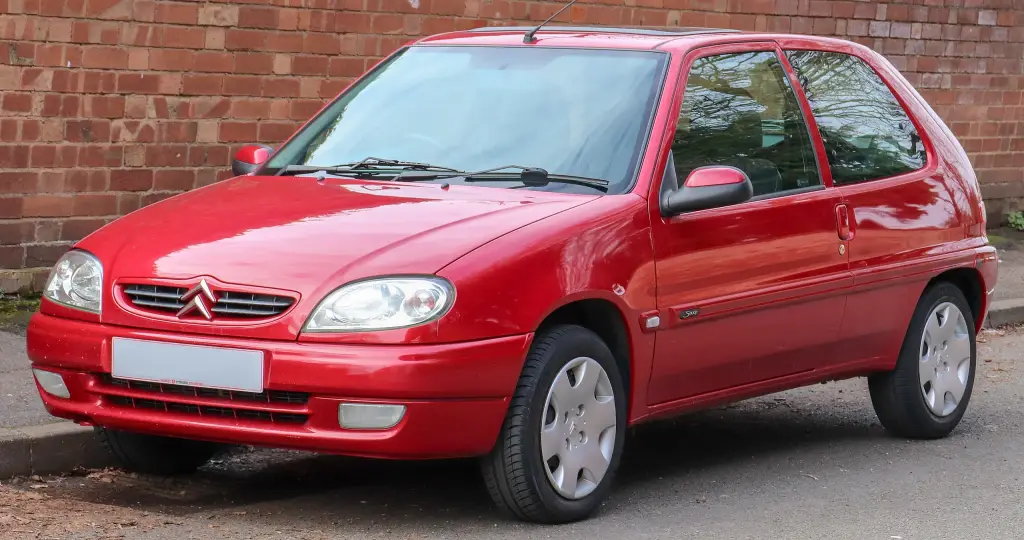
The Citroën Saxo is a supermini produced from 1996 to 2003. It was sold in Japan as the Citroën Chanson, because Honda had registered the Saxo name, and it was a development of the Citroën AX and Peugeot 106, which shared a platform and running gear.
Citroën Saxo at a glance
| Maker | Citroën, France |
|---|---|
| Production | 1996–2003 |
| Also called | Citroën Chanson in Japan |
| Base | Citroën AX and Peugeot 106 |
| Engines | TU series: 1.0, 1.1, 1.4 and 1.6 petrol; 1.5 TUD diesel |
| Power range | 50 to 120 hp |
| Kerb weight | 935 kg for the VTS, about 100 kg less for smaller engines |
| Sport models | Westcoast, Furio, VTR and VTS |
| VTS performance | 120 hp, 205 km/h, 0–60 mph in 7.8 s |
| Electric version | Saxo Électrique |
| Replaced by | Citroën C2 and C3 |
Based on one source (English Wikipedia).
History of the Citroën Saxo
1996: a lighter AX
The Saxo arrived in 1996 as a development of the AX and the Peugeot 106, sharing their platform and running gear, and differing mainly in interiors and body panels. All engines came from the PSA TU series that had powered the Peugeot 205 from 1988 and the AX, with roots in the older PSA X engine. The range had five petrol engines and one naturally aspirated diesel, and although the quoted outputs look modest, kerb weights were very low: even the range-topping VTS weighed 935 kg, and the smaller-engined models were about 100 kg lighter, which gave a high power-to-weight ratio and decent acceleration. Apart from the 16-valve VTS, the engines were older single-cam units, so town economy was only moderate. Production ended in 2003, when the C2 and C3 replaced the car; both were developed alongside the Peugeot 206.
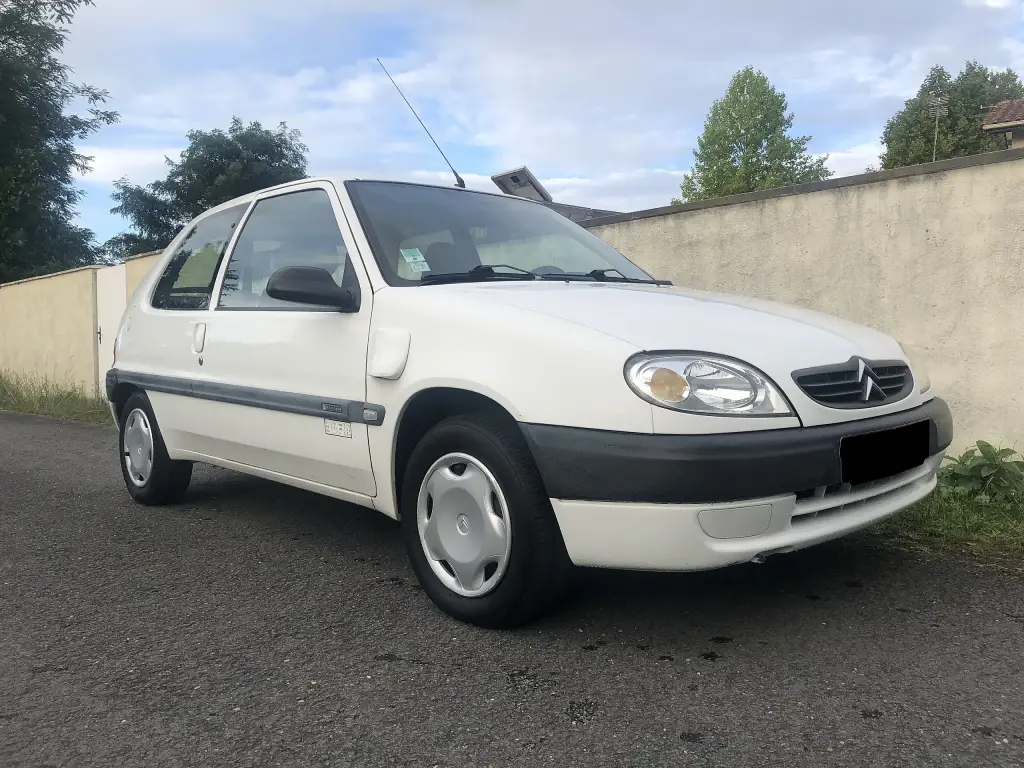
Sport models
There were three: the Westcoast, later replaced by the Furio with a 1.4 of 75 hp, 175 km/h and 0–100 km/h in 11.2 seconds; the VTR, first with a 1.6 of 90 hp and 187 km/h, then from 1999 with 98 hp and 193 km/h; and the VTS 16V with 120 hp, 205 km/h and 0–60 mph in 7.8 seconds. All the sports models wore the same “VT” body kit, used 247 mm vented front discs, and the VTR and VTS also had solid rear discs and a larger master cylinder on the VTS. A three-speed automatic was offered with the 1.6 from 1997 and replaced by a 1.4 automatic at the end of that year; the automatic Saxo ended in March 2002 when the C3 took over that role, while manual cars were sold to the end of 2003.
The electric Saxo
An electric version, the Saxo Électrique, swapped the engine for a separately excited brushed DC motor of 20 kW peak power made by Leroy Somer. It followed Citroën’s earlier electric AX conversions and continued the company’s experiments with battery cars.
Design and features
- Low weight: 935 kg for the VTS and about 100 kg less for smaller models.
- TU engines: 1.0, 1.1, 1.4 and 1.6 petrol plus a 1.5 diesel.
- VTS 16V: 120 hp, 205 km/h and 0–60 mph in 7.8 seconds.
- Shared body kit: the VT kit and 247 mm front discs on every sports model.
- Saxo Électrique: a 20 kW electric conversion sold alongside the petrol cars.
Citroën Saxo versions
- Saxo (1996–2003): three- and five-door supermini.
- Westcoast and Furio: 1.4 of 75 hp.
- VTR MK1 and MK2: 1.6 of 90 then 98 hp.
- VTS 16V: 120 hp, the top model.
- Automatic: 1.6 from 1997, 1.4 from the end of that year.
- Saxo Électrique: the electric version.
The Saxo came from the AX and was replaced by the C2 and C3; its electric successor in spirit is the C-Zero. More cars are in the Citroën collection.
Video: Peugeot 106 vs Citroen Saxo Racing Cars
Video by Gronholmmk2 on YouTube.
Sources
- Citroën Saxo, English Wikipedia: origin, engines, weights, sport models, electric version