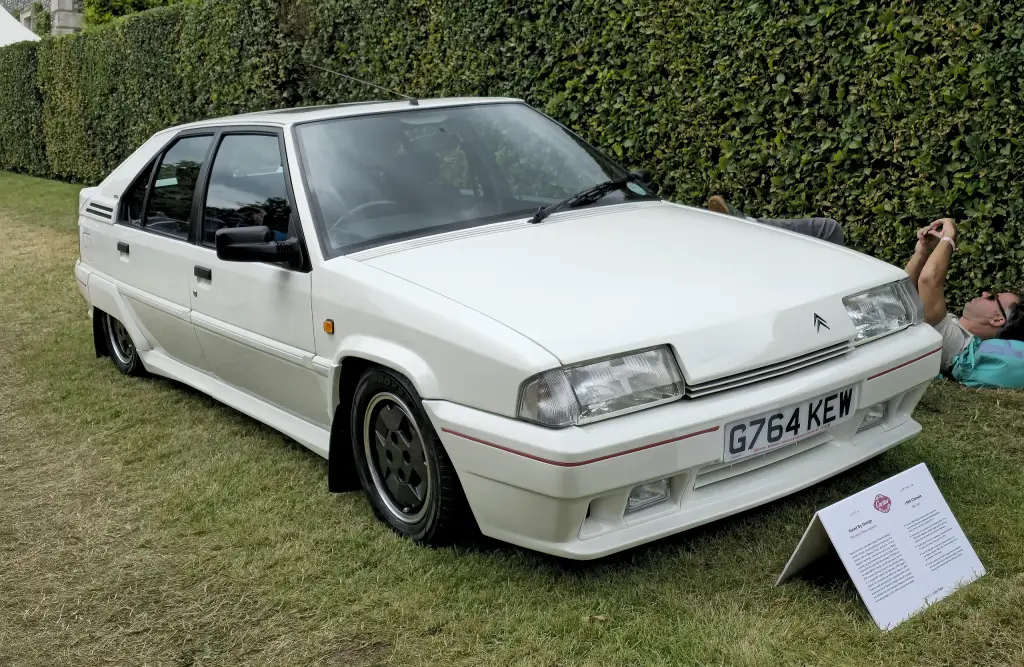
The Citroën BX is a large family car built from 1982 to 1994. More than two and a third million were made in twelve years, and the angular hatchback was styled by Marcello Gandini of Bertone.
Citroën BX at a glance
| Maker | Citroën, France |
|---|---|
| Production | 1982–1994 |
| Built | 2,315,739 |
| Designer | Marcello Gandini, Bertone |
| Shown | Paris, 2 October 1982, under the Eiffel Tower |
| Replaced | Citroën GS/GSA |
| Suspension | hydropneumatic, self-levelling |
| Plastic panels | bonnet, tailgate, bumpers |
| Engines | 1,124 to 1,905 cc petrol; XUD diesels from November 1983 |
| Brakes | discs front and rear |
| Estate | built by Heuliez at Cerizay |
| Replaced by | Citroën Xantia |
Based on one source (English Wikipedia).
History of the Citroën BX
1982: a GS replacement by Gandini
The BX was announced in June 1982, and its commercial life began that autumn with a Paris presentation on 2 October 1982 under the Eiffel Tower. It was designed to replace the GS/GSA of 1970 with a larger car, and it was the second product of the 1976 Peugeot-Citroën merger after the Visa. The angular hatchback came from Marcello Gandini of Bertone, based on his unused design for the 1977 Reliant FW11 concept and his 1979 Volvo Tundra. It shared its platform with the Peugeot 405 that appeared in 1987, apart from a rear suspension taken from the Peugeot 305 Break.
Lightweight by design
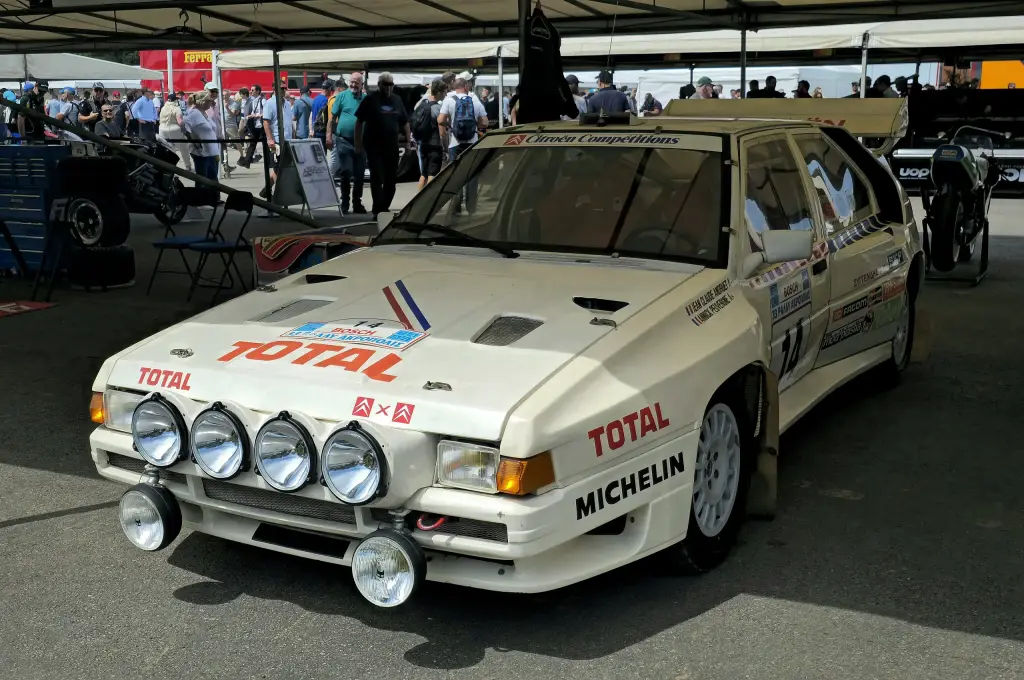
The BX was meant to be light and to use as few body parts as possible, many of them plastic: bonnet, tailgate and bumpers were all moulded in plastics, and the car had disc brakes front and rear. It kept Citroën’s hydropneumatic self-levelling suspension. Advertising pushed the point from both sides: in France the slogan was “J’aime, j’aime, j’aime”, with music written for the campaign by Julien Clerc, while in Britain it was “Loves Driving, Hates Garages”, aimed at the GS/GSA’s reputation for expensive maintenance.
Engines and the diesel reputation
The air-cooled flat four of the GS was dropped in favour of the PSA X, TU and XU petrol engines of 1,360, 1,580 and, from 1984, 1,905 cc; a 1,124 cc unit was sold in countries where tax depended on engine size, such as Ireland, Italy, Portugal and Greece. The 1.6 was the first car to use the new short-stroke XU engine, built at a plant at Trémery erected for it. The XUD diesel arrived in November 1983, and the diesel and turbodiesel models became the most successful versions, especially as estates; the BX was Britain’s best-selling diesel car for four years from 1987. Petrol cars were badged 11, 14, 16 and 19 by engine size, except the “17” diesel, which was a 1,769 cc 1.8.
Estate, Phase II and the end
A year after the hatchback, an estate — Break or Evasion — appeared, all of them built by Heuliez at Cerizay. Power steering became optional in 1984, a ZF four-speed automatic was offered from July 1984, and four-wheel drive and turbodiesels came in the late 1980s; the BX Turbo Diesel of 1988 was praised for bringing refinement and performance to the diesel market. The Phase II of 1986 replaced the eccentric satellite switchgear and bathroom-scale speedometer with conventional stalks and analogue instruments, and rounded the bumpers. The hatchback was discontinued in 1993 when the Xantia arrived, but the estate lasted another year.
Design and features
- Gandini styling: a sharp, angular hatchback derived from two earlier Bertone show cars.
- Hydropneumatic suspension: self-levelling, the Citroën signature kept in a mass-market car.
- Plastic body panels: bonnet, tailgate and bumpers, to save weight and cost.
- Disc brakes all round: unusual in the family class at the time.
- Diesels: the XUD engine made the BX Britain’s best-selling diesel for four years.
Citroën BX versions
- Hatchback (1982–1993): the main body style.
- Break/Evasion estate: built by Heuliez, sold until 1994.
- BX 11: 1,124 cc, for tax-sensitive markets.
- Diesel and Turbodiesel: including the 1988 BX Turbo Diesel.
- Phase II (1986): new interior and rounded bumpers.
- GTi and 4×4: the performance and all-wheel-drive versions.
The BX replaced the GS and was replaced by the Xantia, and it was followed in the range by the ZX. More cars are in the Citroën collection.
Video: Entstehung des Citroën BX –Teil1–
Video by citrofan on YouTube.
Sources
- Citroën BX, English Wikipedia: design, launch, engines, estate, Phase II, production