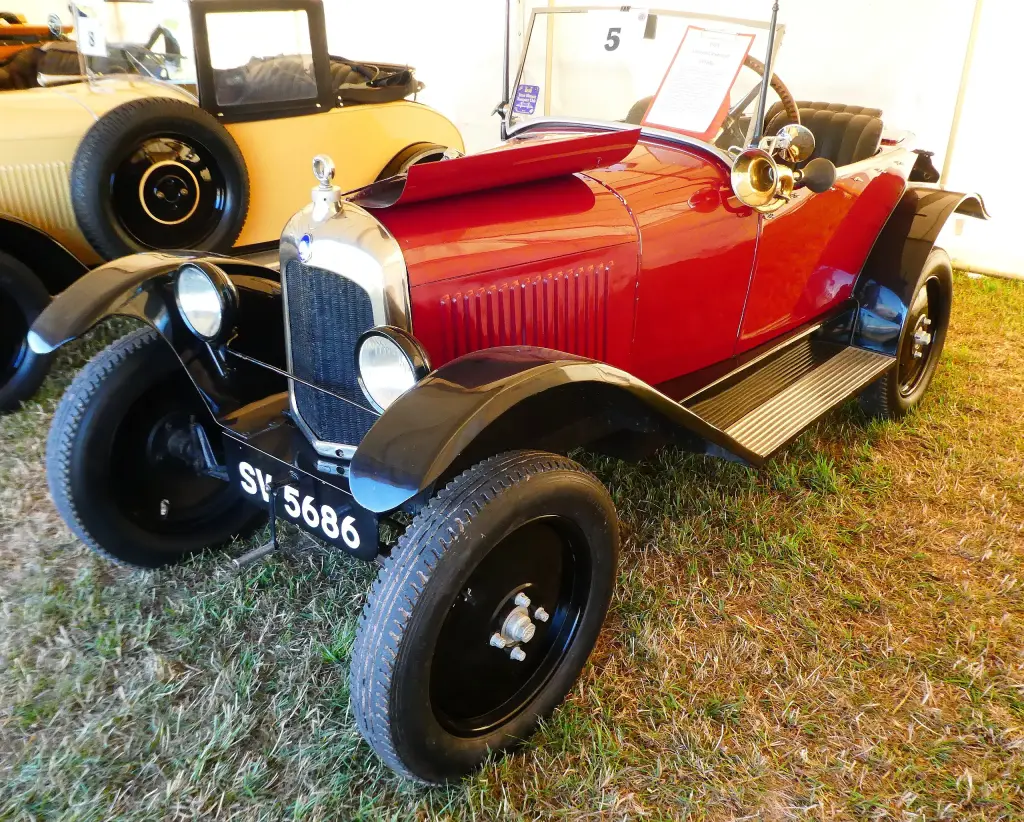
The Citroën Type C was a light car made between 1922 and 1926, with almost 81,000 units built. It was known as the Citroën 5HP or 5CV in France and the 7.5HP in Britain, and it was the second model André Citroën designed and marketed.
Citroën Type C 5HP at a glance
| Maker | Citroën, Quai de Javel, Paris |
|---|---|
| Production | 1922–1926 |
| Built | almost 81,000 |
| Shown | Motor Show, November 1921; deliveries from spring 1922 |
| Designer | Edmond Moyet |
| Body at launch | two-seat Torpedo only |
| Length | 3.2 m, with a 2.25 m wheelbase |
| Price in 1922 | 8,500 francs, about 60% of a 10 HP B2 |
| Power | 5HP, renamed 5CV in 1925 with the new tax calculation |
| Top speed | about 60 km/h |
| Nicknames | petite citron, cul de poule, trèfle |
Based on one source (English Wikipedia).
History of the Citroën Type C 5HP
Edmond Moyet’s little car
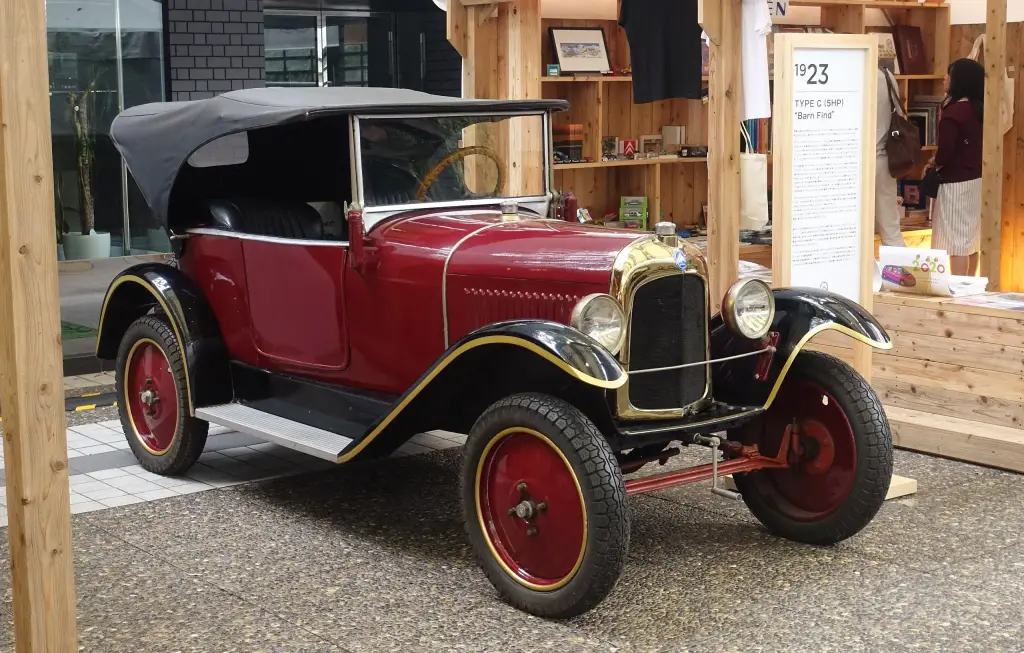
The Type C was the work above all of the engineer Edmond Moyet, who like Jules Salomon had come to the Quai de Javel from “le Zèbre” after wide experience with popular cars, and who a few months earlier had designed a very similar vehicle for Amilcar, the CC. It was presented for the first time at the Motor Show in November 1921 as the Type C, although orders and first deliveries came only in spring 1922. It was a small car offered only with a two-seater Torpedo body, 3.2 m long on a 2.25 m wheelbase, elegant despite its size, with one of the most handsome radiator masks of the period and a tapered boat-deck rear.
Cheap, complete and aimed at women
The 5HP entered the market below the 10 HP Type A and came complete, at no extra charge, with electric starting and lighting, five tyred wheels and a rear axle with a differential. At 8,500 francs in 1922 the Torpedo cost about 60% of a 10 HP B2 at 13,900, and far less than its main rival, the Peugeot Quadrilette at 10,000, which was only a cyclecar. Citroën founded a consumer credit company so customers could buy on credit, and invented the spare parts manual, the repair instructions, detailed repair rates and a standard exchange system for factory-refurbished parts. Unusually for the time, the car was promoted to a female audience: all the 5HP advertising showed it driven by a young woman.
The little lemon
The first colour was a pale grapefruit yellow, which earned the car its first nickname, petite citron, little lemon. It was also called cul de poule, hen’s bottom, and boat tail, for the shape of the rear, and Trèfle, clover leaf, for the three-seat version. After a slow start in 1922 the car was so successful that by 1924 it made up half of Citroën’s sales, nearly 30,000 vehicles a year, and became the leading popular European car. Pierre Dumont wrote that the 5 CV ran at 60 km/h, a speed it seemed able to keep indefinitely, and that it was incredibly robust. The commercial name changed from 5HP to 5CV in 1925 when the tax calculation moved from horsepower to cheval vapeur.
Design and features
- Two-seat Torpedo: the only body at launch, just 3.2 m long.
- Complete equipment: electric starting and lighting, five wheels and a differential included.
- Low price: 8,500 francs against 13,900 for the 10 HP B2.
- Consumer credit: Citroën set up a finance company so buyers could pay over time.
- Sold to women: a rare marketing approach in the early 1920s.
Citroën Type C 5HP versions
- Torpedo two-seater (1922): the original body.
- Trèfle (clover leaf): the three-seat version.
- Cabriolet: the open version praised for its elegance.
- 5CV: the name used from 1925.
The Type C sat below the Type A in price and followed the Type B2. More cars are in the Citroën collection.
Video: autoškola-první jízda-Citröen 5CV 1924
Video by Jonathan Proudvol on YouTube.
Sources
- Citroën Type C 5HP, English Wikipedia: design, price, equipment, marketing, production