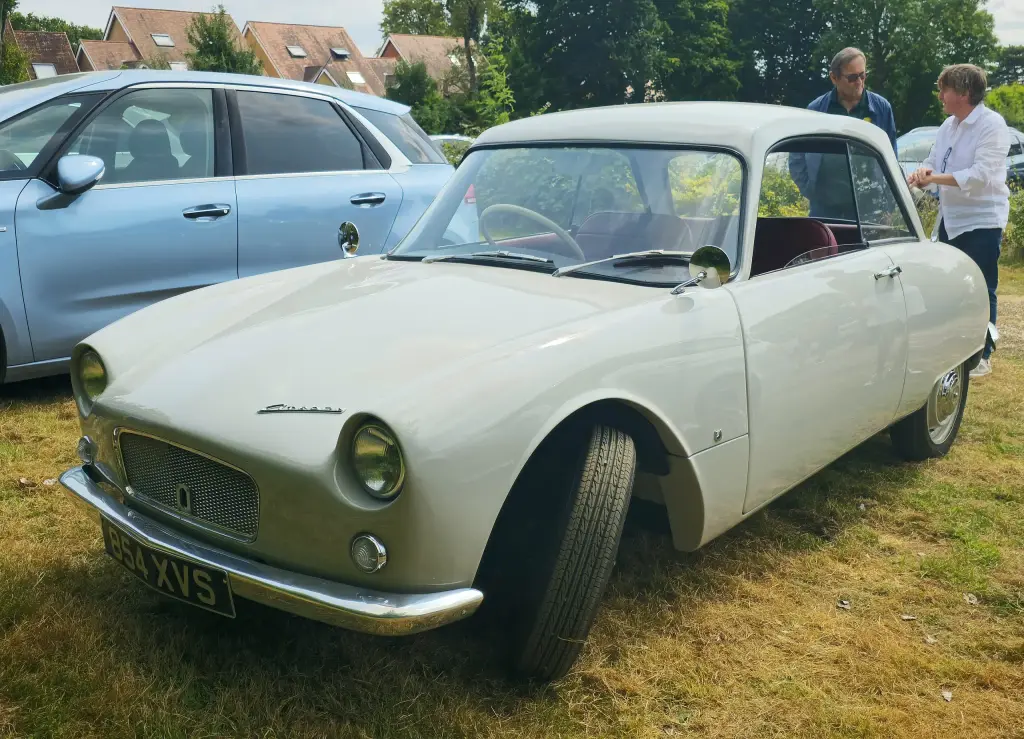
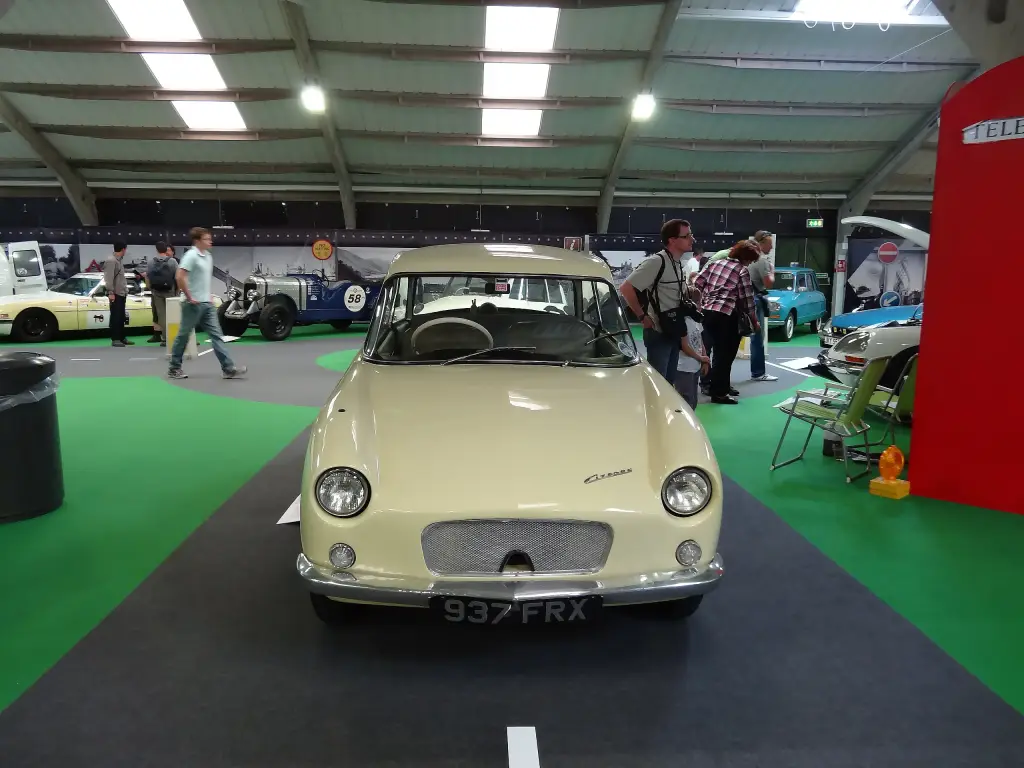
The Citroën Bijou is a small coupé that Citroën built at its Slough works in England from 1959 to 1964. It used the platform chassis of the 2CV and its interconnected independent suspension, wrapped in a body meant to suit British taste better than the utilitarian 2CV.
Citroën Bijou at a glance
| Maker | Citroën, Slough, England |
|---|---|
| Production | 1959–1964 |
| Body | fibreglass coupé |
| Chassis | Citroën 2CV platform |
| Engine | two-cylinder, 425 cc, 12 bhp |
| Designer | Peter Kirwan-Taylor |
| Bodies moulded | by Whitson & Co, then another supplier |
| Price | £674 at the 1959 motor show |
| Built | 210, plus two prototypes |
| Citroën parts | some DS components, notably the single-spoke steering wheel |
Based on one source (English Wikipedia).
History of the Citroën Bijou
A 2CV for British eyes
The Bijou was built at the premises Citroën had occupied at Slough since 1925. Its appearance was thought to be more in line with the conservative taste of British buyers than the utilitarian 2CV, while underneath it kept the same platform chassis and the advanced independent suspension connected front to rear.
Fibreglass and a Lotus designer
The body was made of fibreglass, and the car used the two-cylinder 425 cc engine of 12 bhp also seen in the 2CV. It incorporated some components from the DS, most noticeably the single-spoke steering wheel. It was designed by Peter Kirwan-Taylor, known as the stylist of the elegant 1957 Lotus Elite, another fibreglass-bodied car. Bijou bodies were initially moulded by a company called Whitson & Co, close to the Slough premises, but the work later had to be transferred to another supplier.
Why it failed
Sales were disappointing, and the reason was price. At the 1959 motor show the Bijou cost £674, at a time when the British market was acutely price sensitive: a Ford Popular with four seats and a much larger engine cost £494. The Bijou was also more expensive than the Austin Mini, although it was supposed to be more distinguished. Its more modern styling did give it a higher top speed and lower cruising fuel consumption than the equivalent 2CV, but the heavier body hurt acceleration, and testers considered the car expensive. By 2013 nearly 150 Bijous were on the 2CVGB club register, but fewer than 40 were still on the roads.
Design and features
- Fibreglass coupé body: a British-made shape on 2CV running gear.
- 425 cc flat twin: 12 bhp, with a higher top speed than the 2CV it was based on.
- DS steering wheel: the single-spoke wheel among other DS parts.
- Interconnected suspension: the 2CV’s independent system, front to rear.
- Rarity: 210 cars and two prototypes.
Citroën Bijou versions
- Bijou (1959–1964): the production coupé.
- Prototypes: two cars built before production.
The Bijou was built on the 2CV and borrowed details from the DS. More cars are in the Citroën collection.
Video: Citroen Bijou.m4v
Video by Roadtrackraceltd on YouTube.
Sources
- Citroën Bijou, English Wikipedia: production, body, engine, designer, price, survival