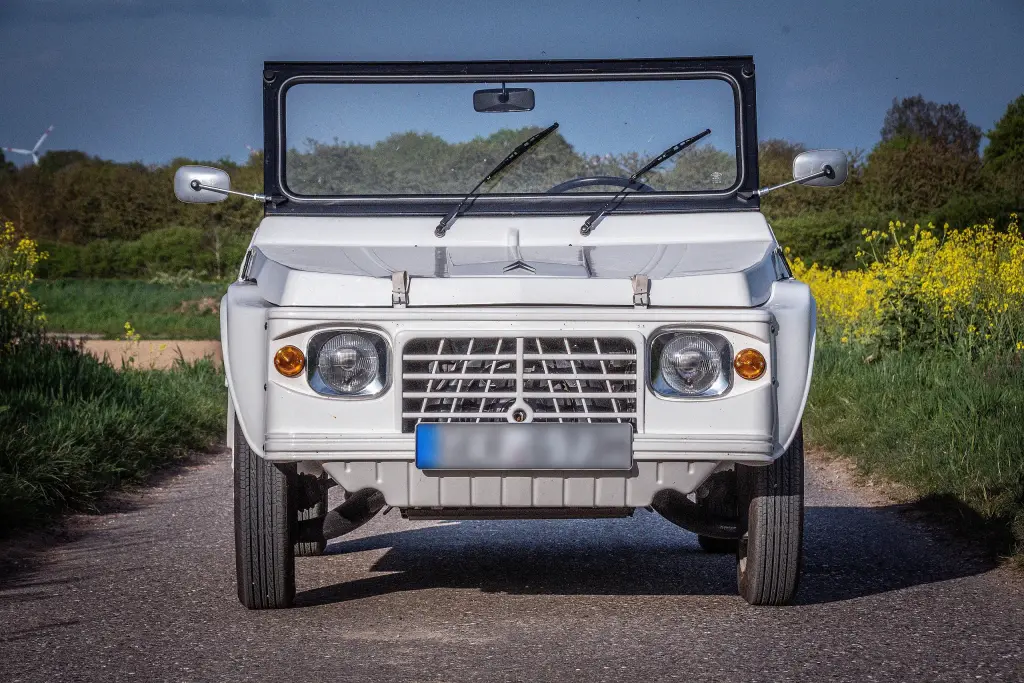
The Citroën Méhari is a lightweight recreational and utility vehicle built over 18 years in a single generation, with front-wheel drive from 1968 to 1988 and four-wheel drive from 1980 to 1983. It has ABS plastic bodywork, doors that can be removed and a fabric top that folds away.
Citroën Méhari at a glance
| Maker | Citroën, France |
|---|---|
| Production | May 1968–1988 |
| Built | 144,953 |
| Weight | about 535 kg |
| Body | ABS plastic, removable doors, folding fabric top |
| Engine | 602 cc flat twin, shared with the 2CV6, Dyane and Ami |
| Chassis | A-Series, as on the Dyane 6 in production form |
| Four-wheel drive | 1980–1983, with inboard rear disc brakes |
| French army order | 7,064 vehicles |
| Facelift | 1977 for the 1978 model year |
Based on one source (English Wikipedia).
History of the Citroën Méhari
Designed by a fighter ace
The Méhari was designed by Count Roland de la Poype, a French World War II fighter ace who headed SEAB, the company that developed the idea of a plastic rather than fibreglass body. De la Poype studied the fashionable Mini Moke and set out to improve on its low ground clearance, hard suspension and rust-prone body. SEAB was already a supplier to Citroën and built a working concept before presenting it to its client, using the somewhat stronger chassis of a 2CV Fourgonnette; production cars used the Dyane 6 chassis. The car is named after the méhari, the fast-running dromedary camel. Citroën built 144,953 between the French launch in May 1968 and the end of production in 1988, and the Méhari used the Dyane’s headlights and bezels.
The French army and the 4×4
The French Army bought 7,064 Méharis, some modified to 24 V electrics to run two-way radios. In 1979 Citroën launched the Méhari 4×4, which unlike the 2CV Sahara had a single engine rather than one per axle. It used the heavier Ami Super floorpan and suspension parts, gained inboard rear disc brakes and had discs on all four wheels, and at the time it was one of the few four-wheel-drive cars with fully independent suspension. Outside, it was recognised by the spare wheel mounted on a specially designed bonnet, steel bullbars front and rear and tail lights similar to the Acadiane’s; for 1982 it received flared arches and larger optional tyres. The gearbox had four normal speeds and a three-speed transfer box for slopes up to 60%, and a tachometer was standard to protect the engine when the reduction gear was in use. Production stopped in 1983: the army, the intended customer, was not interested, and the 4×4 cost twice as much as the standard car, so it sold in small numbers to private buyers.
Editions and the wider world
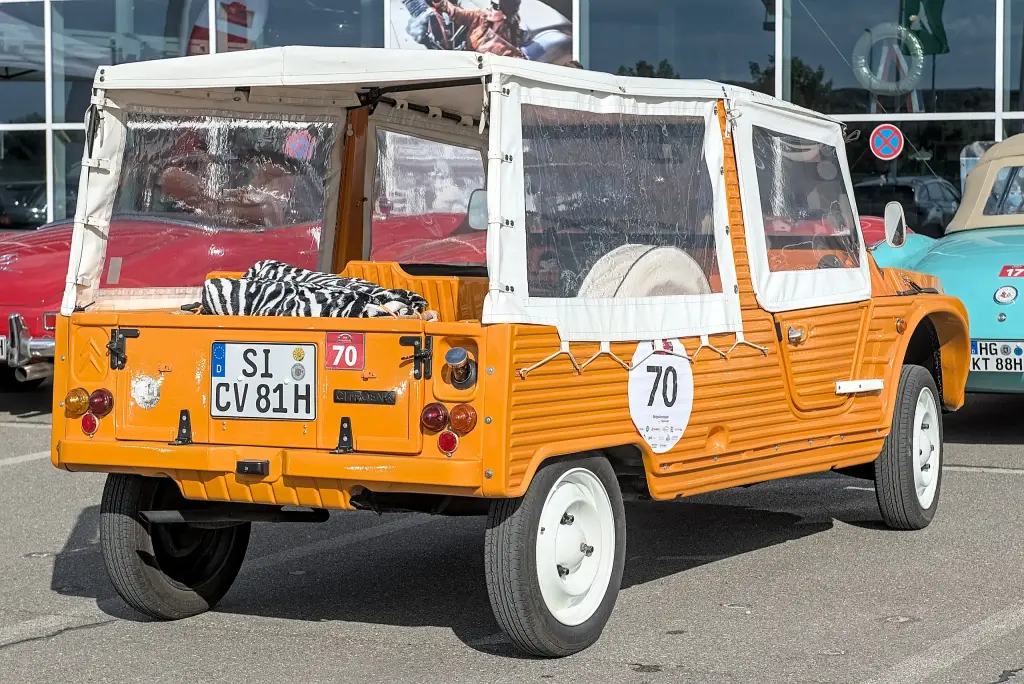
Two limited editions were sold: the Azur, planned for 700 cars but added to the normal range after its success, with a white body and blue doors, grille and top and blue-and-white striped seats, and the Plage for the Iberian market, built at Mangualde in Portugal with a yellow body and white rims. The Méhari was also produced at Vigo in Spain from late 1969 to 1980, with 12,480 built, and in Portugal with 17,500. It was never type-approved for Britain. In the United States it was sold for 1969 and 1970 as a truck, which allowed it to be sold without seat belts, and Budget Rent-A-Car offered it in Hawaii while Hearst Castle used it for its groundskeepers; Elvis Presley featured a US model in his 1973 broadcast Aloha from Hawaii.
Design and features
- ABS body: plastic panels that could not rust, unlike the Mini Moke it answered.
- Removable doors and folding top: open-air motoring in a utility package.
- 535 kg: light enough for the 602 cc flat twin to move it briskly.
- Méhari 4×4: one engine, four driven wheels and a three-speed transfer box.
- Military and rental service: the French army took 7,064, and US rentals used it in Hawaii.
Citroën Méhari versions
- Méhari (1968–1988): the standard front-wheel-drive car.
- Méhari 4×4 (1980–1983): four-wheel drive with a spare wheel on the bonnet.
- Méhari Azur: white with blue doors, grille and top.
- Méhari Plage: the Iberian edition built in Portugal.
- Military version: 24 V electrics for radio equipment.
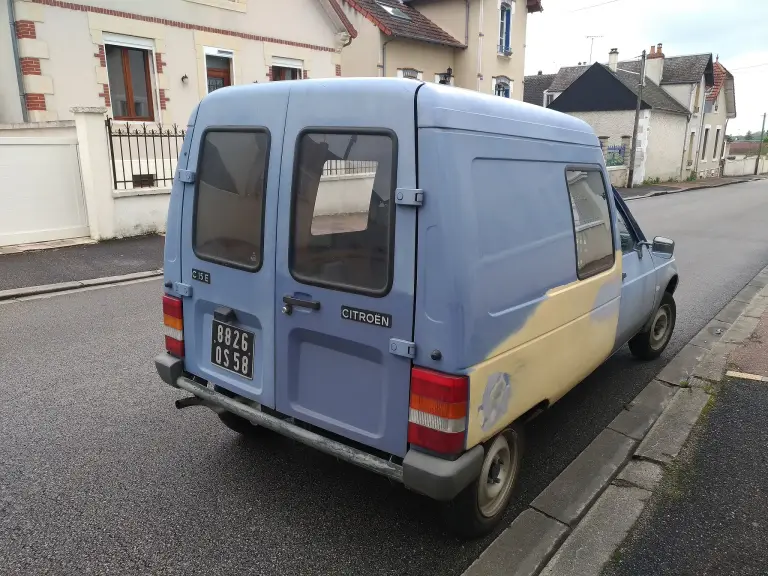
The Méhari was built on the 2CV family and shares its idea with the steel-bodied FAF. The van version of the same mechanicals is the Acadiane. More cars are in the Citroën collection.
Video: Testbericht: Citroën Méhari (1979) – AutoScout24
Video by AutoScout24 Schweiz on YouTube.
Sources
- Citroën Méhari, English Wikipedia: design, engines, 4×4, editions, international production