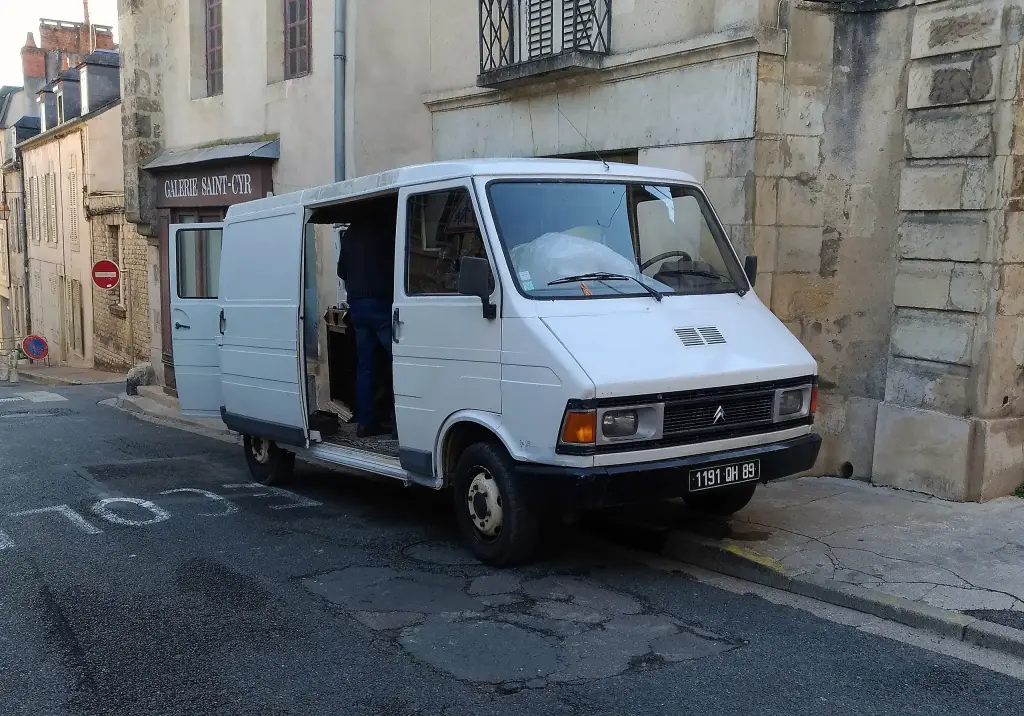
The Citroën C35 is a 3.5-tonne utility vehicle sold from March 1974 to 1991, the first cooperation between Citroën and Fiat in commercial vehicles. In Italy the same van was sold as the Fiat 242.
Citroën C35 at a glance
| Maker | Citroën, with Fiat |
|---|---|
| Production | March 1974–1991 |
| Gross weight | 3.5 tonnes, with a 3.2-tonne C32 version in the early years |
| Sister model | Fiat 242 |
| Engines | Citroën B20/614 petrol, B22/615 and B25/637 diesel |
| Engine origin | derived from the DS/D Super powertrain |
| Suspension | independent on all four wheels, torsion bars |
| Brakes | discs on all four wheels, high-pressure actuation, double-piston calipers |
| Handbrake | a fifth disc behind the gearbox |
| Steering | rack and pinion, never power assisted |
| Later assembly | Chausson, France, from 1987 to 1991 |
Mainly based on the French Wikipedia article on the C35, with the English article on the Fiat 242 for the production arrangement.
History of the Citroën C35
A modern van for 1974
The C35 was the result of a technical cooperation between Fiat and Citroën, and it was the forerunner of the agreements that produced the Sevel company, whose plants built the Fiat Ducato and the Citroën C25 and Jumper. In France it competed mainly with the Peugeot J7 and the Renault Master I. Like the Italian original, the C35 had a modern, styled body with a large glazed area, a sharp contrast with the ageing Type H, and it was the first van to be fitted with a shield-type front bumper.
Unusual engineering
The van was modern for its time, with independent suspension on all four wheels by torsion bars, as on the Type H, and four disc brakes operated by high pressure with double-piston calipers, as on the GS and CX cars. The handbrake acted on a fifth disc at the back of the gearbox on the secondary shaft, a solution then used on some lorries. The steering was rack and pinion and never received assistance, and some vans had anti-roll bars.
Citroën engines in a Fiat-bodied van
Unlike the Type H, every engine was a Citroën unit: the B20/614 petrol and the B22/615 and B25/637 diesels, derived from the powertrain of the D range — DS Spécial and D Super. The engine turned in the same direction as in the cars, but because it was mounted ahead of the front axle the gearbox had reduction gears that reversed the rotation of the driveshafts. As Fiat wanted, the engines were mounted transversely at the front. Timing was by chain on the petrol and by a train of gears on the diesels. The petrol Fiat 242, by contrast, used a Fiat engine.
Bodies, updates and the end
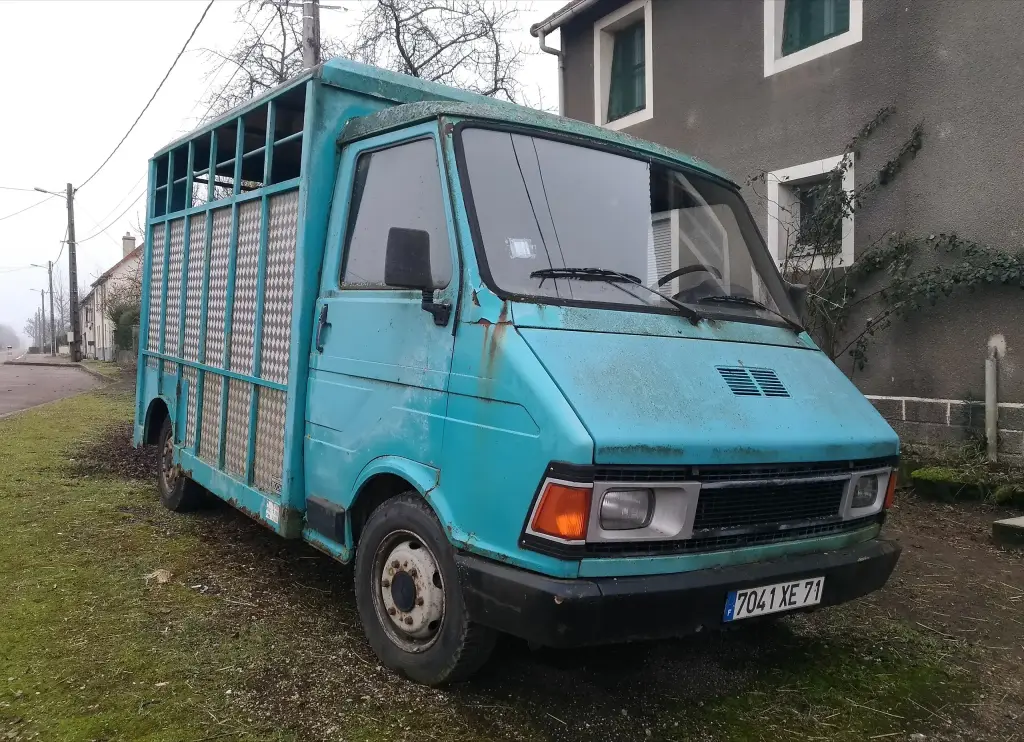
Many body styles and conversions were possible: panel van, flatbed with a tarpaulin, minibus, school transport, camper, ambulance, cattle transporter, vans by Theault and Heuliez and a six-wheel recovery vehicle by Rhodes Industrie. In 1980 the C35 became the C35 L with a 2.5-litre diesel, protruding front indicators, side protection and a reversing light; for the 1984 model year the C35 R received a new dashboard. Italian production stopped in 1987, when Citroën negotiated the rights and component supply and moved the assembly line to Chausson in France, where the van was built until 1991. It never received a turbodiesel, unlike the C25, and was replaced first by the heavier Ducato/C25 versions and from 1994 by the Jumper.
Design and features
- Citroën engines: B-series petrol and diesel units derived from the DS and D Super.
- Four-wheel independent suspension: torsion bars on all four wheels.
- High-pressure disc brakes: double-piston calipers, with the handbrake on a fifth disc.
- First shield bumper: the C35 was the first van with a bumper of this type.
- Wide conversion range: minibus, ambulance, camper, cattle truck and a six-wheel recovery vehicle.
Citroën C35 versions
- C35 (1974): the original 3.5-tonne van.
- C32: a 3.2-tonne version offered in the early years.
- C35 L (1980): 2.5-litre diesel and updated details.
- C35 R (1984 model year): new dashboard.
- Fiat 242: the Italian twin with Fiat petrol engines.
The C35 came before the Jumper and the Sevel-built vans, and it was a bigger alternative to the C15. Its ancestor on the larger side is the H Van. More cars are in the Citroën collection.
Video: buying the citroen c35
Video by MaartenH on YouTube.
Sources
- Citroën C35, French Wikipedia: dates, engineering, engines, versions, assembly
- Fiat 242, English Wikipedia: shared production with Fiat