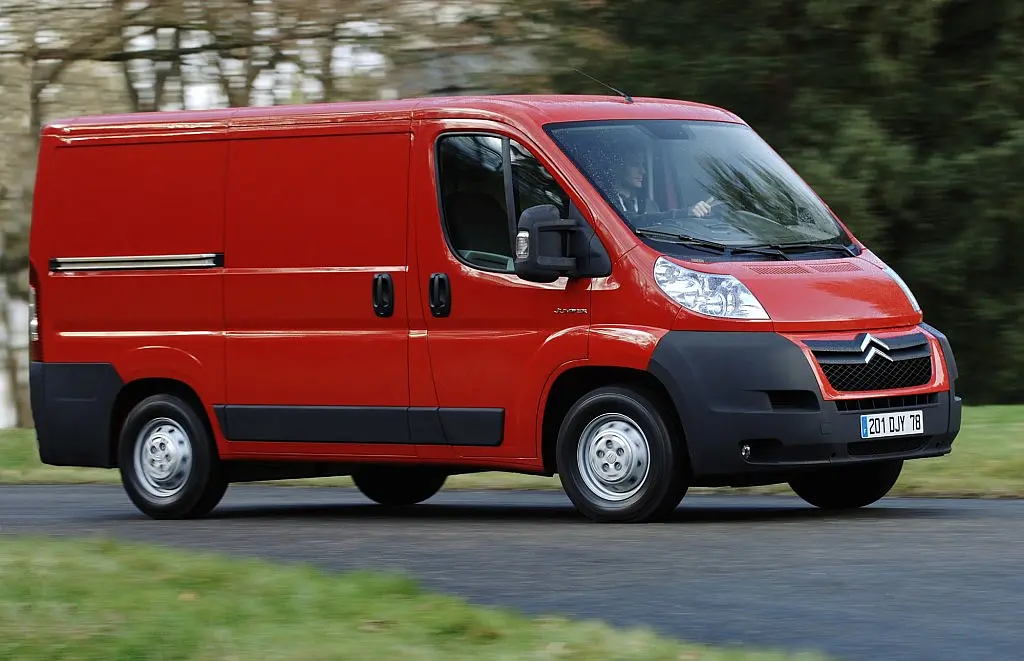
The Citroën C25 and its successor the Citroën Jumper, called Relay in some markets, are the French versions of the Fiat Ducato, a light commercial vehicle developed jointly by Fiat and PSA and built since 1981 by the Sevel joint venture.
Citroën Jumper at a glance
| Maker | Sevel, for Citroën and Fiat |
|---|---|
| C25 production | October 1981–1993 |
| Jumper production | from 1994 |
| C25 capacity | 2.5 tonnes, hence the name |
| C25 engines | Peugeot 504 petrol and Citroën CX diesel, both transverse |
| C25 gearbox | Citroën |
| C25 range | pickup and minibus added in February 1982 |
| Series 2 | 1991, with an enlarged grille |
| Sister models | Peugeot J5, Talbot Express, Alfa Romeo AR6, later Peugeot Boxer |
| Ducato production | more than 3.5 million since 1981 |
| British name for the Jumper | Relay |
Based on one source: the English Wikipedia article on the Fiat Ducato, which covers the Citroën C25 and Jumper. The free photographs available show Fiat-badged Ducatos, so the record keeps its existing cover image.
History of the Citroën Jumper
1981: the C25
The Citroën C25 was a van of 2.5 tonnes capacity, hence the name, produced from October 1981 until 1993, and it succeeded the dated corrugated Type H one-tonne van. It was one of four badge-engineered versions of the new Ducato, along with the Fiat itself, the Peugeot J5 and the Alfa Romeo AR6, built at the Sevel plants at Atessa in central Italy and Pomigliano d’Arco near Naples; the Fiat-PSA collaboration had already produced the Fiat 242 and Citroën C35 from 1974. The C25’s engines were mounted transversely, with a Peugeot 504 petrol unit and a diesel from the Citroën CX, both coupled to a Citroën gearbox. In February 1982 the range was extended with a pickup and a minibus, and in 1991 the C25 series 2 appeared with an enlarged grille.
1994: the Jumper
From 1994 the C25 was replaced by the Citroën Jumper, known as the Relay in the United Kingdom and then Australia, built on the second generation of the Ducato. Its Peugeot sister became the Boxer, sold as the Manager in Mexico. The Ducato itself has been produced at Atessa in Italy and in Brazil, Turkey, Mexico and Russia, and more than 3.5 million have been built since 1981. Four-wheel-drive versions are converted by the French company Dangel with a central viscous coupling.
The most popular motorhome in Europe
The Ducato and its sisters became the most common motorhome base in Europe, with about two-thirds of motorhomes using it, and Fiat began offering campervan manufacturers a platform developed for the purpose in 1990. In July 2019 an electric version was presented, on sale from 2020, and a refreshed model appeared for 2024. The van has also been rebadged as the Ram ProMaster for North America from 2014, the Opel and Vauxhall Movano from the 2022 model year and the Toyota Proace Max from 2023.
Design and features
- Sevel engineering: one van for Citroën, Peugeot, Fiat, Alfa Romeo and later more brands.
- Citroën diesel: the C25 used the CX’s diesel engine with a Citroën gearbox.
- Pickup and minibus: added to the C25 range in February 1982.
- Camper base: about two-thirds of European motorhomes are built on this platform.
- Dangel 4×4: four-wheel drive with a central viscous coupling.
Citroën Jumper versions
- Citroën C25 (1981–1993): the first generation.
- C25 series 2 (1991): larger grille.
- Citroën Jumper (from 1994): second-generation Ducato.
- Citroën Relay: the British and Australian name for the Jumper.
- Peugeot J5 and Boxer, Talbot Express, Alfa Romeo AR6: the sister vans.
The Jumper took over from the C35 and the Type H described under H Van, and it sits above the Jumpy in the range. More vehicles are in the Citroën collection.
Sources
- Fiat Ducato, English Wikipedia: C25, Jumper, Sevel production, variants, volumes