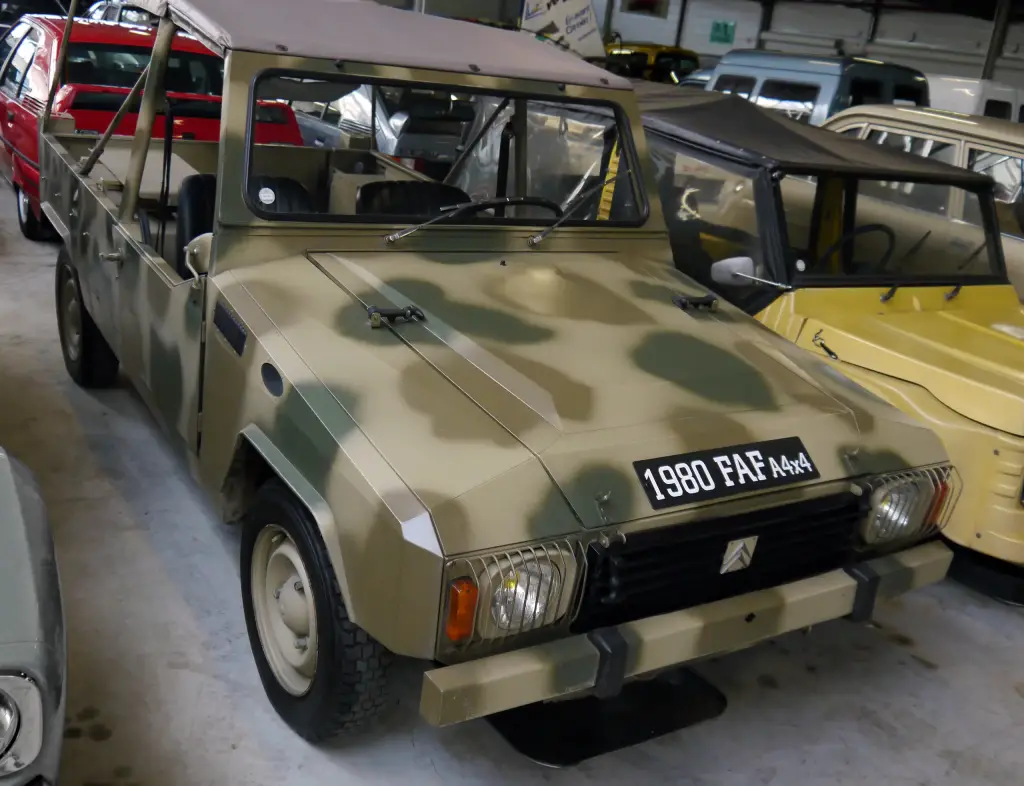
The Citroën FAF is a small utility vehicle produced from 1973 until 1981, built from a combination of imported and locally sourced parts in various developing countries. Its body was made of easy-to-produce folded steel panels, giving it the look of a metal-bodied Méhari.
Citroën FAF at a glance
| Maker | Citroën, assembled in developing countries |
|---|---|
| Production | 1973–1981 |
| Base | Citroën 2CV mechanicals |
| Body | folded steel panels, flat and simple |
| Name | Facile à Fabriquer, Facile à Financer |
| Main target market | Africa |
| Inspiration | the 1963 Baby-Brousse of Ivory Coast |
| Related versions | La Dalat, Pony, Jyane-Méhari, Yagan |
| Baby-Brousse sales | more than 30,000 |
Based on one source (English Wikipedia).
History of the Citroën FAF
A car meant to be built locally
The idea came from the privately built 1963 Baby-Brousse of Ivory Coast and its many derivatives, among them La Dalat in Vietnam, the Pony in Greece, the Jyane-Méhari in Iran and the Yagan in Chile; the Baby-Brousse cars alone sold more than 30,000. Both the FAF and the Baby-Brousse were derived from the 2CV, and because the concept came before the name, it is often wrongly reported that some Baby-Brousse vehicles were based on the FAF. The flat metal panels and simple components were chosen so the vehicle could be produced easily, mostly in developing countries.
The name and the market
FAF stood for Facile à Fabriquer and Facile à Financer — easy to manufacture, easy to finance. The primary target market was Africa, but the idea of a “second-class” car attached to the FAF seems to have hurt it, and sales stayed low.
The family around it
The FAF overlapped with a wave of Baby-Brousse 2CV-based vehicles. In 1969 Citroën’s Vietnamese subsidiary began building La Dalat, the first car manufactured in Vietnam; production ended when the Americans left Saigon in 1975, after 3,880 cars. In 1975 the Greek firm Namco began production of the Pony, after introducing it in 1972; it became the most successful of these simplified 2CV utilities, with 30,000 sold and exports including to the United States, and it ended in 1983, two years after Greece joined the European Union, with 67% of its parts of Greek origin. An attempt to start production in Sri Lanka by the Ceylon Transport Board in the early 1970s failed over royalties, though a prototype was shown at the Republic Day celebrations in 1974. In Iran the car was sold as the Méhari, although it did not have a plastic body like the real one, with about 9,000 built in the 1970s.
Design and features
- Folded steel body: flat panels that could be pressed with simple, cheap tooling.
- 2CV underneath: the same mechanicals as the car that inspired the idea.
- Local assembly: designed for production in developing countries from a mix of imported and local parts.
- Méhari look: a metal-bodied version of the plastic-bodied Citroën.
- A whole family: La Dalat, Pony, Jyane-Méhari and Yagan followed the same recipe.
Citroën FAF versions
- FAF (1973–1981): the Citroën-badged version.
- La Dalat (1969): built in Vietnam, 3,880 cars.
- Pony (1972): Greek production, 30,000 built.
- Jyane-Méhari: the Iranian version.
- Yagan: the Chilean version.
The FAF was built on the 2CV and looked like a metal Méhari. More cars are in the Citroën collection.
Sources
- Citroën FAF, English Wikipedia: origin, name, target market, Baby-Brousse family