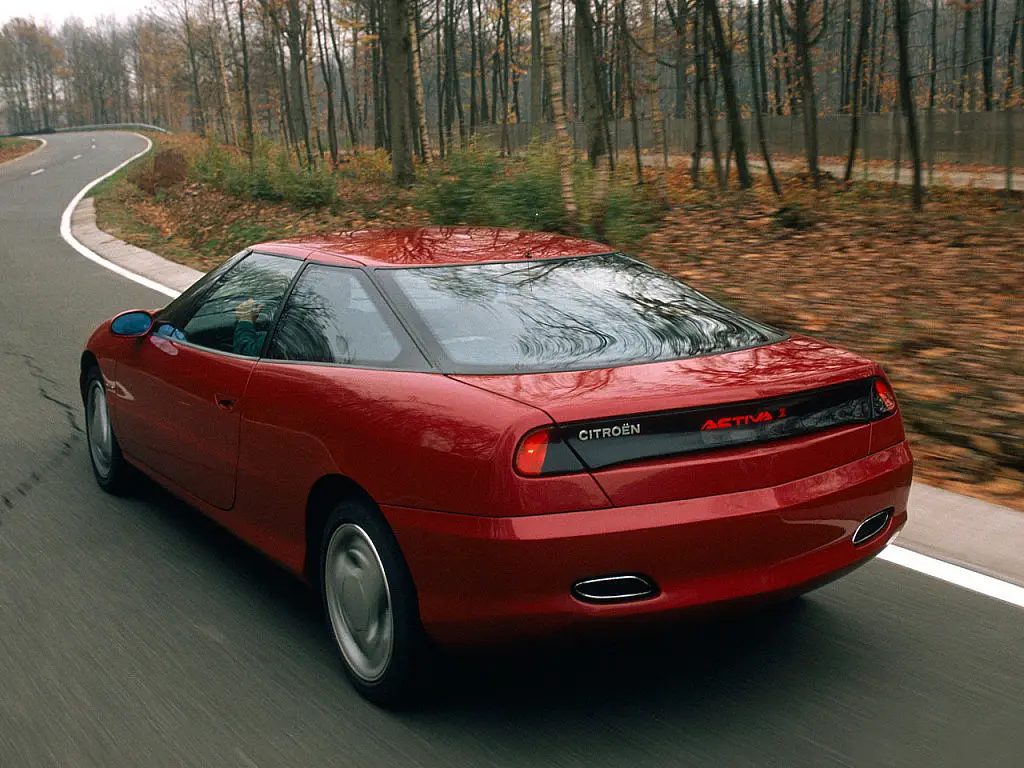
The Citroën Activa and Activa 2 were two concept cars built to test and to show features intended for future production Citroëns. They were unveiled at the Paris Motor Show in 1988 and 1990, and the name was later used for the production Xantia fitted with Activa suspension.
Citroën Activa at a glance
| Maker | Citroën, France |
|---|---|
| Type | two concept cars |
| Shown | Paris Motor Show, 1988 and 1990 |
| Key system | Hydractive hydropneumatic suspension with an active anti-roll bar |
| Activa 1 engine | 3.0-litre SOHC PRV 24-valve V6, 200 PS at 6,000 rpm |
| Activa 1 torque | 260 N·m at 3,600 rpm |
| Activa 1 gearbox | four-speed automatic |
| Activa 1 top speed | 136 mph (219 km/h), claimed |
| Activa 2 top speed | 235 km/h (146 mph), claimed |
| Activa 2 built by | Bertone, on the XM floor pan |
| First production use | Hydractive on the XM in 1989, the Xantia in 1993 |
Based on one source (English Wikipedia). No free photograph of the Activa concept cars was found, so the article uses the record’s existing cover image.
History of the Citroën Activa
1988: Activa 1
The first car combined electronically controlled hydropneumatic suspension, known as Hydractive, with an active anti-roll bar. That married Citroën’s hydropneumatic system to electronics, so the handling could adapt automatically to how the car was driven and body roll — one of the main criticisms of the hydropneumatic cars — was virtually eliminated. The Activa 1 also had hydraulically connected single-wheel independent four-wheel steering, anti-lock brakes and traction control, all high technology for 1988, plus electrically operated doors that could be opened together by remote control. Power came from a 3.0-litre SOHC PRV 24-valve V6 of 200 PS at 6,000 rpm and 260 N·m at 3,600 rpm, driving through a four-speed automatic, for a claimed 136 mph.
1990: Activa 2
The second car was more conventional apart from the anti-roll system: instead of a gear lever it had a keypad in the centre console, and it carried a navigation system. It was a fully functional prototype based on the XM’s floor pan, with the same 24-valve 3.0-litre V6 and four-speed automatic as the Activa 1, and a claimed top speed of 235 km/h. The prototype was mainly built by Bertone, who had the expertise to build running cars, and journalists drove it at the time as part of a push to build interest in Hydractive.
From show car to production
The Activa 2 was considered as a production successor to the SM, but Citroën decided its image would make it too hard to compete with Mercedes-Benz and Porsche in the grand touring market. The technology, however, did reach customers: Hydractive appeared first on the XM in 1989 and on the Xantia in 1993, and in 1995 the active anti-roll bar of the Activa prototypes went into the Xantia Activa, one of the few production cars with active suspension.
Design and features
- Hydractive suspension: hydropneumatics under electronic control, adapting to the driver.
- Active anti-roll bar: the feature that all but removed body roll, a traditional Citroën weakness.
- Four-wheel steering: hydraulically connected single-wheel steering on the Activa 1.
- Electronic aids: anti-lock brakes and traction control in 1988.
- Keypad and navigation: the Activa 2 replaced the gear lever with a console keypad.
Citroën Activa versions
- Activa 1 (1988): V6, four-wheel steering, powered doors, 219 km/h claimed.
- Activa 2 (1990): XM-based grand tourer by Bertone, 235 km/h claimed.
- Xantia Activa (1995): the production car that inherited the active anti-roll bar.
The production cars that carried this technology are described under the XM and the Xantia; the grand tourer the Activa 2 was meant to succeed is the SM. More cars are in the Citroën collection.
Video: Citroën Activa Prototype German Video
Video by citrofan on YouTube.
Sources
- Citroën Activa, English Wikipedia: both concepts, engines, systems, production legacy