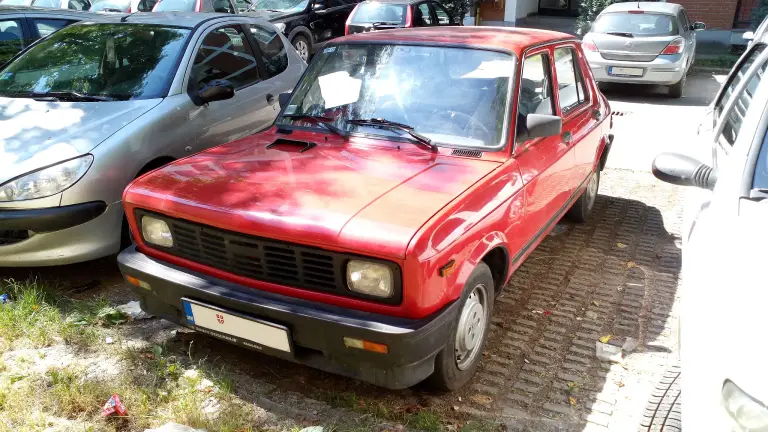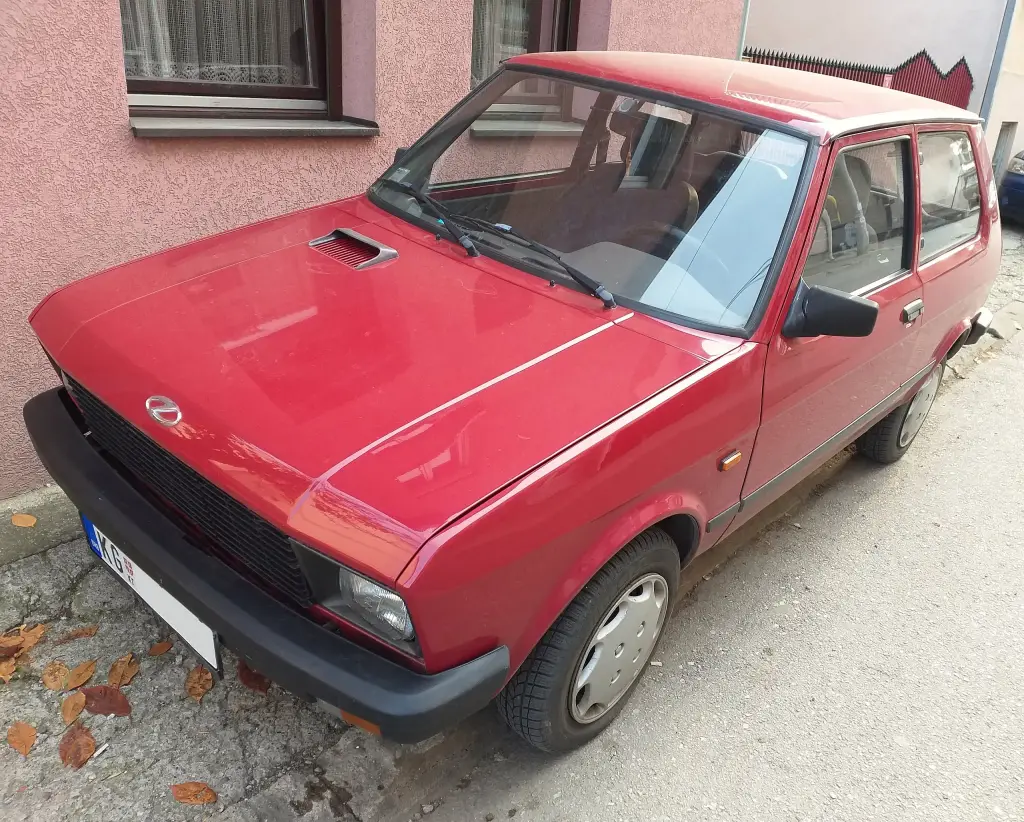
The Zastava Koral is a subcompact hatchback that Zastava built from 1980 until 2008. Known at first as the Zastava Jugo 45 and best known abroad as the Yugo, it was the only Yugoslav car ever exported to the United States, and more than 794,000 were made.
Zastava Koral at a glance
| Also known as | Yugo, Zastava Jugo 45, Yugo Koral, Yugo Tempo, Jugo |
|---|---|
| Maker | Zastava Automobiles, Kragujevac |
| Project name | Zastava 102 |
| Production | 28 November 1980 – 11 November 2008 |
| Based on | shortened Fiat 128 |
| Body | three-door hatchback; also cabriolet and van |
| Engines | 903, 1,116 and 1,301 cc petrol |
| Power | 45 to 68 hp depending on version |
| Drive | front-wheel drive |
| Best year | 1989, 118,237 cars |
| US sales | 141,651 (1985–1992) |
| Built | 794,428 |
History of the Zastava Koral
Zastava 102
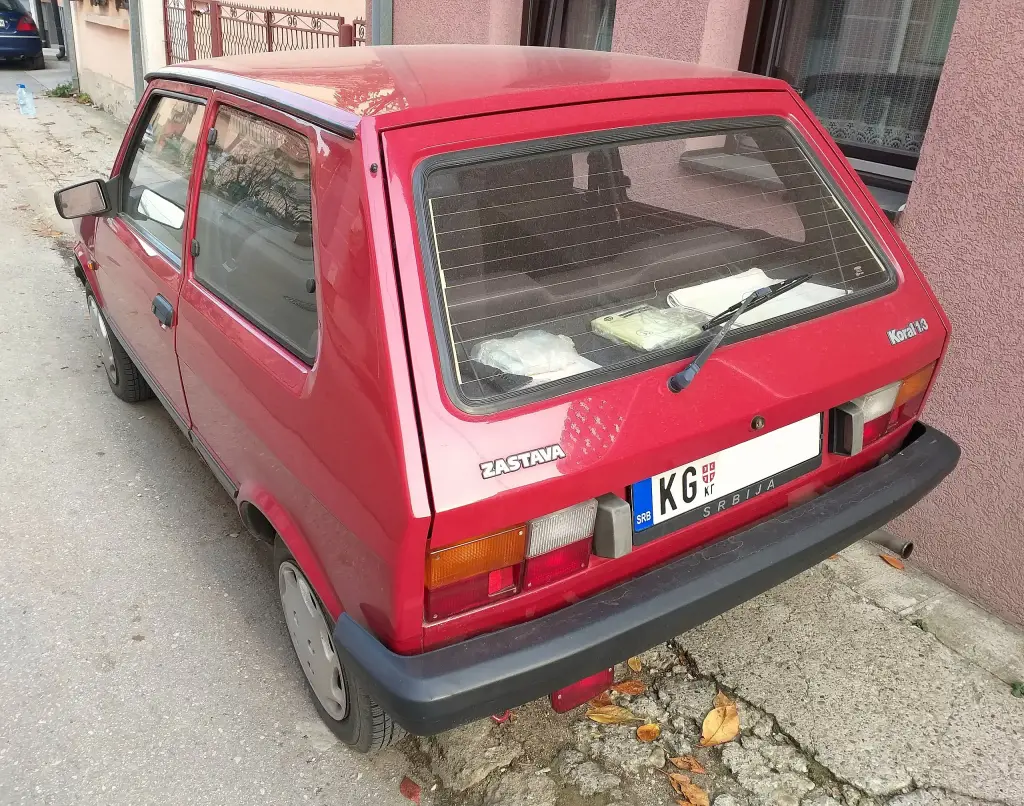
Work on a new car to sit between the Zastava 750 and the Zastava 101 began in 1971 under the project name Y and later Zastava 102, but the success of the 101 pushed it into the background. Fiat gave Zastava access to the technical documentation of the Fiat 127, and the new car was built on a shortened floorpan of the Fiat 128, with front-wheel drive and a transverse engine like the 101. Four prototypes were finished in 1978; one was given to President Tito during his visit to Kragujevac on 2 October 1978, and the others were tested in Yugoslavia and Italy.
Testing started in January 1979 on the Montenegrin coast, where the cars ran four shifts a day for 100,000 km, and continued on Zlatibor for another 10,000 km. The choice of engine took longest: the 1,116 cc unit from the 101 was tried, as was the 848 cc engine of the Zastava 850, but the first was too weak and the second too expensive. Zastava finally bought the licence for Fiat’s 903 cc 45 hp “100 GL” engine from the Fiat 127. A public competition with 3,000 entries chose the name Jugo 45.
From Jugo to Yugo
The car was shown at the 19th Belgrade motor show in March 1980, advance orders were taken, and series production began on 28 November 1980; 138 cars were built before the end of that year. The Yugo 55 with the 1,116 cc engine of the Zastava 101 joined the range in 1983, and in the same year the name was changed from Jugo to Yugo to suit export markets. Output reached 118,237 in 1989, the best year, after the 100,000th car in 1985 and the 500,000th in 1990. The name Koral was adopted in 1988 and stayed to the end of production.
Export was the model’s great achievement. Of 256,691 exported cars, 141,651 went to the United States, where the Yugo was marketed from 1985 to 1992 by Malcolm Bricklin. American sales peaked at 48,812 in 1987 and fell to 1,412 in 1992, and the car was criticised for its design, safety and reliability even as it gathered a cult following. In early 1985 500 cars were also shipped to China, and exports to Bulgaria and Egypt were already established.
Koral IN and the end
In its last years the range centred on the Zastava Koral IN, a second facelift with modified bumpers, body parts and interior. It came with central locking, a four-position headlamp levelling switch, a four-speaker audio system, electric windows, folding electrically adjustable mirrors, alloy wheels and an optional air conditioner, and the Koral IN L used a Peugeot 1.1-litre engine of 60 PS that met EU standards in a test supervised by TÜV. Production ended on 11 November 2008, after 794,428 cars in 28 years.
Design and features
- Simple mechanicals: a shortened Fiat 128 floorpan, front-wheel drive and a range of small four-cylinder engines.
- Many names: Yugo 45, 55, 60 and 65 at home and in Europe, GV and its sub-versions in America, Innocenti Koral in Italy.
- Facelifts: Yugo CL, the sporty Ciao and finally the Koral IN with modern equipment.
- Cheap to buy and run: the reason for its huge production figures and its appeal in export markets.
Zastava Koral versions
- Yugo 45: 903 cc, 45 hp, the original model.
- Yugo 55 and 60: 1,116 cc engines of 55 and 60 hp.
- Yugo 65: 1,301 cc, 65 hp, later with fuel injection.
- Yugo GV range: American versions, including the GVX with the 1.3 EFI engine.
- Yugo Cabrio: convertible with an electric roof.
- Zastava Koral IN: the final facelift, with 1.0, 1.1 and 1.3 petrol engines.
The Koral was the successor to the Zastava 750 and the stablemate of the Zastava Skala, with the larger Florida above it. More cars are in the Zastava collection.
Sources
- Yugo, English Wikipedia: model range, engines, exports, Koral IN equipment
- Југо, Serbian Wikipedia: development, production figures, export totals