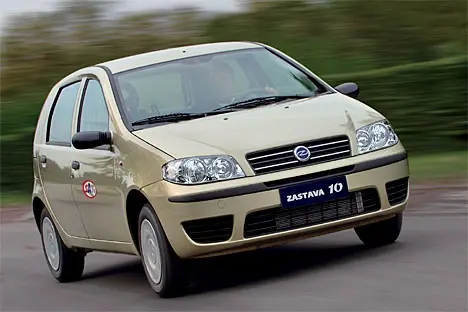
The Zastava 10 is a subcompact car that Zastava produced between 2006 and 2008. It was, in effect, a rebadged Fiat Punto built under licence, and it was the last vehicle the company introduced before Fiat acquired the factory in Kragujevac.
Zastava 10 at a glance
| Maker | Zastava, Kragujevac |
|---|---|
| Production | 2006–2008 |
| Based on | Fiat Punto (Mk2, facelift) |
| Premiere | 2006 Belgrade Motor Show |
| Engine | 1,242 cc 8-valve petrol, 60 hp at 5,000 rpm |
| Gearbox | five-speed manual |
| Top speed | 155 km/h |
| 0–100 km/h | about 14.3 seconds |
| Trim levels | Standard, Standard+, Comfort, Dynamic, Impressionante |
| Price | from about €7,920 to €9,325 |
| Built | 4,224 |
| Market | Serbia only |
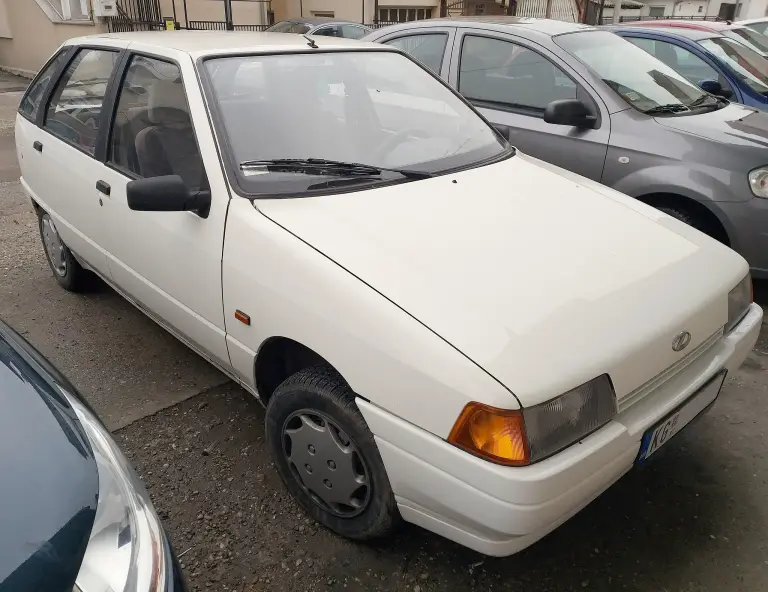
The English article is short; the Croatian one adds a 1.9-litre diesel to the range, while the English article lists only the 1.2 petrol. No free photographs of the Zastava 10 were found on Wikimedia Commons, so this page uses the photograph already attached to the record.
History of the Zastava 10
A Punto with Zastava badges
The Zastava 10 was presented at the 2006 Belgrade Motor Show, six years after Zastava and Fiat agreed in October 2003 that the Yugoslav company would build the Fiat Punto for Eastern European markets. The car was nearly identical to the facelifted Punto of the 188 generation, and the only noticeable difference was the Zastava badge in place of the Fiat one. The changes were limited to the engine meeting Euro 4 emission standards and a more modern colour palette taken from the Fiat Grande Punto.
The mechanical package was the Punto’s as well. Power came from the 1,242 cc eight-valve petrol engine at 60 horsepower and 5,000 rpm, driving through a five-speed manual gearbox. That was enough for a top speed of 155 km/h and a 0–100 km/h time of about 14.3 seconds.
Equipment and prices
Five trim levels were offered: Standard, Standard+, Comfort, Dynamic and Impressionante. Even the base Standard came with power steering, a driver’s airbag and 14-inch steel wheels with hubcaps — a considerable step up from the Skala and Koral that Zastava was still selling alongside it. The top Impressionante added air conditioning, anti-lock brakes, a passenger airbag and electric windows. Prices started at about 7,920 euros and reached 9,325 euros for the Impressionante, making the Zastava 10 the most expensive car in the range and, briefly, the most modern.
Commercial life
Zastava sold the 10 only on the Serbian domestic market, where it took over 10 per cent of the market share. Sales were nevertheless slow, and by the time the company went bankrupt in 2008 only 4,224 examples had been built and sold. When Fiat took over production at Kragujevac the Zastava 10 was discontinued, and the factory went on to build the Fiat Punto Classic instead. The model thus closed fifty years of Zastava passenger car production that had begun with licensed Fiat models in the 1950s.
Design and features
- Punto underneath: the same body, suspension and 1.2-litre engine as the facelifted second-generation Fiat Punto.
- Euro 4 engine: the emission update was the main technical change over the Fiat original.
- Modern equipment: power steering and a driver’s airbag as standard, air conditioning and ABS at the top of the range.
- New colours: a palette borrowed from the more recent Fiat Grande Punto.
Zastava 10 versions
- Standard: power steering, driver airbag, 14-inch steel wheels with hubcaps.
- Standard+ and Comfort: the middle of the five-level range.
- Dynamic: higher equipment level below the top model.
- Impressionante: air conditioning, ABS, passenger airbag and electric windows.
The Zastava 10 was the last in a line that began with the Zastava 750 and ran through the Yugo Koral and the Florida. More cars are in the Zastava collection.
Video: Zastava 10 1.2 acceleration 0-100 (Fiat punto 2)
Video by Nenad Stosovic on YouTube.
Sources
- Zastava 10, English Wikipedia: production dates, engine, equipment, prices, sales
- Fiat Punto (1999), Italian Wikipedia: the model the Zastava 10 was based on
- Zastava 10, Croatian Wikipedia: basic equipment, engine range