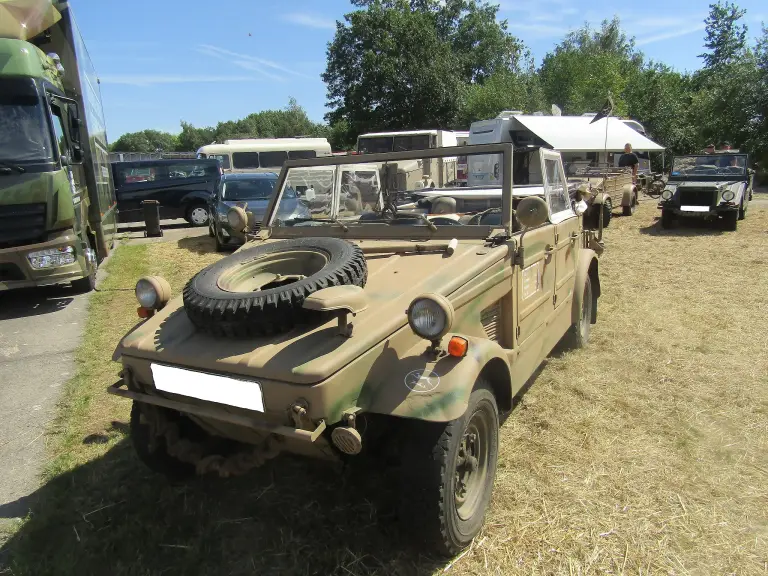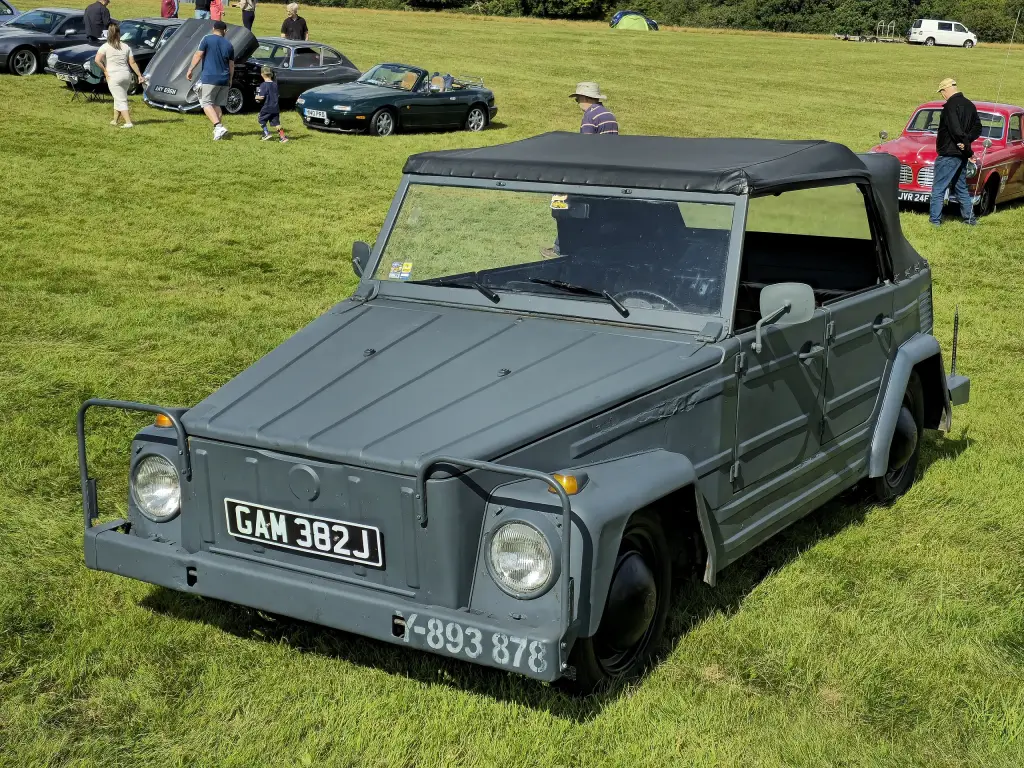
The Volkswagen Type 181 is a two-wheel-drive, four-door convertible manufactured and marketed by Volkswagen from 1968 until 1983. It was developed for the West German army as a successor to the DKW Munga and sold to civilians as the Kurierwagen in Germany, the Trekker in Britain, the Thing in the United States and Canada, the Safari in Mexico and South America and the Pescaccia in Italy. Civilian sales ended after the 1980 model year, but military customers kept buying the car until 1983.
Volkswagen Type 181 at a glance
| Maker | Volkswagen |
|---|---|
| Production | 1968–1983 |
| Developed for | the West German army, as a stand-in for the Europa Jeep |
| Civilian names | Kurierwagen, Trekker, Thing, Safari, Pescaccia |
| Bodies | four-door convertible with removable doors and roof |
| Mechanicals | Volkswagen Type 1 (Beetle) and pre-1968 Microbus |
| Floorpan | Type 1 Karmann Ghia, wider than the Beetle’s |
| Layout | rear-engined, rear-wheel drive, air-cooled flat four |
| Rear suspension | swing axles with reduction gearing to 1973, then double-jointed axles and IRS |
| Plants | Wolfsburg, Hannover, Emden, Puebla and Jakarta |
| Military deliveries | over 50,000 to NATO forces, 1968–1979 |
| US sales | 1973–1974 only |
History of the Volkswagen Type 181
A 1953 tender for a future West German army was won by Auto Union with the DKW Munga, and by the 1960s its two-stroke engine had become outdated, with Auto Union dropping the concept in 1965 in favour of the Audi name and four-stroke engines. Several European governments then began work on the Europa Jeep, a lightweight amphibious four-wheel-drive vehicle to be mass-produced for several armed forces, but design by committee proved slow and the West German government needed a limited number of light, inexpensive and durable vehicles in the meantime. Volkswagen had declined such a request in the 1950s, but its management now saw potential in a civilian version, because Mexican customers wanted something that could cope with rural roads better than the Type 1 and the popularity of Volkswagen-based dune buggies in the United States suggested that a tough, fun off-roader might sell.
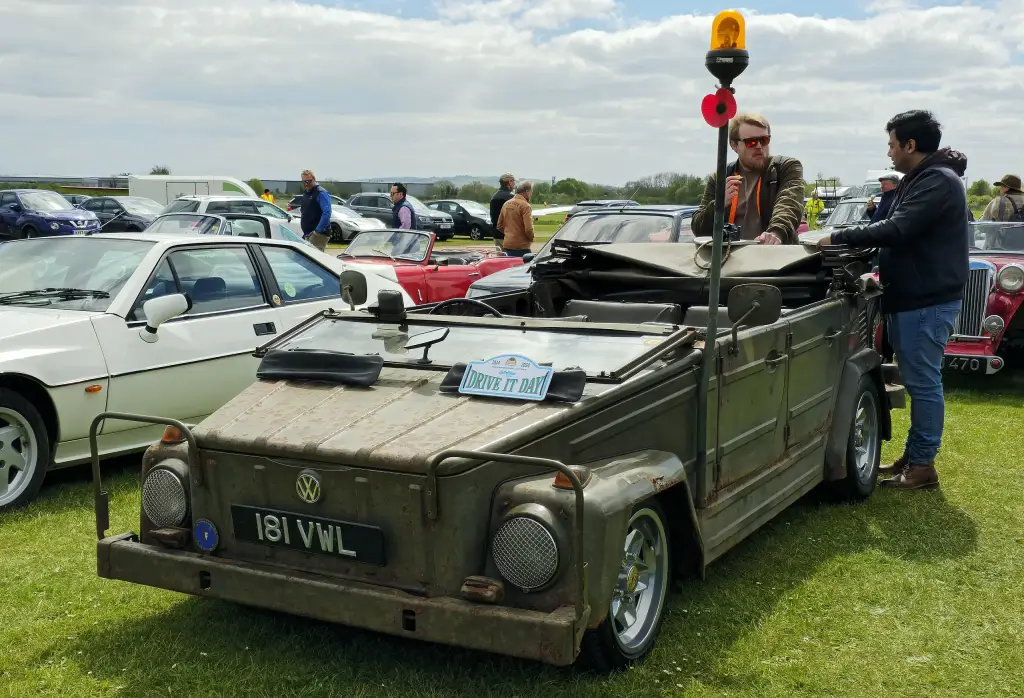
Like the wartime Type 82 Kübelwagen, the Type 181 used mechanical parts of the Type 1 with a rear engine, manual transmission and flat four. It shared its parts with the Beetle and the pre-1968 Microbus, its floorpan – wider than the Beetle’s – with the Type 1 Karmann Ghia, and its concept with the Kübelwagen. All four doors were removable and interchangeable, the windscreen folded flat and the convertible roof could be taken off entirely, while the spartan interior had vinyl-covered bucket seats, painted sheet metal, drain holes and perforated rubber mats, with a fibreglass hardtop and a trunk-mounted auxiliary heater as options. Until 1973 the car used rear swing axles with reduction gearing from the discontinued split-screen Transporter; from then on it had the double-jointed axles and semi-trailing-arm independent rear suspension of the 1303 and American Beetles.
Civilian sales began in mainland Europe and Mexico during 1971, in the United States in 1972 and briefly in Britain in 1975, where the Trekker sold poorly and was soon dropped. The model left the American range for 1975 because it failed the stricter safety standards: reclassified as a passenger vehicle, it fell foul of the windscreen intrusion rule that demanded more distance between front-seat occupants and the glass. The 181 was only ever meant to fill the gap until the Europa Jeep arrived. From 1968 to 1979 more than 50,000 were delivered to NATO forces, and when the Europa Jeep was abandoned in 1979 the West German government began supplementing its 181s with the new front-engined Type 183 Iltis. Even so, European and Mexican civilian sales continued through 1980, and organisations including NATO bought military-specification cars until 1983 because of their reliability and low purchase and maintenance costs. Military cars used reduction boxes, a form of portal axle, for more ground clearance and lower gearing, and could be fitted with dual oil-bath air cleaners for dusty conditions and low-noise ignition for radio work.
Design and features
- Open body: four removable doors, a folding windscreen and a removable roof.
- Beetle mechanicals: the engine, transmission and rear-engine layout came from the Type 1.
- Karmann Ghia floorpan: a wider floor than the Beetle’s.
- Many names: Kurierwagen, Trekker, Thing, Safari and Pescaccia in different markets.
- Military favourite: more than 50,000 delivered to NATO and purchases until 1983.
Volkswagen Type 181 versions
- Kurierwagen (Germany): the civilian name at home.
- Trekker (Type 182, Britain): the right-hand-drive version, sold from 1975.
- Thing (United States and Canada, 1973–1974): the American name.
- Safari (Mexico and South America): the local name, built in Puebla.
- Pescaccia (Italy): the Italian name.
- Military 181: with reduction boxes and radio-friendly ignition.
The Type 181 was the civilian heir of the Kübelwagen and was itself replaced in military service by the Iltis; its mechanicals came from the Beetle. More cars are in the Volkswagen collection.
Video: VW Safari 181 Monterrey Club – Paso de la Bruja
Video by RG on YouTube.
Sources
- Volkswagen Type 181, English Wikipedia: origins, names, construction, military history