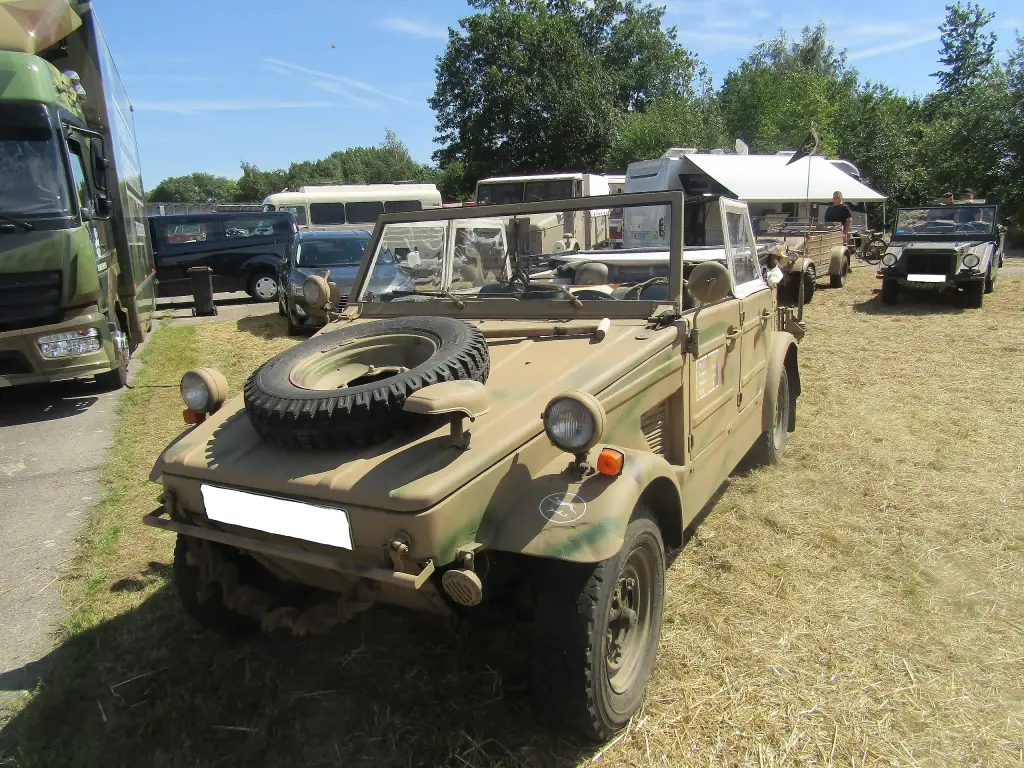
The Volkswagen Type 82 Kübelwagen, or simply Kübel, is a military light utility vehicle designed by Ferdinand Porsche and built by Volkswagen during the Second World War for the German armed forces. Based heavily on the Beetle, it was prototyped and first deployed in Poland as the Type 62 before entering full production as the Type 82. It had no four-wheel drive, but its low weight and a self-locking differential made it the German equivalent of the Willys jeep.
Volkswagen Kübelwagen at a glance
| Official name | Volkswagen Type 82 Kübelwagen |
|---|---|
| Designer | Ferdinand Porsche |
| Role | light military utility vehicle |
| Prototype | Type 62, presented in November 1938 |
| Production | February 1940 – 1945 |
| Basis | Volkswagen Beetle |
| Drive | rear-wheel drive with a ZF self-locking differential |
| Empty weight | 725 kg |
| Seats | four, five in a pinch |
| Original engine | 985 cm³ flat four of 23.5 PS |
| Engine from 1943 | 1,131 cm³ unit from the Schwimmwagen |
| Body builder | Ambi Budd Presswerke, Berlin |
History of the Volkswagen Kübelwagen
Adolf Hitler had discussed the military use of the Volkswagen with Ferdinand Porsche as early as April 1934, but it was not until January 1938 that the army weapons office formally asked Porsche for an inexpensive, lightweight military transport that could work on and off road in extreme conditions. Porsche had a prototype within the month and soon realised that reinforcing the Beetle chassis would not be enough. To guarantee off-road performance with a two-wheel-drive car and a 1,000 cm³ engine, the vehicle had to be light: the army set a gross weight of 950 kg including four fully equipped soldiers, which meant the car itself could weigh no more than 550 kg. Porsche sub-contracted the experienced military coachbuilder Trutz to help with the body.
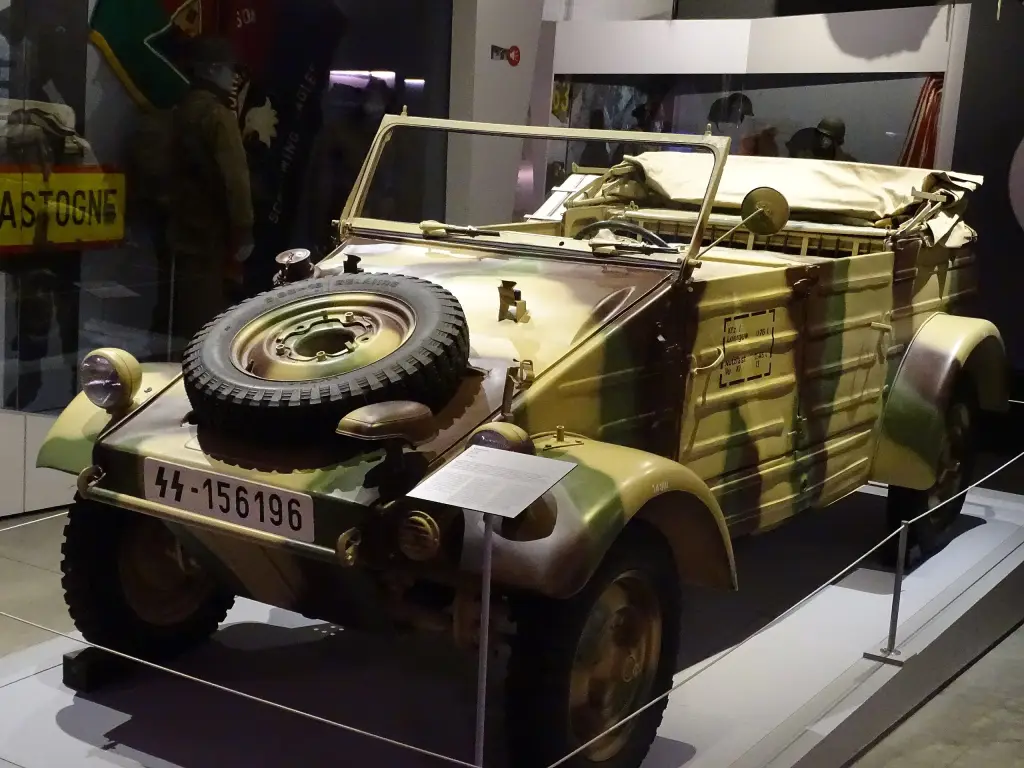
Testing began after the Type 62 prototypes were presented in November 1938. Despite the lack of four-wheel drive, the car proved very competent over rough ground, even against a standard German army 4×4, and the project was cleared for further development; low weight and a ZF self-locking differential compensated for the missing driven front axle. Development continued through 1939 with a more angular body, and pre-production cars were field-tested in the invasion of Poland that September. Commanders asked for two changes: the lowest speed had to fall from 8 km/h to 4 km/h to match marching soldiers, and cross-country ability needed improving. Porsche fitted new axles with gear-reduction hubs for more torque and greater ground clearance, along with revised dampers, 41 cm wheels, a limited-slip differential and many small modifications, and the vehicle was renamed Type 82. Full production started in February 1940 and ran to 1945 with no major changes, only small modifications that removed unnecessary parts and strengthened others.
The Kübelwagen took its name from the bucket seats that kept occupants on board in open vehicles without doors, a body style first developed by the coachbuilder N. Trutz in 1923; the first Porsche Type 62 cars had no doors and were therefore Kübelsitzwagen, later shortened to Kübelwagen, and the name stayed even when doors and lower, more regular seats arrived. The rolling chassis and mechanicals were built at the Stadt des KdF-Wagens, renamed Wolfsburg after 1945, while the body came from the US-owned Ambi Budd Presswerke in Berlin. The 725 kg car seated four men easily, and the rear bench could take three in a pinch for five inside; it was light enough for the crew to manhandle it out of trouble, being 300 kg lighter than a jeep. Four-wheel-drive prototypes such as the Type 86 offered no significant gain over the Type 82 and were not adopted, though the four-wheel drive developed for them went into mass production in the Schwimmwagen. In March 1943 the car received a revised dashboard and the bigger 1,131 cm³ engine developed for the Schwimmwagen, which gave more torque and power than the original 985 cm³ unit of 23.5 PS.
Design and features
- Beetle mechanicals: the engine, transmission and rear-engined layout came from the Beetle.
- Light and simple: 725 kg empty, light enough for the crew to lift it out of trouble.
- No four-wheel drive: low weight and a ZF self-locking differential did the job instead.
- Gear-reduction hubs: fitted for the Type 82 to raise torque and ground clearance.
- German jeep: the Wehrmacht’s counterpart to the Willys MB and the GAZ-67.
Volkswagen Kübelwagen versions
- Type 62 (1938–1939): the prototype with no doors and bucket seats.
- Type 82 (1940–1945): the production vehicle.
- Type 86: a four-wheel-drive prototype that was not adopted.
- Kommandeurswagen and other derivatives: built in dozens to hundreds.
The Kübelwagen was based on the Beetle and was followed after the war by the Type 181 and later the Iltis. More cars are in the Volkswagen collection.
Video: 1943 Kubelwagen We go for a ride.
Video by RideswithChuck on YouTube.
Sources
- Volkswagen Kübelwagen, English Wikipedia: design brief, prototypes, production, engine changes