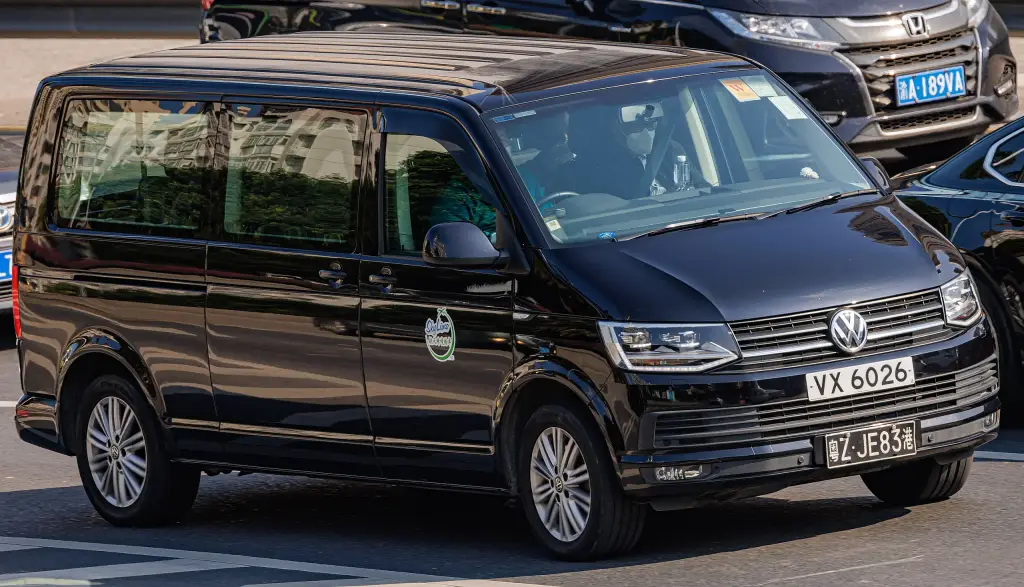
The Volkswagen Transporter is a series of vans produced for over 70 years and sold worldwide, now in its seventh generation. Generations are numbered T1 to T7, and the first three were originally called Type 2, after their position relative to the Type 1 or Beetle. With more than 12 million units sold it is the best-selling van in history, and the range covers panel vans, minibuses, campervans, chassis cabs and pickups.
Volkswagen Transporter at a glance
| Maker | Volkswagen Commercial Vehicles |
|---|---|
| Production | since 1950, seven generations |
| Generations | T1 to T7, the first three also called Type 2 |
| Total sold | over 12 million, the best-selling van in history |
| T1 | 1950, derived from the Beetle |
| T2 | 1967–1979, with a Type 4 engine available from 1972 |
| T3 | 1979, T25 in Britain and Vanagon in the United States |
| T3 details | air-cooled until 1983; Syncro four-wheel drive from January 1985 |
| T4 | 1990, front engine and front-wheel drive; Eurovan in North America |
| T5 | 2003, facelift in 2009 with common-rail diesels and a seven-speed DSG |
| T6 and T6.1 | 2016 and 2019 |
| T7 | November 2021, a Multivan on the MQB platform |
History of the Volkswagen Transporter
The Transporter began in 1950 with the Type 2, derived from the Beetle, and its first three generations carried the Type 2 name before the T platform designations were applied retroactively. The T2 was marketed from 1967 to 1979 and from 1972 could be ordered with a Type 4 engine. The T3 arrived in 1979, known as the T25 in Britain and the Vanagon in the United States, and was one of the last all-new Volkswagen platforms to keep the air-cooled, rear-engined layout. It was sturdier and heavier than the T2, with a larger and much squarer body that offered more usable space, and its sharply folding front earned it the nickname “the wedge” among enthusiasts. The air-cooled boxer engine was replaced by a water-cooled one, still at the rear, in 1983; Porsche and Oettinger each built six-cylinder versions in very small numbers, the Porsche car reaching about 200 km/h, and a four-wheel-drive Syncro model premiered in January 1985. European production of the T3 ended in 1992, with Syncro models built in Austria until then, while South Africa kept building the T3 until 2002.
The T4 of 1990 was the first officially designated T platform vehicle and changed the line completely, with a front-mounted, front-wheel-drive water-cooled engine, and in North America it was sold as the Volkswagen Eurovan. The T5 followed in 2003 and was sold in Mexico but not in the United States or Canada, where the chicken tax would have added 25 per cent to the price of a light truck. A facelift in late 2009 brought common-rail diesel engines and the first use in a light commercial vehicle of a dual-clutch transmission, Volkswagen’s seven-speed DSG. The T6 of 2016 was based on the T5, and a refreshed T6.1 appeared in 2019.
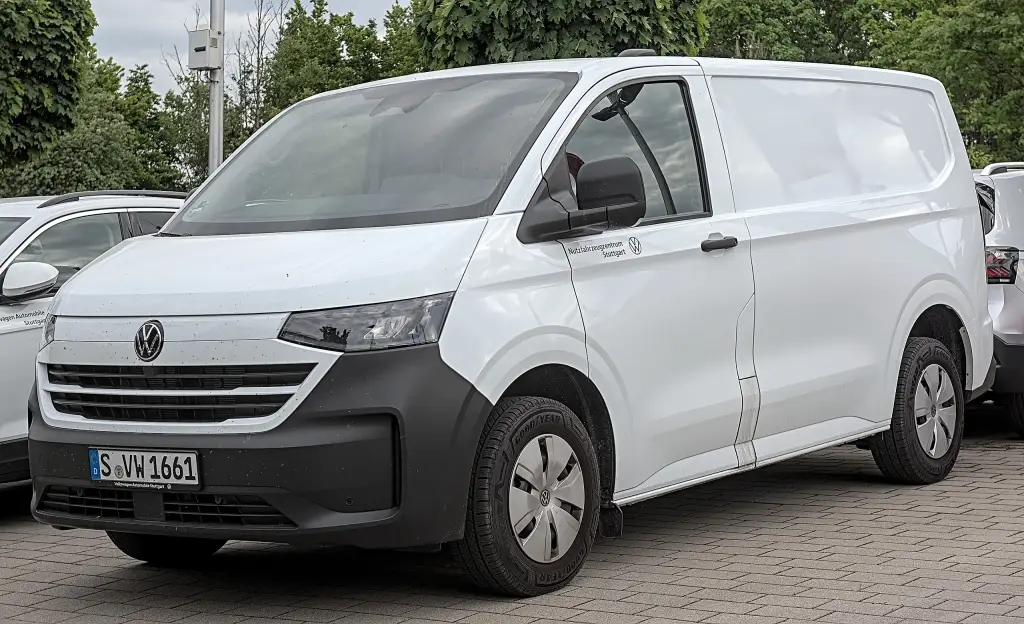
The T7 was released in November 2021 with petrol, diesel and plug-in hybrid versions and is available only as a minivan, replacing the Caravelle in Britain and the Multivan elsewhere; it is built on Volkswagen’s MQB platform. It should not be confused with the new Transporter panel van and chassis cab, which are based on the 2023 Ford Transit Custom, are larger than the Multivan and share most of their body and mechanical parts with the Ford, built alongside the Volkswagen at the Ford Otosan factory in Turkey. In December 2023 the seventh-generation Transporter was teased with diesel, plug-in hybrid and electric powertrains and a launch planned for the second quarter of 2024, and Volkswagen did not apply the T7 designation to this model, which is officially known simply as the Transporter.
Design and features
- Seven generations: from the 1950 Beetle-based T1 to the T7 Multivan and the Ford-based Transporter.
- Best-selling van: more than 12 million units worldwide.
- The wedge: the T3 kept the rear engine until 1983 and gained Syncro four-wheel drive in 1985.
- Front-wheel drive from 1990: the T4 moved the engine to the front and became the Eurovan in North America.
- DSG first: the 2009 T5 was the first light commercial vehicle with a dual-clutch gearbox.
Volkswagen Transporter versions
- T1 (1950) and T2 (1967–1979): the original rear-engined vans, the T2 with an optional Type 4 engine.
- T3 (1979): the T25 and Vanagon, with Syncro from 1985.
- T4 (1990): the front-wheel-drive Eurovan.
- T5 (2003) and T6 (2016): the modern front-wheel-drive vans.
- T7 Multivan (2021): the MQB-based minivan with a plug-in hybrid.
- Transporter (2024): the Ford Transit Custom-based van.
The Transporter grew out of the Type 2, sits between the smaller Caddy and the larger Crafter, and its Caravelle and Multivan versions are the people carriers of the range. More cars are in the Volkswagen collection.
Video: Volkswagen Transporter review
Video by Auto Express Vans on YouTube.
Sources
- Volkswagen Transporter, English Wikipedia: generations, T3 details, T4 to T7, production