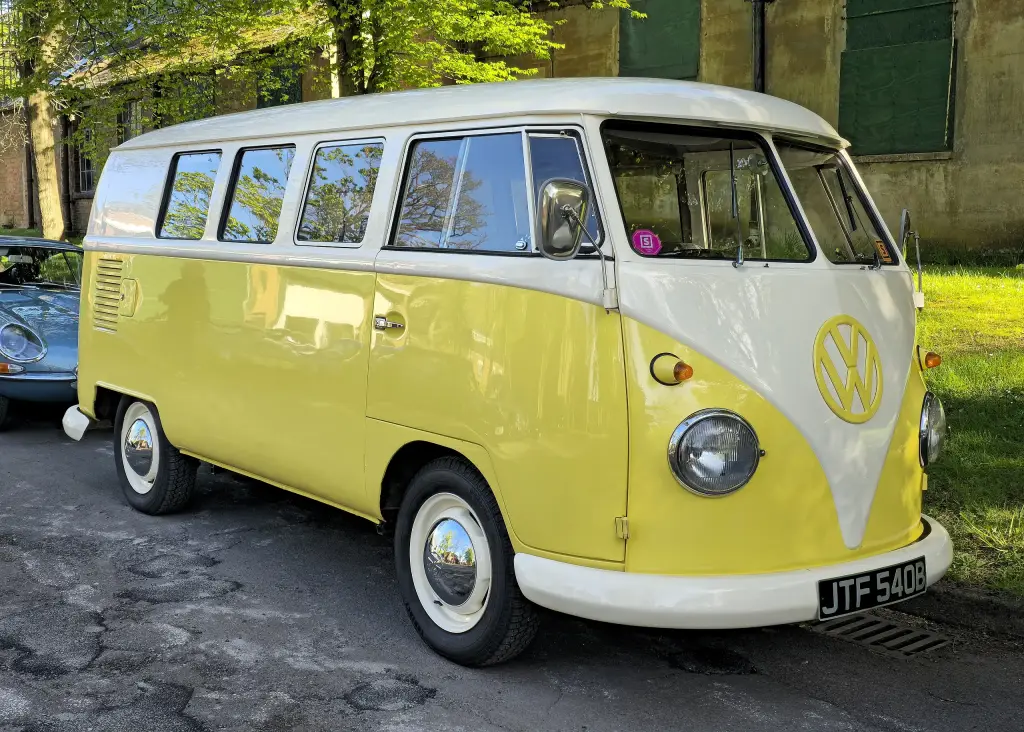
The Volkswagen Type 2 is the original form of the Transporter, a range of light commercial vehicles built as vans, pickups and cab-and-chassis variants and introduced in 1950. It was the company’s second mass-production light vehicle series and came from an idea of the Dutch Volkswagen importer Ben Pon. Depending on body type it was known as the Transporter, Kombi or Microbus, or informally as the Station Wagon and Bus in the United States, the Camper in Britain and the Bulli in Germany.
Volkswagen Type 2 at a glance
| Maker | Volkswagen |
|---|---|
| Introduced | 12 November 1949, on sale from 1950 |
| Idea | Ben Pon, Dutch Volkswagen importer, sketch of 23 April 1947 |
| Prototype | Type 29, built in three months |
| Layout | forward control, rear-mounted air-cooled flat four, rear-wheel drive |
| Wheelbase | 2.40 m, as the Beetle, for the first thirty years |
| Drag coefficient | 0.75 on the first prototypes, 0.44 in production against 0.48 for the Beetle |
| First-year production | 9,541 cars |
| Early models | Kombi and Commercial, then the Microbus (May 1950) and Deluxe Microbus (June 1951) |
| Bodies | panel van, bus with up to 23 windows, pickups in standard and crew cab |
| Last factory | Brazil, until 31 December 2013 |
| Nicknames | Bus, Camper, Bulli, hippie van |
History of the Volkswagen Type 2
The idea for the Type 2 is credited to Ben Pon, the Dutch Volkswagen importer. On a visit to Wolfsburg in 1946 to buy Type 1s for the Netherlands he saw a Plattenwagen, an improvised parts mover built on a Beetle chassis, and realised that something better could be made from the standard Type 1 floorpan. He sketched the van in a doodle dated 23 April 1947, proposing a payload of 690 kg and placing the driver at the very front; the sketch is now in the Rijksmuseum. Production had to wait because the factory was at full capacity building the Beetle. When capacity appeared, a prototype known internally as the Type 29 was built in three months; the Beetle floorpan proved too weak, so it used a ladder chassis with unit body construction, and by coincidence the wheelbase matched the Type 1’s. Engineers reused the reduction gear from the Type 82 Kübelwagen, which let the 1.5-tonne van run on a 25 hp flat four.
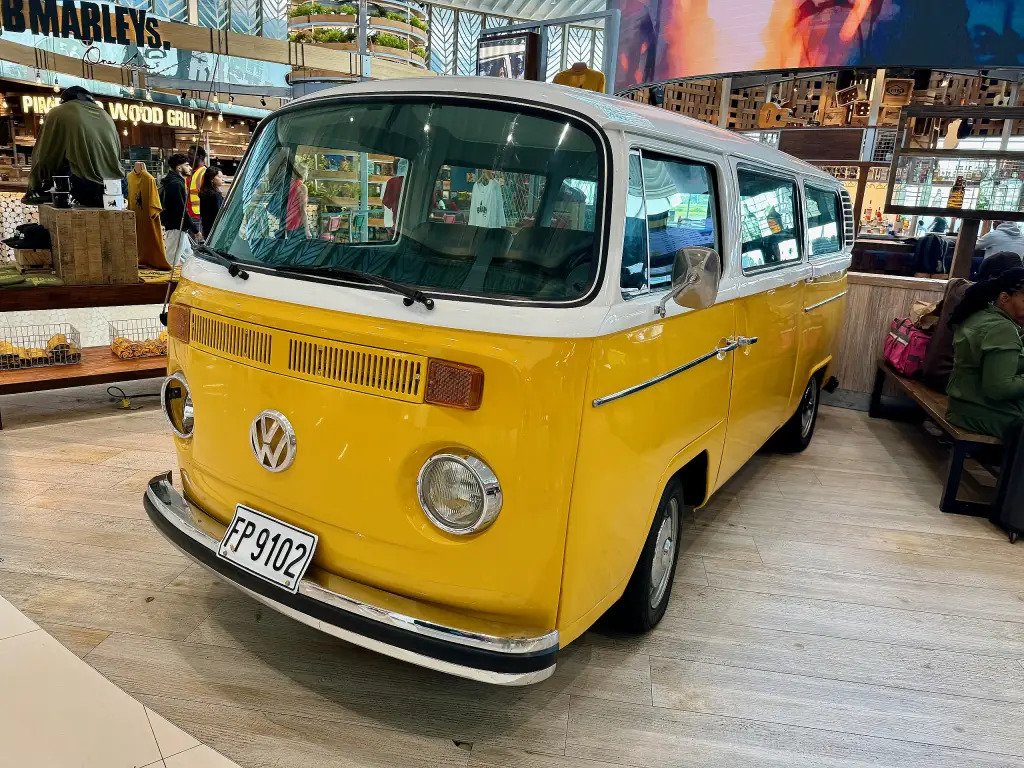
The first prototypes had poor aerodynamics, with a drag coefficient of 0.75, but the engineers used the wind tunnel at the Technical University of Braunschweig and simple changes such as splitting the windscreen and roofline into a vee brought the production car to 0.44, better than the Beetle’s 0.48. Heinz Nordhoff, chief executive from 1 January 1948, approved the van for production on 19 May 1949, and the first production model, now designated Type 2, rolled off the line to debut on 12 November. Only two models were offered at first, the Kombi, with two side windows and middle and rear seats that one person could remove, and the Commercial; the Microbus followed in May 1950 and the Deluxe Microbus in June 1951. In its first year 9,541 Type 2s were built, and an ambulance model was added soon afterwards.
For its first 40 years every Type 2 variant was forward control, with a Beetle-derived flat four in the rear and the same 2.40 m wheelbase as the Beetle for the first thirty years. The range grew to include panel vans, buses with up to 23 windows and hinged or sliding side doors, and pickups in standard-cab long-bed and crew-cab short-bed forms, most of them with drop sides because the bed floor sat high above the flat engine; many firms built camper conversions on the chassis. The Type 2 was one of the forerunners of the modern cargo and passenger van and prompted forward-control rivals in the United States such as the Ford Econoline, Dodge A100 and Chevrolet Corvair 95 Corvan, as well as European and Japanese competitors. The third generation of 1979 brought a squarer body and, in the 1980s, a four-wheel-drive bus, and in 1990 the fourth-generation Transporter moved to a front engine and front-wheel drive. Brazil held the last factory building the T2 series, which stopped on 31 December 2013 under stricter safety rules, ending the era of rear-engined Volkswagens that had begun with the Type 1 prototypes in 1935.
Design and features
- Ben Pon’s sketch: the van began as a 1947 doodle by the Dutch importer.
- Beetle underneath: rear-mounted flat four and a 2.40 m wheelbase shared with the Type 1.
- Many bodies: panel van, bus with up to 23 windows, pickups and camper conversions.
- Aerodynamics: the drag coefficient fell from 0.75 to 0.44 before production.
- Long life: built until 2013 in Brazil, the last rear-engined Volkswagen.
Volkswagen Type 2 versions
- Kombi (1949): the first passenger version, with removable rear seats.
- Commercial: the original panel van.
- Microbus (1950) and Deluxe Microbus (1951): the passenger buses.
- Pickups: standard-cab long-bed and crew-cab short-bed versions.
- Campers: conversions by outside coachbuilders, including Westfalia.
- Ambulance: added soon after the launch.
The Type 2 followed the Beetle and grew into the Transporter range; its camper versions are part of the same story. More cars are in the Volkswagen collection.
Video: im blick: 60 Jahre VW Camping-Bulli
Video by DW Deutsch on YouTube.
Sources
- Volkswagen Type 2, English Wikipedia: Ben Pon, prototype, aerodynamics, early models, layout, Brazil