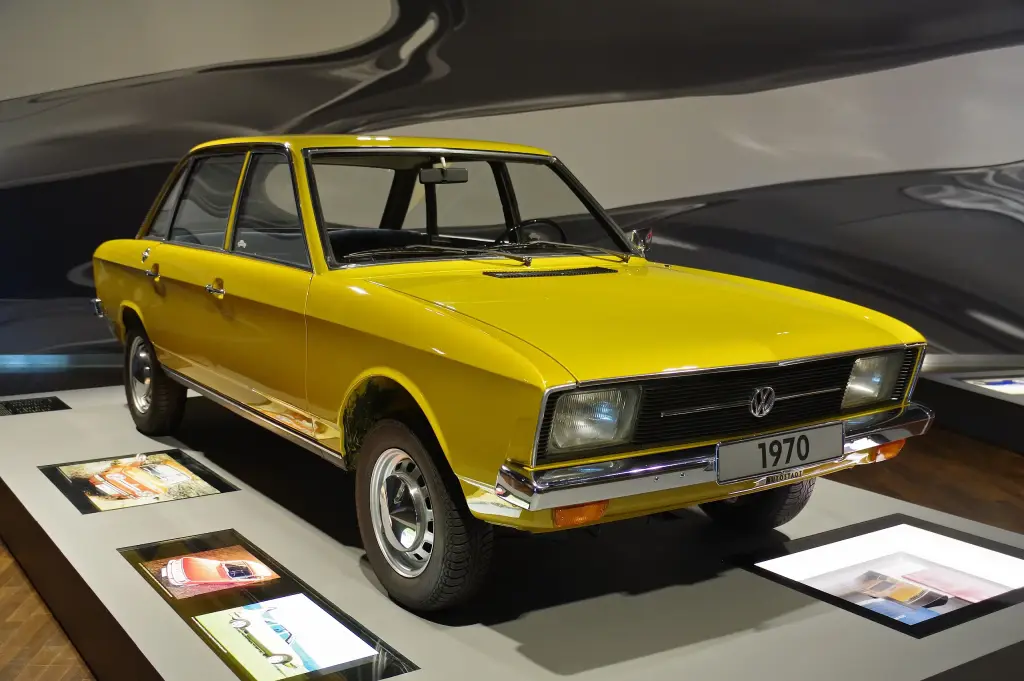
The Volkswagen K70 is a four-door saloon developed by NSU and marketed by Volkswagen from 1970 to 1975, after the 1969 takeover of NSU. It was the first water-cooled, front-engined, front-wheel-drive car from a company that until then was known for air-cooled, rear-engined, rear-wheel-drive vehicles. Designed by NSU’s chief engineer Ewald Praxl and styled by Claus Luthe, it was meant to complement the NSU Ro 80 and compete with Volkswagen’s own 411 and 412 and with the Audi 100; 211,127 were built.
Volkswagen K70 at a glance
| Maker | NSU, then Volkswagen |
|---|---|
| Production | August 1970 – 1975 |
| Built | 211,127 |
| Plant | Salzgitter |
| Design | Ewald Praxl (engineering), Claus Luthe (styling) |
| Name | K for Kolben (piston), 70 for an intended 70 PS |
| Engine 1970 | 1,605 cm³ water-cooled four, rated 75 PS (55 kW) |
| Engine 1973 | 1,807 cm³ four of 100 PS (74 kW) |
| Layout | front-wheel drive, engine longitudinal above the differential |
| Brakes | inboard disc brakes, as on the NSU Ro 80 |
| Luggage capacity | 650 litres |
| Place in the range | between the Type 4 (411/412) and the Audi 100 |
History of the Volkswagen K70
The K70 was developed to complement the NSU Ro 80 with a conventional piston engine instead of the Ro 80’s Wankel rotary. NSU scheduled a press launch for March 1969 and planned to show the car at the Geneva Motor Show, but rumours that Volkswagen would absorb the cash-strapped NSU put its future in doubt even before the takeover was public: management feared the K70 was too close in size and price to the newly launched Audi 100. Volkswagen removed the K70 from the NSU stand on the eve of the show, the car appeared in the 1969 Geneva yearbook with a note that it would not be built for the time being, and only 23 pre-series cars with NSU badging were made.
A shareholders’ meeting on 26 April 1969 endorsed a merger in which NSU was to take over Auto Union, though in reality Volkswagen took over NSU and integrated it with Auto Union. Volkswagen needed a new family saloon to replace the Type 4, the 411 and 412, which had met with little market success, and it believed that the K70, with front-wheel drive and modern styling, could reshape its image. Publicity material showing the K70 as an NSU was scrapped, and just over a year later the car entered production at Volkswagen’s new Salzgitter plant rather than at Neckarsulm. Production cars badged as Volkswagens arrived in August 1970, and export production followed; a planned estate version, which would have competed with the 411 and 412 Variant, was postponed indefinitely.
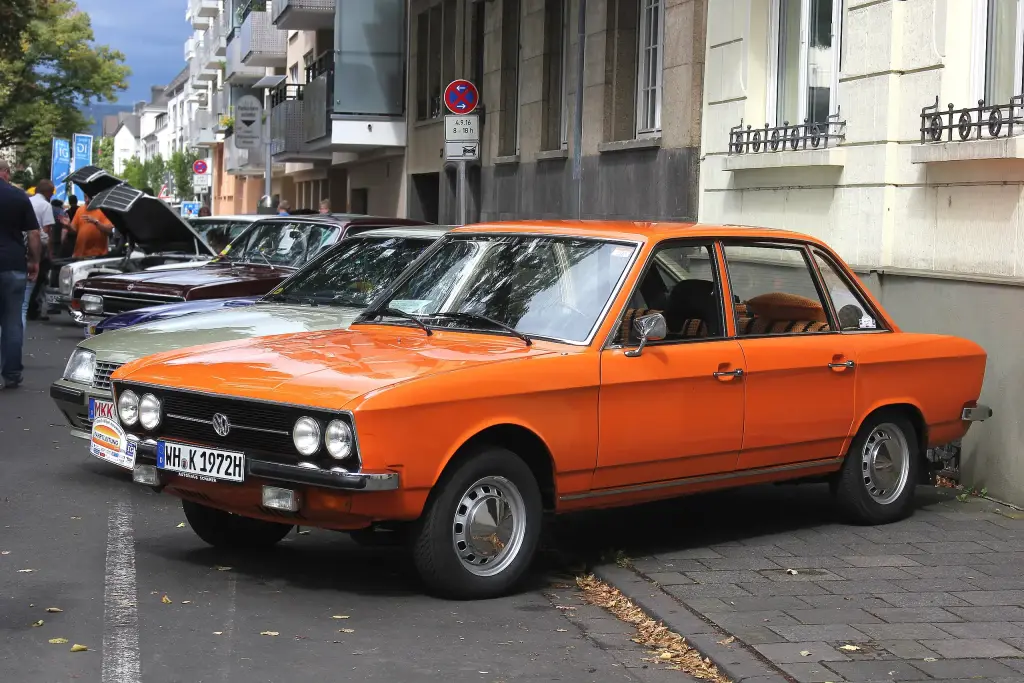
The engine was a water-cooled four derived from the air-cooled unit at the rear of the NSU 1200, enlarged to 1,605 cm³. Although the name suggested 70 PS, the engine was rated 75 PS (55 kW, 74 hp). It was mounted longitudinally, well forward and directly above the differential between the front wheels, and canted to the right, with the clutch and gearbox behind the differential: a compact package that needed a relatively high bonnet but maximised the weight on the front wheels and the space for passengers and luggage. The K70 also used the inboard disc brakes of the Ro 80. Over its short life the car was revised to share more parts with other Volkswagens: the square bumpers gave way to the rounded items of the Audi 100 in August 1971, the gear linkage was simplified in the spring of 1972, new synchronisation and extra cooling openings under the front bumper arrived in August 1972 with twin round headlights replacing the rectangular units of the L versions, a padded four-spoke steering wheel from the Beetle came in August 1974, and in May 1973 a 1,807 cm³ engine of 100 PS (74 kW) addressed the performance complaints, with redesigned engine and transmission mountings to cut interior noise. Tall by the standards of the day, the K70 had an unusually spacious cabin with 650 litres of luggage capacity, though its fuel consumption became a problem when production overlapped with the 1973 oil crisis.
Design and features
- First of its kind for Volkswagen: water-cooled, front-engined and front-wheel drive.
- NSU engineering: designed by Ewald Praxl and styled by Claus Luthe as a companion to the Ro 80.
- Compact powertrain: the engine sat above the differential, with the gearbox behind it.
- Inboard brakes: the same layout as the NSU Ro 80.
- Room and luggage: a tall cabin and 650 litres of luggage capacity.
Volkswagen K70 versions
- K70 (1970): the 1,605 cm³ car of 75 PS.
- K70 L: the version with rectangular headlights before the 1972 changes.
- K70 1.8 (1973): the 1,807 cm³ engine of 100 PS.
- NSU-badged pre-series (1969): 23 cars built before the takeover.
The K70 was meant to replace the Type 4 and stood apart from the rear-engined Beetle; its front-wheel-drive layout led to the Passat. More cars are in the Volkswagen collection.
Sources
- Volkswagen K70, English Wikipedia: origins, NSU takeover, engine, revisions, dimensions