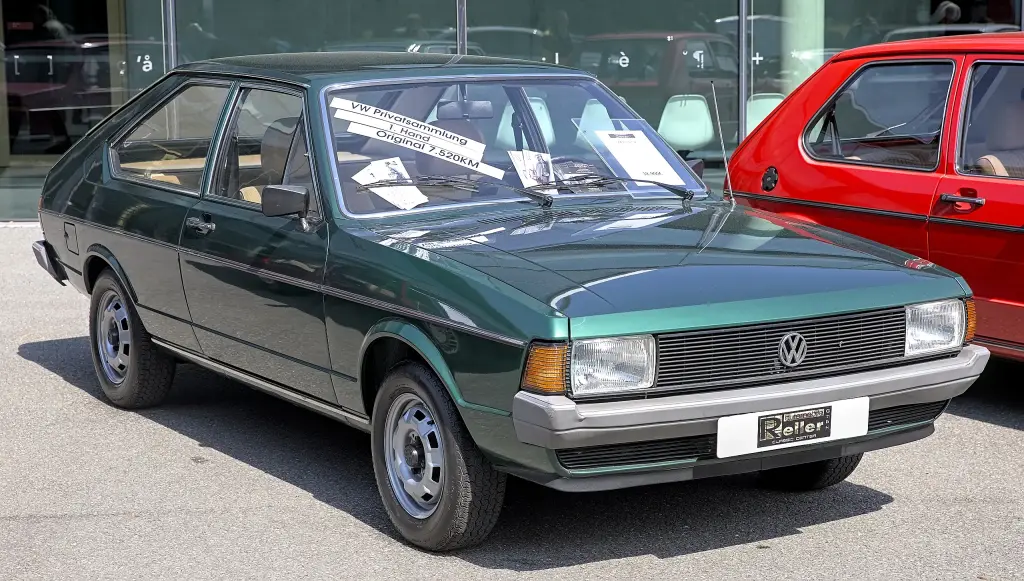
The Volkswagen Passat is a nameplate of large family cars made since 1973 and sold in saloon, estate and hatchback forms, also marketed as the Dasher, Santana, Quantum, Magotan, Corsar and Carat. With 34 million units sold worldwide it is the fourth best-selling automobile of all time. Its name comes from the German word for the trade winds, in the same tradition as the Scirocco, Bora and Jetta.
Volkswagen Passat at a glance
| Maker | Volkswagen |
|---|---|
| Production | since 1973 |
| Total sold | 34 million, the fourth best-selling car of all time |
| Other names | Dasher, Santana, Quantum, Magotan, Corsar, Carat |
| Bodies | saloon, estate and hatchback |
| First generation | B1, Type 32, fastback version of the Audi 80 |
| Styling | Giorgetto Giugiaro |
| B1 engines | 1.3 of 55 PS and 1.5 of 75 or 85 PS; 1.6 from August 1975 |
| B1 diesel | 1.5-litre, 50 PS, from July 1978 |
| Second generation | B2, from November 1980, with the Santana saloon |
| Four-wheel drive | Syncro estate from October 1984 |
| Later models | Passat CC in 2008, NMS for North America in 2011, B9 estate in 2023 |
History of the Volkswagen Passat
The first Passat was launched in 1973 as a fastback version of the mechanically identical Audi 80 saloon, in two- and four-door saloon and three- and five-door forms, all styled by Giorgetto Giugiaro. A five-door estate followed in 1974 and was sold in North America as the Audi Fox. The car was intended to replace the ageing Type 3 and Type 4 and was one of the most modern European family cars of its time: besides the Renault 16 and Austin Maxi it was the only European car of its size with front-wheel drive and a hatchback. Engines were the 1.3-litre of 55 PS and the 1.5-litre of 75 or 85 PS from the Audi 80, mounted longitudinally with front-wheel drive, with a four-speed manual or three-speed automatic and MacPherson struts in front with a solid axle and coil springs behind. The 1.5 was enlarged to 1.6 in August 1975, a 1.5-litre diesel of 50 PS from the Golf arrived in July 1978 and a fuel-injected 1.6 GLI followed in February 1979. A facelift came in 1977, and in North America the car was sold as the Volkswagen Dasher with a carburetted 1.5 or, from 1976, a fuel-injected 1.6 and single DOT headlamps. In Brazil the B1 Passat was built from June 1974 until 1988, with the Audi 80 front-end after a 1979 facelift, 1.6 and 1.8-litre engines, a five-speed gearbox and sports versions called the TS 1.6 and later the GTS 1.8 Pointer.
The second generation, the B2, was launched in November 1980 on the platform of the 1978 Audi 80 and was slightly longer. Besides the hatchbacks and Variants there was a conventional three-box saloon sold in Europe as the Volkswagen Santana until the 1985 facelift. In the United States the Passat and Santana were sold as the Volkswagen Quantum, in three-door hatchback, four-door saloon and estate forms, although the five-door hatchback was never offered there and the three-door was dropped after less than two years. A four-wheel-drive Syncro estate was introduced in October 1984, at first only with the more powerful five-cylinder engine. The Passat and Santana were also produced and sold in China, Mexico and South America, under names such as Magotan and Corsar.
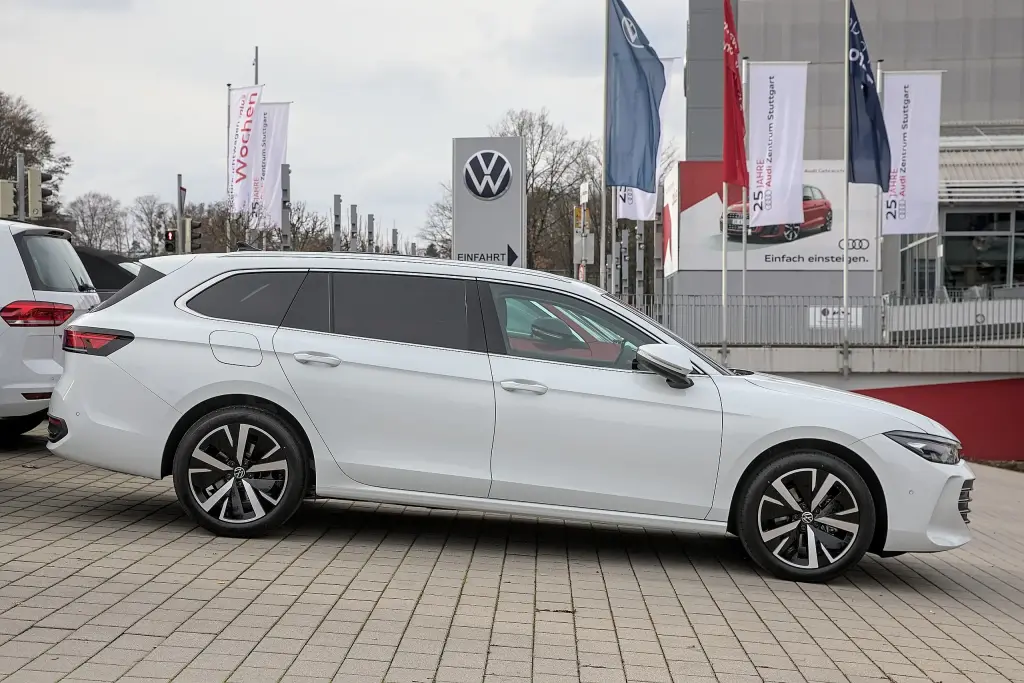
Later the range split: a four-door coupé version with a lower roof appeared in North America in 2008 as the Passat CC, later renamed the Volkswagen CC and replaced by the Arteon in 2017. In January 2011 Volkswagen introduced a separate Passat line for North America, the New Midsize Sedan built in Chattanooga and in Nanjing, larger and cheaper to produce and sold in North America, South Korea, China and the Middle East, while the B8 Passat was built on the MQB platform. In 2019 the NMS programme split in two, leaving three models under the Passat name worldwide; the North American car was discontinued after the 2022 model year. Volkswagen ended European production of the Passat saloon in 2022, and the B9 Passat of 2023 is available only as an estate, though the saloon continues in China.
Design and features
- Wind name: Passat is the German word for the trade winds.
- Bestseller: 34 million cars, the fourth best-selling automobile in history.
- German-American roots: the B1 was a fastback version of the Audi 80, styled by Giugiaro.
- Many badges: Dasher, Santana, Quantum, Magotan, Corsar and Carat in different markets.
- Wide range: hatchback, saloon and estate bodies, with Syncro four-wheel drive from 1984.
Volkswagen Passat versions
- B1 (1973): the Giugiaro-styled fastback, sold as the Dasher in North America.
- B2 (1980): the second generation, with the Santana saloon and the Quantum in the United States.
- Syncro estate (1984): the four-wheel-drive Variant.
- Passat CC (2008): the four-door coupé that became the CC.
- NMS (2011): the separate North American and Chinese car.
- B9 (2023): the estate-only European generation.
The Passat replaced the Type 3 and Type 4 and was joined by the CC coupé version; the smaller Golf and Jetta sit below it. More cars are in the Volkswagen collection.
Video: 2014 Volkswagen Passat Variant 2.0 TDI 4MOTION Highline
Video by Ausfahrt.tv on YouTube.
Sources
- Volkswagen Passat, English Wikipedia: generations, engines, names, markets, later models