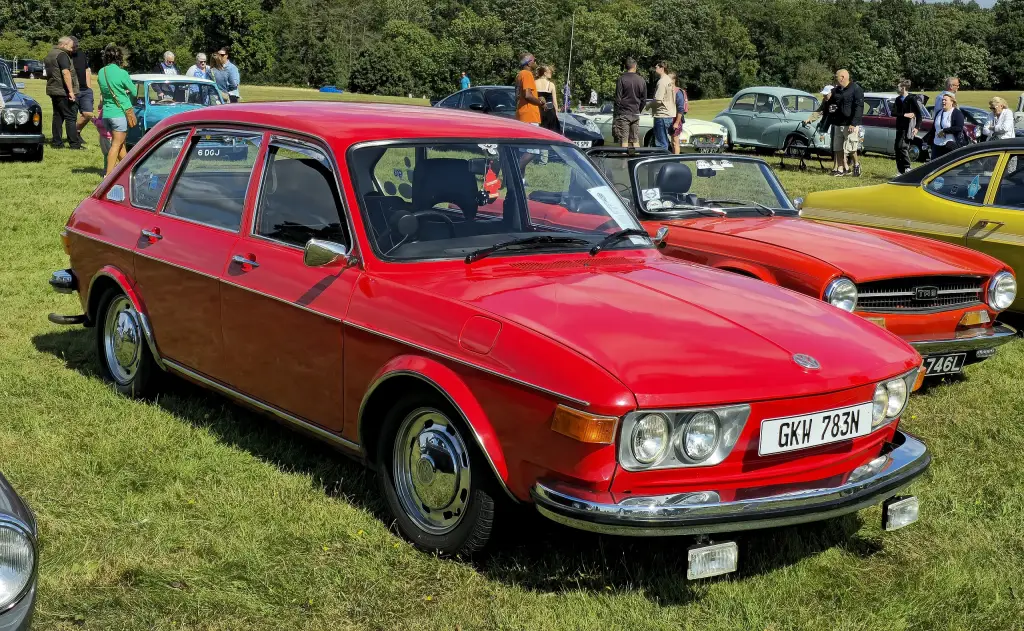
The Volkswagen Type 4 is a family car built from 1968 to 1974 as a D-segment model in two- and four-door saloon and two-door estate forms, in two series: the 411 of 1968 to 1972 and the 412 of 1972 to 1974. Designed under Heinrich Nordhoff and shown at the Paris Motor Show in October 1968, the 411 was Volkswagen’s largest passenger car with the company’s largest engine, styled with the help of Carrozzeria Pininfarina. It kept the trademark air-cooled rear engine and rear-wheel drive, and when production ended the Type 4 was the last air-cooled Volkswagen saloon and estate apart from the Brazilian Brasília.
Volkswagen Type 4 at a glance
| Maker | Volkswagen |
|---|---|
| Production | 1968–1974 |
| Series | 411 (1968–1972) and 412 (1972–1974) |
| Debut | Paris Motor Show, October 1968 |
| Styling | Carrozzeria Pininfarina |
| Bodies | two- and four-door saloon, two-door estate |
| Layout | rear-engined, air-cooled flat four, rear-wheel drive |
| Weight distribution | 45 per cent front, 55 per cent rear |
| Front luggage | 400 litres |
| Engine 1968 | 1,679 cm³ with twin carburettors, 68 PS; 80 PS with injection from 1969 |
| Engine 1973 | 1,795 cm³ with twin carburettors |
| Built | 367,728 |
History of the Volkswagen Type 4
The 411 was introduced at the Paris Motor Show in October 1968 as Volkswagen’s largest passenger vehicle, with its largest engine and styling credited to Pininfarina, which at the time had an advisory contract with the company. The cars kept the air-cooled rear-mounted boxer engine and rear-wheel drive with a 45/55 front-to-rear weight distribution and 400 litres of luggage space in front, while introducing departures for the company: a completely flat passenger floor and suspension with control arms and MacPherson struts. Volkswagen had prototyped notchback saloon and convertible versions of the 411 without putting them into production. Four-door bodies made the Type 4 the company’s first four-door saloon, and it also brought unibody construction, coil springs, trailing wishbone rear suspension and a hydraulically operated clutch; the 411’s front suspension layout was later adopted for the Beetle 1302 and 1303.
At launch the 411 had a 1,679 cm³ engine with twin carburettors. In 1969 it gained Bosch D-Jetronic electronic fuel injection, raising claimed power from 68 to 80 PS, and this engine was shared with the mid-engined Porsche 914 that also appeared in 1969; European cars marked the injection with the suffix E for Einspritzung, and the single oval headlights gave way to twin round units. The battery sat under the front passenger seat. All models had ventless front door windows notched at the leading edge for draught-free ventilation, metallic paint at no extra cost, radial tyres, full carpeting, a clock, an electric rear window demister, flow-through ventilation, undercoating and an Eberspächer BA4 petrol-fired auxiliary heater reached through a hidden panel in the rear window shelf. The 411 was assembled in South Africa from 1969 in two- and four-door forms, and in 1968 Karmann presented a 411-based cabriolet prototype that never entered production.
The 412 replaced the 411 in Germany in August 1972, with a redesign by Brooks Stevens that brought halogen lights and revised headlight surrounds and nose panels. In August 1973, for the 1974 model year, the engine grew to 1,795 cm³ and fuel management returned to twin carburettors, with the 412LE renamed 412LS; North American cars kept Bosch fuel injection. In February 1974 the four-door 412L cost DM 10,995 in Germany and the 412 LS DM 11,145. Production ended in June 1974 after 367,728 Type 4s, against 210,082 of the K70 that followed over four model years. Sales reached 119,627 in the United States between 1971 and 1974, 119,094 in Germany, 34,452 in South Africa and 13,367 in Britain. The 412 was also built in South Africa from 1972 to 1974, without the petrol heater and the rear window demister; its visual design lived on in the Brazilian Type 3 TL and Variant and in the Brasília. The Type 4 was succeeded by the first-generation Passat, and its engine carried on in the larger-engined Type 2 from 1972 to 1979 and in the T3 bus from 1980 to 1983.
Design and features
- Largest Volkswagen of its day: the biggest body and engine in the range in 1968.
- Pininfarina styling: the Italian coachbuilder advised on the shape.
- Two boots again: 400 litres of luggage space in front of the cabin.
- Technical firsts: the first four-door Volkswagen saloon, with unibody construction and MacPherson struts.
- Long-lived engine: the flat four continued in the Type 2 and T3 buses until 1983.
Volkswagen Type 4 versions
- 411 (1968–1972): the first series, with 1,679 cm³ and later injection.
- 411E: the fuel-injected European model of 80 PS.
- 412 (1972–1974): the redesigned series with halogen lights.
- 412 LS (1973): the 1,795 cm³ twin-carburettor model.
- South African cars (1969–1974): assembled locally in two- and four-door form.
The Type 4 followed the Type 3 and was replaced by the Passat, while the K70 was developed as another answer to the same market. More cars are in the Volkswagen collection.
Video: Volkswagen 412 LE Variant (Österreich – Mayrhofen)
Video by Henning Stepputtis on YouTube.
Sources
- Volkswagen Type 4, English Wikipedia: 411 and 412, engines, equipment, production and sales