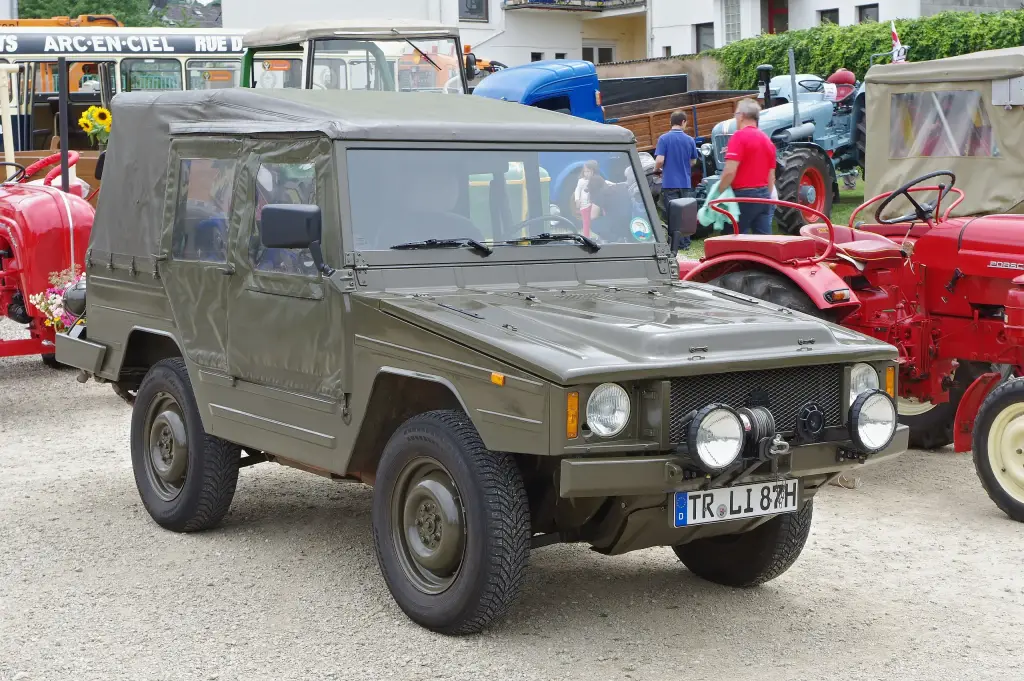
The Volkswagen Type 183, commonly known as the Iltis, is a military light utility vehicle designed and built by Volkswagen in the 1970s and 1980s for the West German armed forces. Its four-wheel-drive system, based on parts from the Audi 100, became the basis of Audi’s quattro drive, and an Iltis prepared by Audi won the 1980 Paris-Dakar Rally. The vehicle was also built under licence in Canada by Bombardier for the Canadian and Belgian armies.
Volkswagen Iltis at a glance
| Also known as | Volkswagen Type 183 |
|---|---|
| Role | military light utility vehicle |
| Built for | the Bundeswehr, West Germany |
| Developed by | Audi, on a variation of the DKW Munga platform |
| Engine | 1.7-litre four-cylinder, 75 PS (55 kW) |
| Four-wheel drive | from Audi 100 components, lever-engaged on the floor |
| Production start | summer 1978; first 200 delivered in November |
| 1979 deliveries | about 2,000, including 310 for the Luftwaffe and 20 for the navy |
| Predecessor | Volkswagen Type 181 |
| Civilian model | shown at the 1979 Geneva Motor Show |
| Rally | Paris-Dakar victory in 1980 |
| Licence production | Bombardier, Valcourt, Quebec, until 1986 |
History of the Volkswagen Iltis
West Germany’s military had joined a cooperative effort in the late 1960s to create a Europa Jeep, an amphibious four-wheel-drive vehicle for several European armies. When that project dragged on, the Bundeswehr asked for something inexpensive in small numbers, and Volkswagen answered with an updated Kübelwagen, the Type 181. By 1979 the Europa Jeep had collapsed under rising costs, and the government asked several manufacturers for prototypes to fill the gaps. Volkswagen, which had bought Auto Union and with it DKW, chose to build an evolution of the DKW Munga, out of production since 1968 and unpopular for its two-stroke engine.
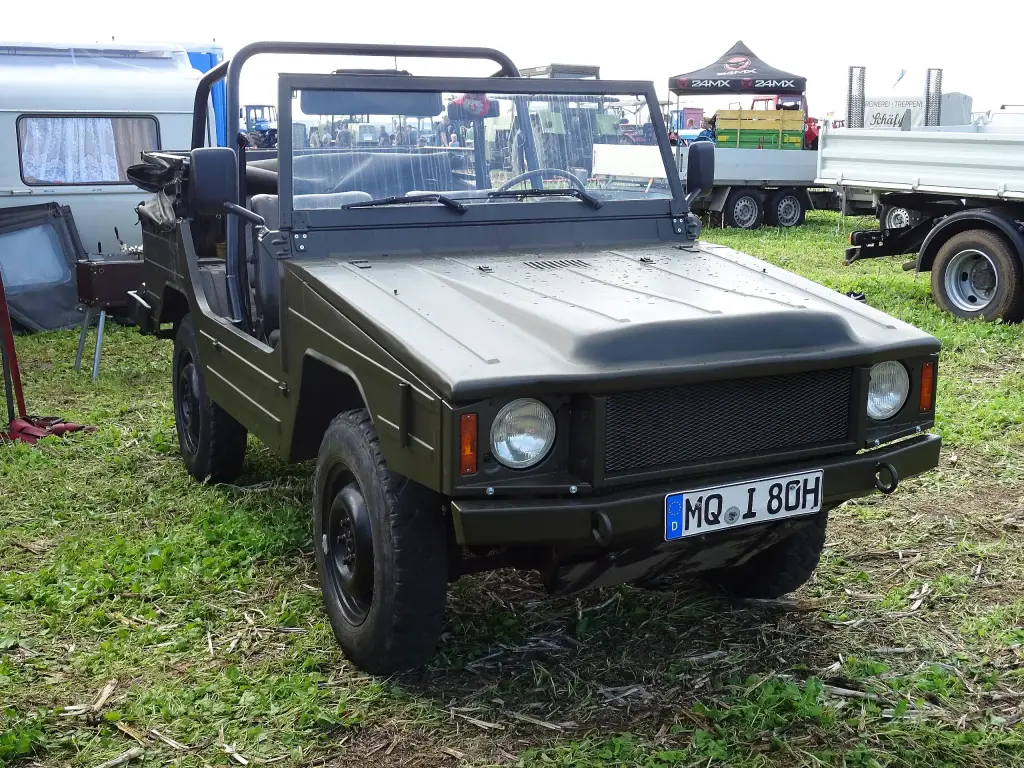
The vehicle developed by Audi used a variation of the Munga platform with modified suspension, a four-wheel-drive system built around Audi 100 components and a 1.7-litre Volkswagen four of 75 PS (55 kW). That four-wheel-drive design provided the basis for Audi’s quattro system, which appeared four years later on the original Audi Quattro of 1980. The Iltis passed the government’s tests easily and was chosen over the equally capable but more expensive Puch G, the Mercedes-Benz G-Wagen. Production began in the summer of 1978 and the first 200 vehicles were delivered in November; by late 1979 about 2,000 had been handed over, of which 310 went to the Luftwaffe and 20 to the Bundesmarine. Most were four-door vehicles with open tops, and small numbers of ambulance, anti-tank, artillery survey, command and field communications versions were built with different bodies.
A civilian model, offered mostly in West Germany, was first shown at the 1979 Geneva Motor Show and went into production soon afterwards with only a utilitarian soft top. In 1980 Freddy Kottulinsky and Gerd Löffelmann won the Paris-Dakar Rally in an Audi-prepared Iltis; the civilian car found even fewer buyers than the 181, largely because of its price and utilitarian nature. In Canada, Volkswagen announced a C$100 million plant after Bombardier obtained the manufacturing rights, and the vehicles were built in Valcourt, Quebec. In 1983 the Canadian government ordered 1,900 Iltises for C$68 million, with grants to expand the line and to market a civilian version, Belgian sales followed in 1984, Ottawa bought another 600 cars in 1985 for C$15 million, and Bombardier production stopped by 1986. The engine had a low 8.2:1 compression ratio so that it could run on low-octane petrol; four-wheel drive and the optional differential locks were engaged by levers on the floor, the steering was rack-and-pinion and many suspension parts were the same at all four corners, while the seats came from the contemporary Passat.
Design and features
- Quattro ancestry: the four-wheel-drive system of the Iltis was the basis of Audi quattro.
- Munga evolution: developed by Audi from the DKW Munga platform.
- Simple and strong: a low-compression 1.7-litre engine that ran on low-octane fuel.
- Dakar winner: Kottulinsky and Löffelmann won the 1980 Paris-Dakar Rally.
- Bombardier production: built under licence in Quebec for Canada and Belgium.
Volkswagen Iltis versions
- Military Iltis: the standard open-topped four-door vehicle.
- Special bodies: ambulance, anti-tank, artillery survey, command and communications versions.
- Civilian Iltis (1979): soft-top model sold mainly in West Germany.
- Bombardier Iltis: Canadian-built vehicles for Canada and Belgium.
The Iltis replaced the Type 181, itself an evolution of the Kübelwagen. More cars are in the Volkswagen collection.
Video: Vw Iltis Offroad
Video by AeroxScootertuning on YouTube.
Sources
- Volkswagen Iltis, English Wikipedia: origins, engineering, production, rally, Canada