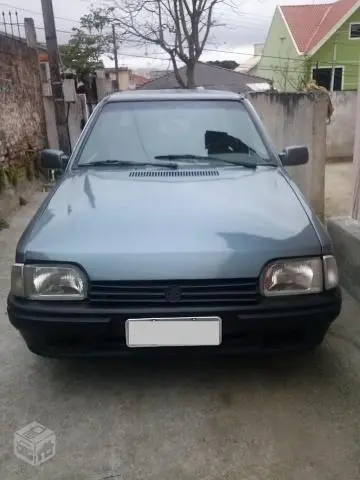
The Volkswagen Apollo was the Volkswagen version of the Ford Verona, a pair of small family cars built in Brazil by Autolatina, the joint venture of the Brazilian Ford and Volkswagen subsidiaries. The Apollo was sold from 1990 to 1992 as a two-door sedan with the 1.8-litre AP engine, positioned as the more expensive and sportier of the twins. Autolatina ended production in 1992 after three years of the original model.
Volkswagen Apollo at a glance
| Maker | Autolatina, Volkswagen do Brasil and Ford do Brasil |
|---|---|
| Production | 1990–1992 |
| Twin model | Ford Verona |
| Based on | second-generation Ford Orion, on the Escort Mk3 platform |
| Body | two-door sedan |
| Engine | 1.8-litre AP, petrol or ethanol |
| Trim levels | GL and GLS |
| Special edition | VIP, 1991 |
| Gearbox | manual with rod-operated gear shift |
| Differences from the Verona | shorter gear ratios, stiffer shock absorbers, orange-lit dashboard, smoked tail lights, painted mirrors |
| Programme cost | US$100 million for the Verona and Apollo together |
Based on the English Wikipedia article on the Ford Verona, which covers the Volkswagen Apollo. No free photograph of the Apollo itself was found, so this page uses no photographs.
History of the Volkswagen Apollo
In 1986 the Argentine and Brazilian subsidiaries of Volkswagen and Ford formed the Autolatina joint venture, which led to a series of badge-engineered cars. The Ford Verona was the first model to be rebranded during the alliance, released in November 1989 as a two-door sedan with a unique rear end, heavily based on the second-generation European Ford Orion and its Escort Mk3 platform. It was built to take on the Chevrolet Monza, the leader of the Brazilian mid-size segment, although it came from a lower class of car. The programme cost US$100 million, of which US$30 million went on updating the São Bernardo do Campo assembly line.
The Volkswagen Apollo arrived in 1990 as the Verona’s sibling. It was more expensive and marketed as the sportier of the two, and it was available only with the 1.8-litre AP engine, in petrol or ethanol form, against the 1.6-litre CHT and 1.8 engines of the Ford. Compared with the Verona the differences were small: shorter gear ratios, stiffer shock absorbers, a dashboard with orange lighting of its own instead of the Escort item, smoked tail lights resembling those of the Ford Sapphire, chrome-less rear window frames, fixed-height front seats, painted mirrors on the GLS and an airfoil. In the first model years its front turn signals had clear lenses where the Verona used orange ones. Trim levels were GL and GLS, and a special edition called VIP was released in 1991.
Owners often complained about the steel rod-operated gear shift instead of the usual cable-operated one, and both twins suffered cambering problems, partly because the rear suspension had not been designed for a saloon. Autolatina stopped building the Verona and Apollo in 1992, after only three years of the original car, but kept the Verona name alive on the third-generation Orion from the following year, until the sixth-generation Ford Escort saloon replaced it in 1996.
Design and features
- Badge engineering: the Apollo was a Ford Verona with Volkswagen badges, built by the Autolatina joint venture.
- One engine: only the 1.8-litre AP unit, in petrol or ethanol form.
- Sportier set-up: shorter gear ratios and stiffer shock absorbers than the Ford twin.
- Own dashboard: orange-lit instruments instead of the Escort-derived panel of the Verona.
Volkswagen Apollo versions
- Apollo GL (1990–1992): the base trim.
- Apollo GLS (1990–1992): the upscale trim with painted mirrors.
- Apollo VIP (1991): a special edition.
The Apollo shared its Brazilian market with the Gol, the front-engined hatchback that replaced the rear-engined models. More cars are in the Volkswagen collection.
Sources
- Ford Verona, English Wikipedia: Autolatina, Apollo version, engines, trims, end of production