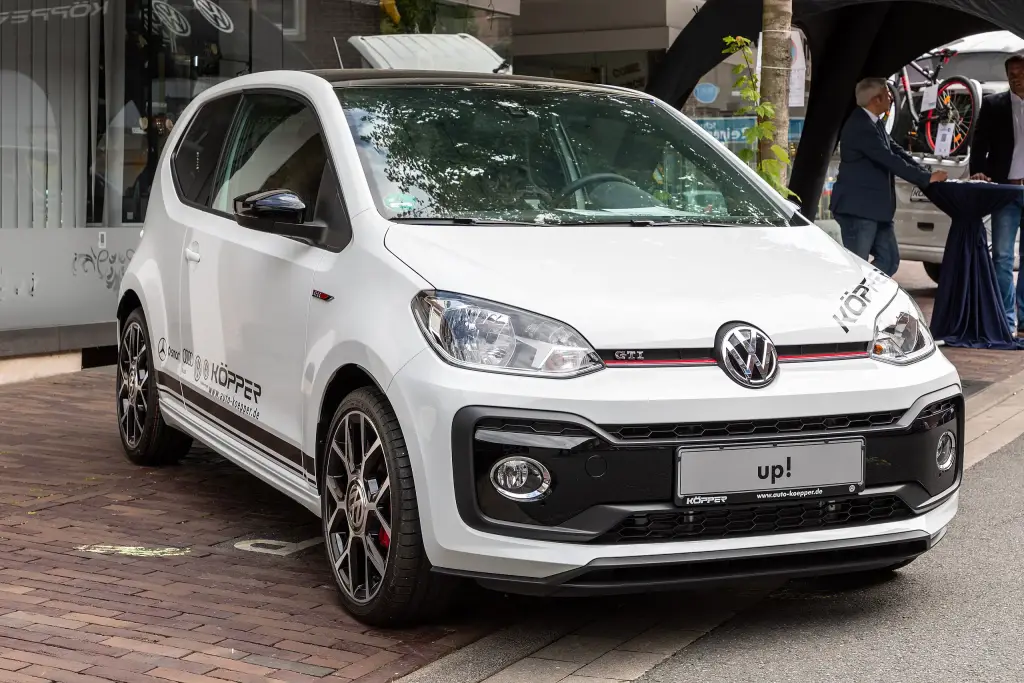
The Volkswagen up! is a city car produced by the Volkswagen Group from 2011 to 2023 as part of the New Small Family, alongside the SEAT Mii and Škoda Citigo, which are rebadged versions with slightly different front and rear ends. Production began in December 2011 in Bratislava, Slovakia, with Volkswagen do Brasil building the car in Taubaté from February 2014 until 2021, and an electric version, the e-up!, arriving in autumn 2013. Production ended in October 2023.
Volkswagen up! at a glance
| Maker | Volkswagen Group |
|---|---|
| Production | December 2011 – October 2023 |
| Family | New Small Family (NSF), with SEAT Mii and Škoda Citigo |
| Plant | Bratislava, Slovakia; Taubaté, Brazil from 2014 to 2021 |
| Bodies | three- and five-door |
| Length | 3.54 m, wheelbase 2.42 m |
| Seats | four |
| Engines | 1.0-litre three-cylinder petrol of 60 and 75 hp; CNG eco-up! |
| Gearbox | five-speed manual |
| Electric | e-up! from autumn 2013 |
| Sports model | up! GTI from January 2018, 115 PS |
| Award | World Car of the Year 2012 |
History of the Volkswagen up!
The production up! followed a series of concept cars that began at the 2007 Frankfurt Motor Show. Its exterior was originally designed by the Brazilian designer Marco Pavone, and the design was chosen and refined by the group’s chief designer Walter de’Silva and by Klaus Zyciora, head of design for the Volkswagen passenger car brand; the Frankfurt show also brought further concepts, including a 98 hp GT, a natural gas Eco-up! with CO2 emissions of 79 g/km and a four-door Cross model. Where the concept had a rear engine and rear-wheel drive, the 2011 production car used a front engine and front-wheel drive on the NSF platform with a three-cylinder 1.0-litre petrol engine. Volkswagen had planned to call the car Lupo, reviving the name of the model dropped in 2005, but changed its mind and named it the up!.
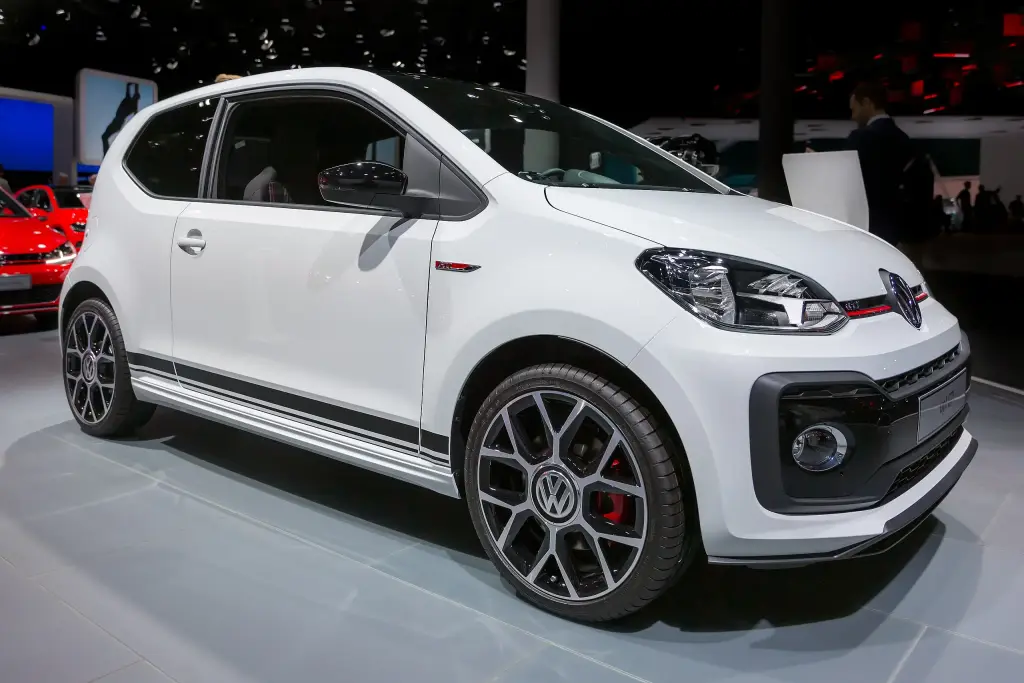
The final version was unveiled at the 2011 International Motor Show Germany. Production started with the 2012 model year in December 2011 in Bratislava, where the SEAT and Škoda versions were also built before being withdrawn from sale in 2021 and 2020. The three-door body was inspired by the 2007 concept, and the engine range was a 1.0-litre three-cylinder petrol of 60 hp (45 kW) and 75 hp (56 kW), with three- and five-door versions available running on compressed natural gas as the eco-up!. The car was 3.54 m long on a 2.42 m wheelbase, with four seats and a five-speed manual gearbox. Along with its rebadged siblings it was the first car in its class to offer an automated braking system, City Emergency Braking, which activated below 30 km/h when a laser sensor detected a collision risk and was sold as City Safety Assist by SEAT and City Safe Drive by Škoda. The up! won the 2012 World Car of the Year.
In Britain the car was available to order from October 2011 in five versions, Take Up, Move Up, High Up, Up Black and Up White, and Top Gear presenters mocked the name by calling it Up-exclamation-mark; the German market launch was on 3 December 2011, with other European deliveries from April 2012. A cross up! with 15 mm more ground clearance, plastic side skirts and wheel-arch flares came in 2013, and a facelift at the 2016 Geneva show brought a new TSI engine. The up! GTI, previewed by the GT concept and presented in mid-December 2016, went on sale in January 2018 with a turbocharged 1.0-litre three-cylinder of 115 PS (85 kW); an electric hybrid badged Blue-e-motion was planned for 2014 but never released. The car was not sold in North America, the CIS, the Middle East, India, China, South Korea or South-East Asia, but it did well in Japan from October 2012 and reached South Africa in March 2015. The Latin American up! of February 2014 was 65 mm longer, with a 50-litre tank instead of 35 litres, a full-sized spare wheel and more cargo space, and from July 2015 it was offered in Brazil with a turbocharged direct-injection 1.0-litre three-cylinder.
Design and features
- New Small Family: shared with the SEAT Mii and Škoda Citigo, with different front and rear ends.
- City Emergency Braking: the first car in its class with automated braking below 30 km/h.
- eco-up! and e-up!: compressed natural gas and electric versions.
- up! GTI: a 115 PS turbocharged three-cylinder from 2018.
- World Car of the Year: the 2012 title.
Volkswagen up! versions
- up! (2011): the standard three- and five-door city car.
- eco-up!: the compressed natural gas version.
- e-up! (2013): the electric model.
- cross up! (2013): the raised version with plastic cladding.
- up! GTI (2018): the 115 PS turbocharged model.
- Latin American up! (2014): the longer Brazilian version with a 50-litre tank.
The up! replaced the Fox as the smallest European Volkswagen and sat below the Polo. More cars are in the Volkswagen collection.
Video: Volkswagen Up (Team Review)
Video by Fifth Gear on YouTube.
Sources
- Volkswagen up!, English Wikipedia: concepts, production, engines, GTI, markets