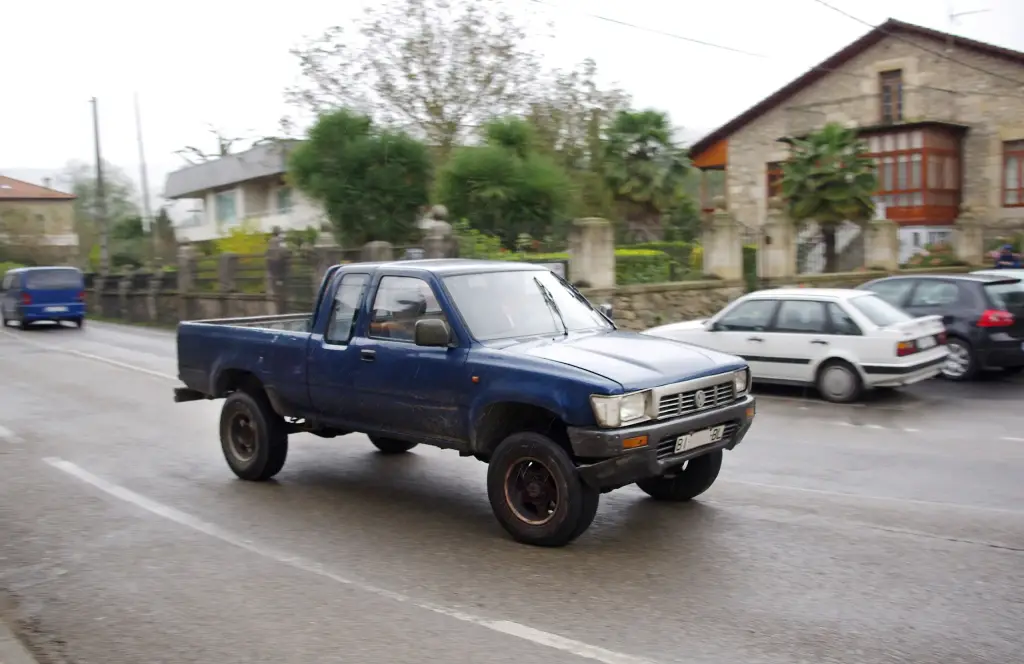
The Volkswagen Taro was a compact pickup truck introduced in January 1989 by Volkswagen Commercial Vehicles as a one-tonne model above the half-tonne Caddy and alongside the one-tonne Transporter. It was a rebadged fifth-generation Toyota Hilux, fully engineered and designed by Toyota, the result of an agreement in which Volkswagen gained a one-tonne pickup and Toyota a larger share of the European utility market. The name tarō is a Japanese suffix for the first-born son.
Volkswagen Taro at a glance
| Maker | Volkswagen Commercial Vehicles |
|---|---|
| Production | 1989–1997 |
| Basis | fifth-generation Toyota Hilux |
| Assembly | Hanover, Germany, and Tahara, Japan |
| Models | 2.4 diesel in Hanover; other versions imported from Japan |
| Hanover version | 2.4 diesel of 61 kW (83 PS), 165 N·m, two-wheel drive, regular cab |
| Payload | 1,125 kg on the Hanover 4×2 |
| Load area | 3.4 m² on the early 4×2, 3.0 m² single cab, 2.1 m² double cab |
| 4×4 Extended Cab | from September 1994, 2.4 diesel of 58 kW |
| Towing | 750 kg unbraked, 2,100 kg braked on the 4×4 |
| Top speed | 145 km/h (4×2) and 130 km/h (4×4) |
| Successor | Volkswagen Amarok from 2010 |
History of the Volkswagen Taro
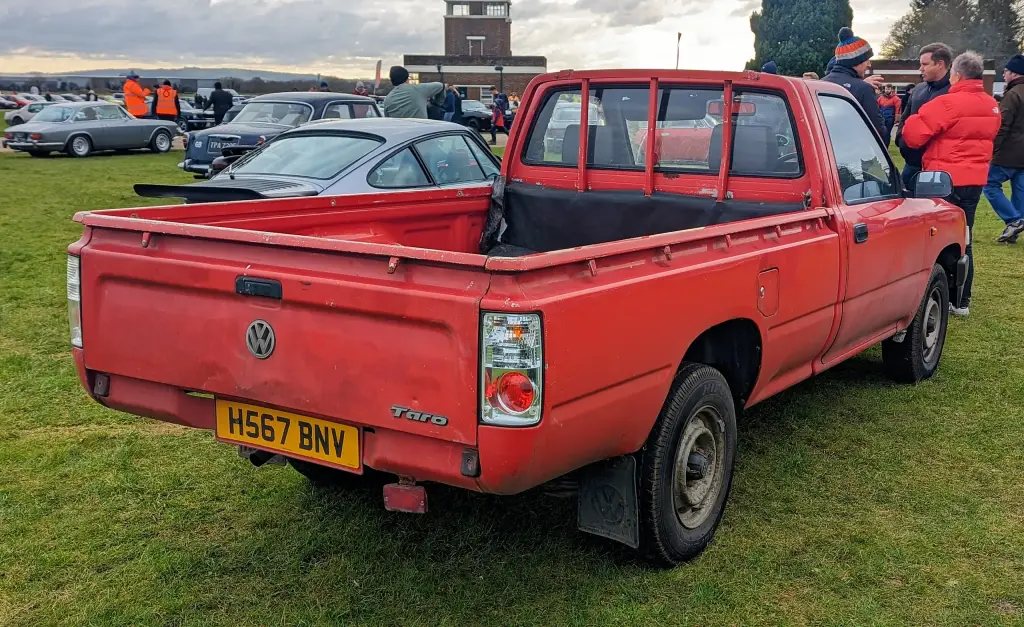
In the late 1980s Volkswagen Group and Toyota signed an agreement under which Volkswagen Commercial Vehicles would assemble the Toyota Hilux at its Hanover factory and sell it as the Volkswagen Taro. Taros built in Hanover from 1989 to 1994 had a 2.4-litre diesel engine of 61 kW (83 PS) and 165 N·m at 2,400 rpm, a load area of 3.4 m² and a payload of 1,125 kg; the Hanover plant built only the two-wheel-drive regular cab, while the Taro name was used for other versions imported from Japan in some European markets.
In September 1994, at the IAA commercial vehicle show in Hanover, Volkswagen released a four-wheel-drive version with an extended cabin, built at Toyota’s Tahara plant and using an updated 2.4-litre diesel of 58 kW (79 PS) and 163 N·m. That version had 2.9 m² of load area and an 815 kg payload, but could tow 750 kg without brakes and 2,100 kg with them. The basic specifications listed a single cab with 3.0 m² of load area and a double cab with 2.1 m², engines from a 1.8-litre petrol of 61 kW and a 2.2-litre petrol of 68 kW to the 2.4-litre diesel and a 2.4-litre injected petrol of 84 kW, a top speed of 145 km/h for the 4×2 and 130 km/h for the 4×4, acceleration from 0 to 80 km/h in 15.0 and 17.0 seconds and consumption of 9.6 and 10.2 l/100 km.
The joint venture ended in 1997 because sales fell short of the expectations of both companies. In the 1990s Volkswagen Brazil built a pickup prototype of the Volkswagen Santana using the bed of the Taro, but it never entered production. Volkswagen returned to the one-tonne pickup class only in 2010, with the Amarok.
Design and features
- Toyota engineering: the Taro was a fifth-generation Toyota Hilux with Volkswagen badges.
- Two sources: assembly in Hanover and imports from Toyota’s Tahara plant.
- Diesel workhorse: a 2.4-litre diesel with 165 N·m and a 1,125 kg payload.
- 4×4 Extended Cab: added in 1994 with a 2,100 kg braked towing capacity.
- Short life: sold from 1989 to 1997, until the Amarok arrived in 2010.
Volkswagen Taro versions
- 2.4 diesel 4×2 (1989–1994): the Hanover-built regular cab.
- Imported versions: other body styles and engines from Japan.
- 4×4 Extended Cab (1994–1997): built at Tahara with the updated diesel.
The Taro sat above the Caddy and was eventually replaced by the Amarok. More cars are in the Volkswagen collection.
Sources
- Volkswagen Taro, English Wikipedia: origins, versions, specifications, end of the venture